Why Most Penetration Tests Fail Compliance (Wrong Scope, Wrong Timing, Wrong Methodology)
Many SaaS companies assume they are “audit ready” because they already completed a penetration test.
Then the SOC 2 auditor asks for remediation evidence. Enterprise customers request API testing coverage. The security questionnaire asks whether internal admin functions were tested. Suddenly, the report that looked impressive during procurement becomes unusable.
This happens more often than most CTOs expect.
A penetration test that is poorly scoped, heavily automated, or performed outside the audit window can create a false sense of security while still leaving critical vulnerabilities exposed. In many cases, companies lose enterprise deals, delay compliance certification, or discover severe weaknesses only after an incident response engagement.
The problem is not always the absence of testing. The problem is ineffective testing.
Before your next audit cycle, it’s worth taking a step back to run a quick vulnerability scan and identify whether your current environment already exposes common weaknesses tied to SOC 2, ISO 27001, and PCI DSS requirements.
Modern attackers are not targeting only infrastructure anymore. They target APIs, authorization logic, cloud integrations, mobile workflows, and business logic flaws that automated scanners routinely miss.
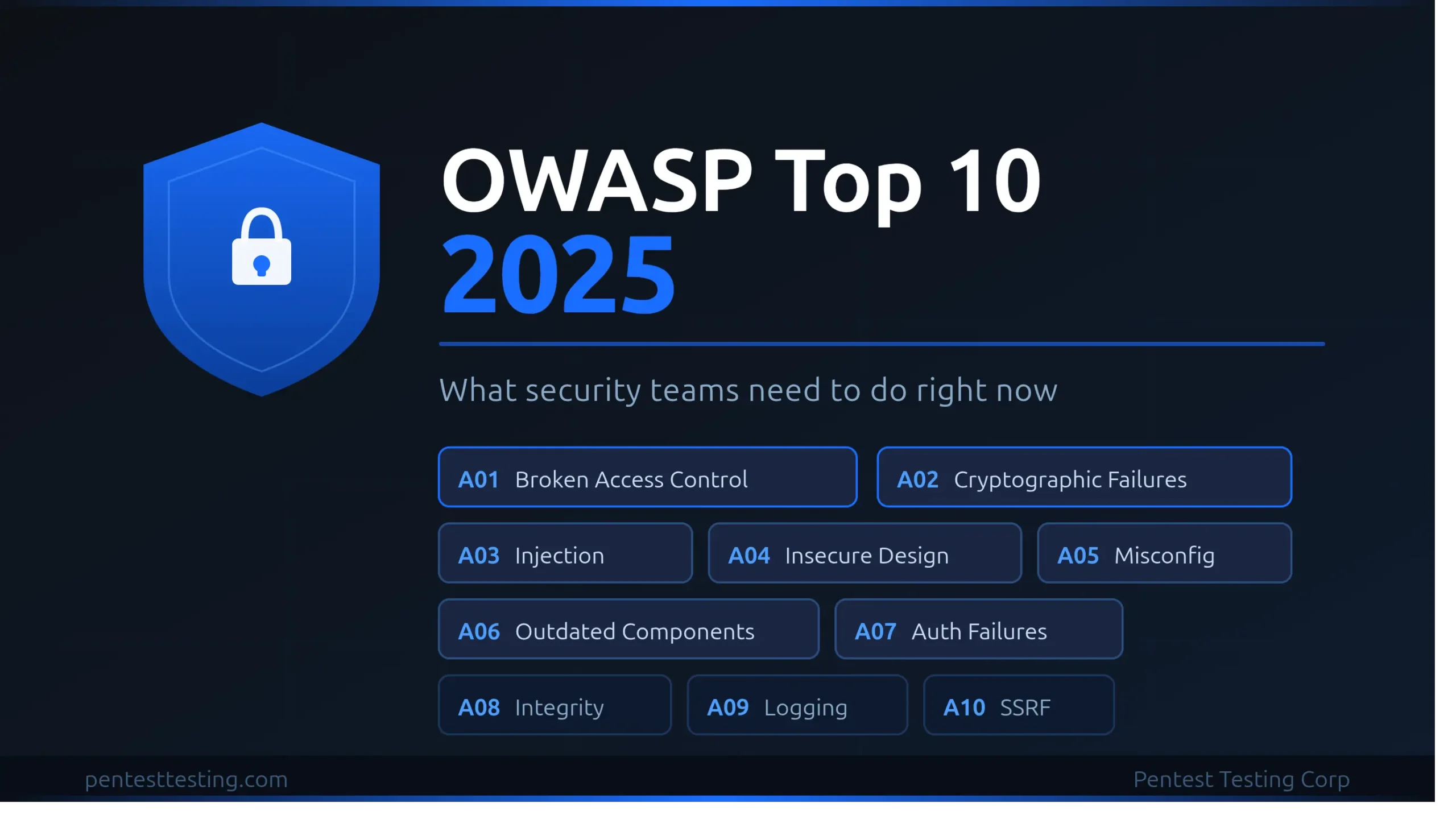
According to OWASP Top 10 2025, Broken Access Control remains the number one web application security risk. APIs are equally vulnerable, especially to Broken Object Level Authorization (BOLA) flaws.
The Real Compliance Risk Most Companies Miss
A compliance-driven penetration test is not just about producing a PDF report.
It must prove three things:
- Your critical systems were actually tested
- Realistic attack paths were validated
- Findings were remediated and verified within the compliance timeline
This is where many assessments fail.
A company might commission a low-cost scan against the production website while completely excluding:
- APIs
- Admin portals
- Mobile backends
- Cloud storage
- Authentication workflows
- Multi-tenant authorization logic
The result is predictable. Auditors still identify gaps, enterprise clients request additional evidence, and serious vulnerabilities remain exploitable.
At Pentest Testing Corp, real-world assessments frequently uncover issues like SQL Injection, Cross-Site Scripting, broken authentication, CSRF, insecure file uploads, and security misconfigurations during manual validation.
These are not theoretical risks. They directly impact compliance posture and customer trust.
A Realistic Attack Scenario Most SaaS Platforms Overlook
Imagine a B2B SaaS platform preparing for SOC 2 Type II.
The company completed an automated scan six months ago and received a clean summary report. No critical findings were listed.
An attacker signs up for a low-privileged account and starts reviewing API traffic in Burp Suite.
They notice requests like:
GET /api/v1/invoices/48392
The platform only checks whether the user is authenticated. It does not verify ownership of the invoice object.
The attacker increments the invoice ID.
Now they can access invoices belonging to other customers:
- Billing records
- Customer names
- Internal notes
- Payment history
- PII
This is a classic IDOR/BOLA vulnerability.
OWASP specifically highlights Broken Object Level Authorization as one of the most critical API risks because attackers can manipulate object identifiers to access unauthorized data.
From a compliance perspective, this creates immediate problems:
- SOC 2 trust criteria failure
- Potential PCI exposure
- Contractual violations with enterprise clients
- Incident disclosure obligations
- Loss of customer confidence
The worst part is that many automated tools will never detect this vulnerability because the flaw depends on authorization logic, not missing patches or known CVEs.
This is why organizations increasingly choose to get a professional security assessment focused on real-world attack simulation instead of relying exclusively on vulnerability scans.
Why Automated Scanners Miss Critical Compliance Findings
Automated tools are useful for coverage and continuous monitoring. They are not enough for serious compliance validation.
Most scanners fail in four major areas.
1. Business Logic Vulnerabilities
A scanner cannot understand how your application is supposed to behave.
For example:
- Can a regular user approve refunds?
- Can subscription tiers be bypassed?
- Can invoice ownership be manipulated?
- Can MFA enrollment be disabled through hidden endpoints?
These flaws require human analysis.
2. API Authorization Complexity
Modern SaaS platforms rely heavily on APIs.
Authorization failures often involve:
- JWT manipulation
- Tenant isolation weaknesses
- Role escalation
- Hidden GraphQL functions
- Broken function-level authorization
OWASP’s API Security guidance specifically warns that APIs create a wide attack surface for authorization failures.
3. False Negatives
Many tools produce “clean” reports simply because they failed to authenticate correctly or did not crawl hidden workflows.
A clean report does not mean secure.
4. Exploit Validation
Scanners frequently identify potential issues without confirming exploitability.
Manual penetration testing validates:
- Whether the issue is actually exploitable
- What data can be accessed
- How severe the business impact is
- Whether privilege escalation is possible
That context matters during audits and remediation prioritization.
The Vulnerabilities Most Commonly Missed During Compliance Testing
SQL Injection
SQL Injection remains one of the most dangerous vulnerabilities in modern applications.
Attackers exploit weak input validation to manipulate backend database queries. Once exploited, they may:
- Read sensitive customer data
- Modify records
- Extract password hashes
- Escalate privileges
- Gain server access
Real-world assessments frequently still uncover exploitable SQL Injection flaws in search functions, reporting APIs, and admin portals.
Organizations investing in web application penetration testing should ensure manual payload validation is included, not just automated scanning.
Broken Access Control and IDOR
Broken access control vulnerabilities occur when applications fail to enforce authorization rules properly.
Attackers simply manipulate:
- Object IDs
- API parameters
- User identifiers
- Role values
OWASP continues ranking Broken Access Control as the most critical application security risk because it is widespread and highly impactful. (OWASP)
Authentication Flaws
Weak authentication logic still causes major breaches.
Examples include:
- Session fixation
- Weak password reset workflows
- Missing MFA enforcement
- Predictable tokens
- Broken JWT validation
OWASP API Security guidance also highlights modern authentication abuse techniques such as GraphQL batching attacks against login systems.
API Abuse
Attackers increasingly target APIs because APIs often expose:
- Sensitive business operations
- Internal object references
- Administrative functionality
- Third-party integrations
Without proper authorization testing, APIs become a direct path to customer data exposure.
Companies handling enterprise integrations should prioritize dedicated API security testing instead of treating APIs as an extension of web testing.
Looking for a deeper understanding of how manual security assessments uncover vulnerabilities that automated scanners miss? Read our comprehensive guide on Web Application Penetration Testing, covering OWASP methodologies, testing phases, reporting standards, compliance requirements, and vendor selection best practices.
Why Timing Matters for SOC 2, ISO 27001, and PCI Compliance
A technically valid penetration test can still fail compliance requirements if timing is wrong.
Common mistakes include:
- Testing before major infrastructure changes
- Running tests outside the audit period
- Failing to retest after remediation
- Submitting outdated reports to auditors
Many auditors expect evidence showing:
- Findings were identified
- Remediation occurred
- Validation testing confirmed fixes
Several SOC 2 readiness guides emphasize that testing should align with the audit window and include remediation verification.
What a Compliance-Focused Penetration Test Should Include
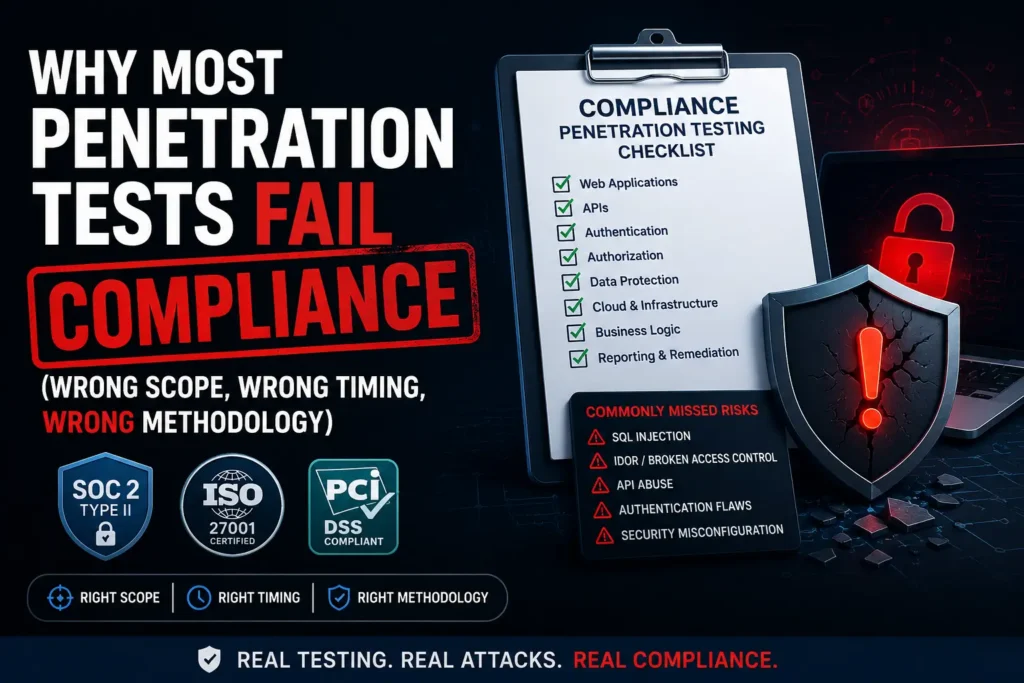
A proper compliance penetration testing checklist should cover:
Scope Validation
- Web applications
- APIs
- Mobile applications
- Cloud infrastructure
- Authentication systems
- Administrative interfaces
- Third-party integrations
Manual Security Testing
- Authorization testing
- Business logic validation
- Authentication bypass attempts
- Privilege escalation testing
- Multi-tenant isolation testing
Exploit Validation
Not just identifying possible weaknesses, but proving real-world exploitability.
Retesting
Auditors increasingly expect proof that vulnerabilities were remediated successfully.
Compliance-Aligned Reporting
Your report should clearly map findings to:
- OWASP Top 10
- OWASP API Security Top 10
- SOC 2 controls
- ISO 27001 risk management
- PCI DSS requirements
At Pentest Testing Corp, assessments follow structured methodologies aligned with OWASP testing standards and include detailed remediation guidance.
How to Evaluate a Penetration Testing Company for SOC 2 Readiness
Not all penetration testing vendors are built for compliance-focused SaaS environments.
Here is what decision-makers should evaluate carefully.
Manual vs Automated Testing
Ask directly:
- How much testing is manual?
- Are business logic flaws tested?
- Are APIs manually validated?
- Is exploitability confirmed?
If the answer revolves mostly around scanners, the assessment will likely miss critical findings.
Reporting Quality
A strong report should include:
- Reproduction steps
- Business impact
- Risk severity
- Remediation guidance
- Retesting validation
Weak reports create problems during audits.
SaaS and API Experience
Modern SaaS platforms rely heavily on:
- APIs
- Multi-tenant architectures
- Cloud integrations
- Authentication flows
Your provider should understand these environments deeply.
Compliance Alignment
A penetration test should support:
- SOC 2 evidence collection
- ISO 27001 risk management
- PCI DSS validation
- Enterprise customer due diligence
Not just vulnerability discovery.
Enterprise customers, auditors, and procurement teams increasingly expect more than a basic scan report. They want evidence that your organization can withstand realistic attacks against web applications, APIs, cloud infrastructure, and authentication systems.
If your current assessment only checks boxes instead of validating real security risks, now is the time to schedule a penetration testing consultation and review whether your testing methodology actually supports your SOC 2, ISO 27001, or PCI compliance goals.
🔐 Frequently Asked Questions (FAQs)
Find answers to commonly asked questions about the Compliance Penetration Testing Checklist.