PCI Segmentation Change Testing Evidence: Close the Ticket
A compliance lead is asked to approve a firewall change before the next assessor review. Payments are working, the network owner has attached the deployed configuration, and the change ticket says validation passed. Yet the attachment only proves that the application can connect. It does not show whether systems outside the cardholder data environment, or CDE, remain isolated.
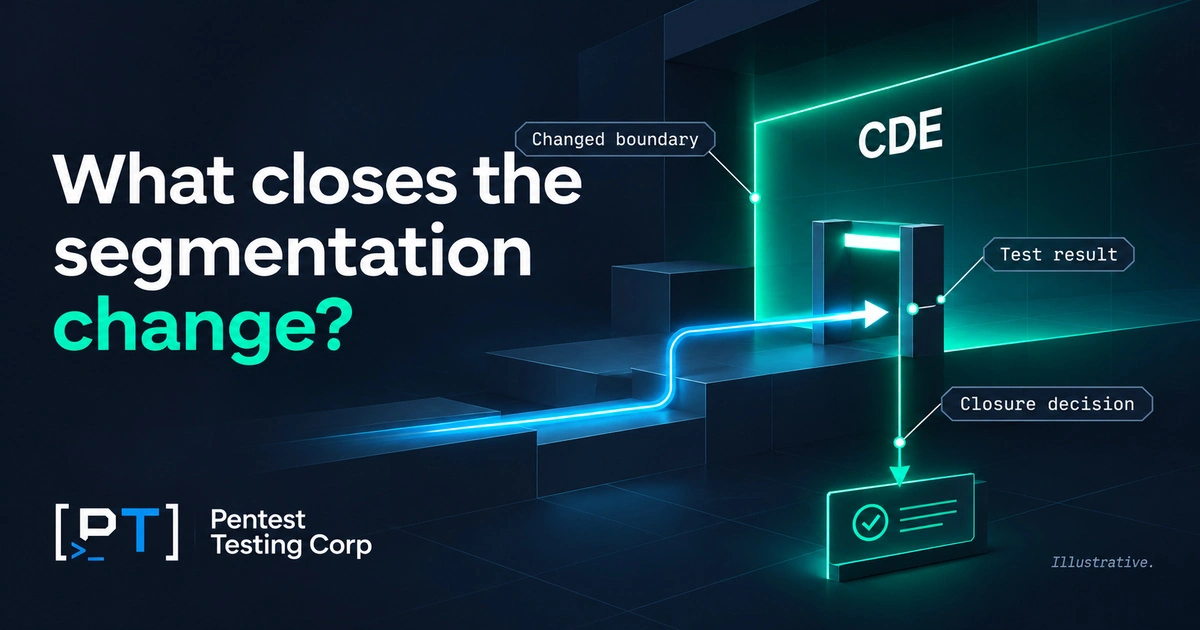
PCI segmentation change testing evidence should connect the changed boundary to an observed result and a defensible closure decision. Without that connection, a routine infrastructure update can leave the business relying on scope assumptions that have not been demonstrated in the deployed environment.
The immediate decision is practical: close the change, keep validation open, or escalate an unresolved boundary problem. This guide explains the evidence behind that decision, the questions to settle with your tester and assessor, and the handoff that lets someone review the conclusion without reconstructing the entire project.
Define the decision before commissioning evidence
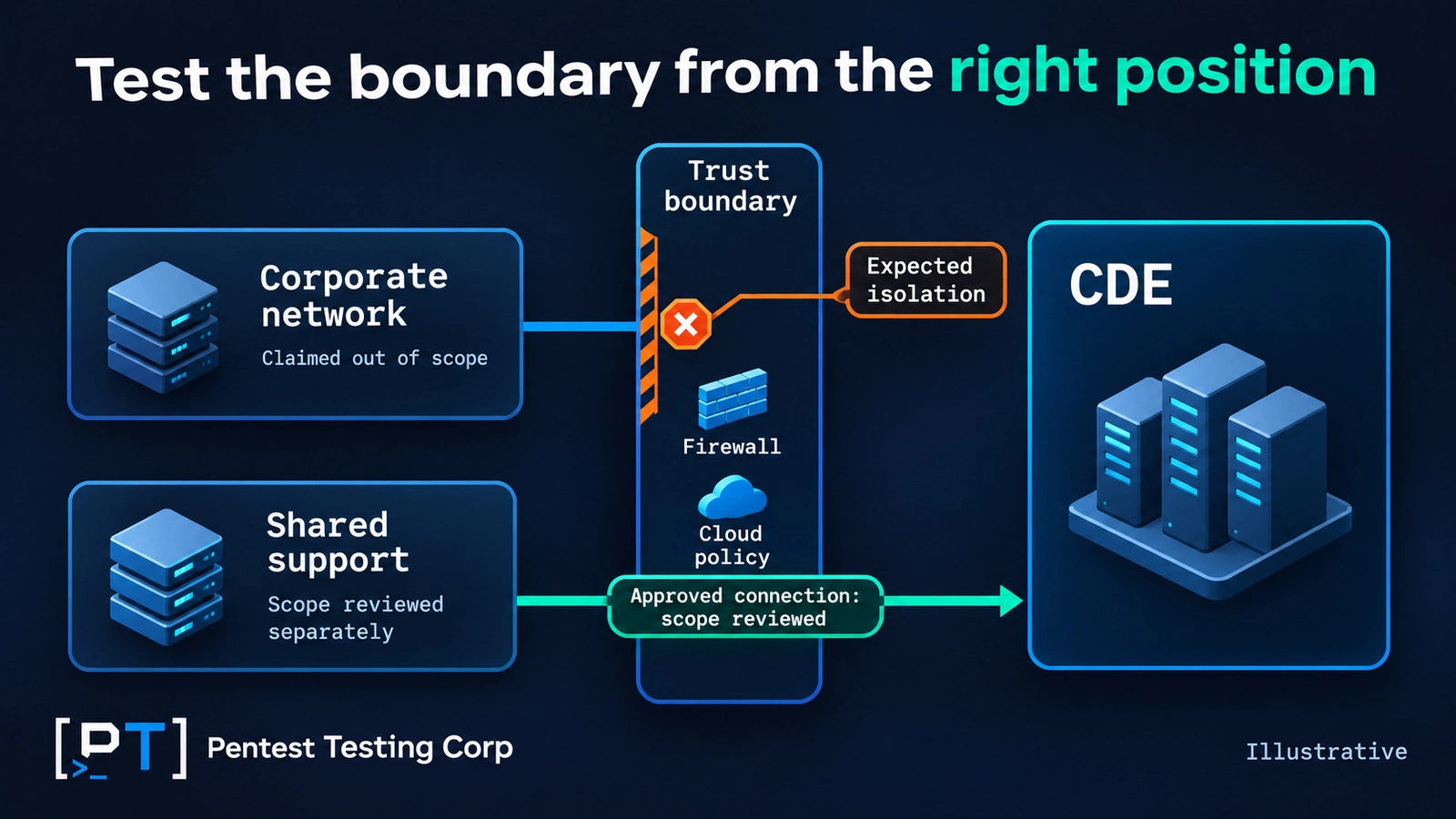
Start with the business claim the change must preserve. For example: the corporate workstation network remains outside the CDE because its systems cannot access or affect the payment environment through the segmentation boundary. Name the affected business services and the specific scope assumption being relied on. “Firewall migration completed” is too broad to define success.
Next, identify what changed: a firewall policy, cloud route, security group, workload isolation rule, shared gateway, or management connection. A small configuration edit can alter an important boundary. Classifying a change as routine in the IT service-management system does not establish that its PCI testing implications are routine.
For the defined approach, PCI DSS v4.0.1 Requirement 11.4.5 addresses testing all segmentation controls and methods in use at least every 12 months and after changes. Requirement 11.4.6 adds an at-least-six-month and after-change obligation for applicable service providers. Requirements 11.4.2 and 11.4.3 separately address internal and external penetration testing after significant infrastructure or application changes. Use the current PCI SSC standard and applicable assessment documents to confirm coverage.
An annual report dated before the deployment cannot, by itself, demonstrate the resulting boundary. Equally, a narrowly commissioned change check should not be presented as replacing broader obligations. Ask the assessor how the after-change work will establish the necessary coverage, including unchanged methods and dependencies. Record that reasoning before the test window.
Bring the change description, current diagrams and intended evidence recipient into your PCI DSS testing and readiness scope. The procurement question is whether the engagement will produce the evidence this decision needs, including correction and verification if testing finds a gap.
Keep the complete program in the wider PCI DSS 11.4 evidence guide. This article focuses on accepting a changed boundary. It does not determine your assessment eligibility, certify compliance, or replace the assessor’s review.
Record the changed boundary and test vantage points
The evidence begins with a before-and-after scope record. Show the CDE systems, networks claimed to be outside scope, connected or security-impacting services, and the controls separating them. Explain whether the deployment changes the boundary itself, the enforcement technology, or a dependency that can influence isolation.
Identify the implemented state, not just the intended design. A policy approved on Monday may differ from the configuration deployed on Wednesday. Record the configuration version, deployment time, relevant cloud account or site, and inventory version. If an emergency adjustment happens during testing, identify which results belong to each state.
A test vantage point is the actual position from which the boundary is evaluated. A tester connected to a convenient VPN may follow different routes or inherit different permissions from the supposedly isolated systems. Ask the tester to explain why each starting position represents the boundary claim. A useful source label describes both location and relevant identity assumptions.
Cover the mechanisms the claim depends on. A physical firewall, virtual firewall, cloud security group and workload policy may enforce different paths. List shared administration, monitoring, backup and deployment services that connect environments or can alter controls. Their presence does not automatically settle classification, but it requires an explicit scope decision.
PCI SSC’s scope and segmentation FAQ explains why connected paths matter. A system does not become outside scope merely because its owner labels it that way. Where permitted connections exist, document how those systems are classified and why the remaining exclusion is supportable.
If the change exposes questions beyond the agreed boundary, expand the authorized assessment deliberately. Our internal assessment methodology explains the broader engagement context. Where a shared AI runtime is specifically part of the path, the workload segmentation assessment helps frame that dependency without making this a general AI review.
Sampling needs a reason. Similar network names do not establish equivalent enforcement. Identify the common control, exceptions and architectural differences before proposing representative locations. Agree the methodology and assessor expectations, while preserving coverage of all segmentation methods. Record which locations were exercised and which conclusions rely on documented equivalence.
Build PCI segmentation change testing evidence around outcomes
Use a coverage matrix that relates each boundary claim to a test and supporting artifact. The table below is a recommended operating model, not a PCI SSC-mandated ticket template. Its purpose is to help a reviewer distinguish deployment proof, test coverage and the final decision.
| Evidence item | Question it answers | Acceptance check |
|---|---|---|
| Change and scope record | What boundary assumption changed? | Before-and-after diagrams, inventory and scope rationale match the implemented change. |
| Methods and vantage points | Which isolation mechanisms and starting positions were covered? | All-method coverage is explained; sampling, exclusions and dependencies are visible. |
| Authorized test plan | What could be tested safely? | Targets, permitted methods, windows, stop conditions and escalation contacts are agreed. |
| Observed boundary results | Did the intended control prevent prohibited access? | Expected and actual outcomes trace to dated evidence and the deployed state. |
| Correction and retest trail | What happened to each weakness? | Findings link to fixes, repeat-test results and remaining issues. |
| Closure and handoff record | Who approved which conclusion? | The decision cites evidence, limitations, scope consequences and follow-up owners. |
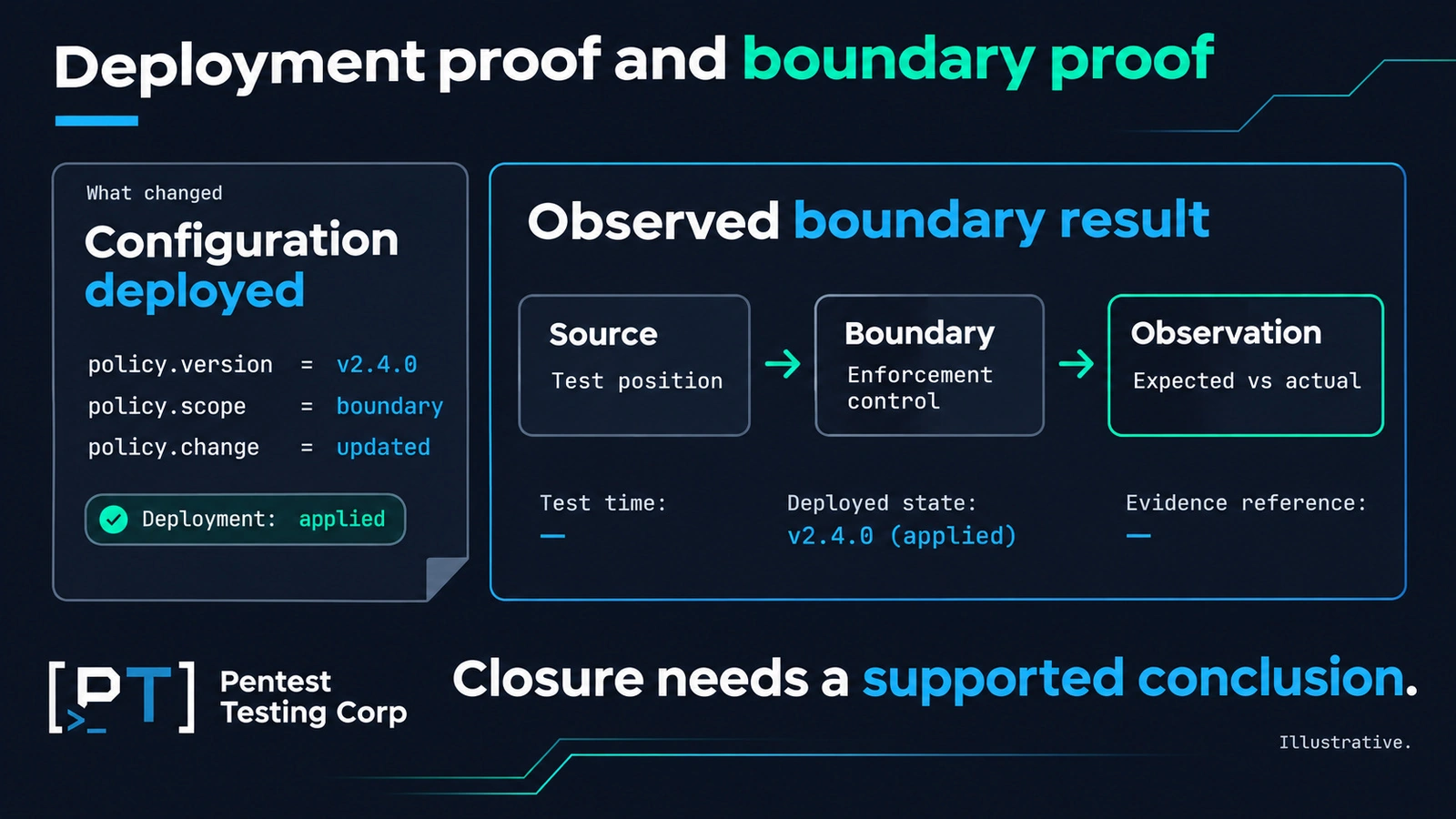
For each result, capture a stable case reference, source zone, destination or protected service, relevant identity, expected behavior, observed behavior, test time and evidence reference. Add the segmentation method being evaluated. A reader should be able to trace “isolation maintained” back to a specific observation.
Record failed connection attempts carefully. A destination that is offline, an expired test account or a test system with no route may produce a negative result without proving enforcement at the intended boundary. The tester should explain the basis for attributing the outcome to the control and identify conditions that could not be established.
Also validate explicitly permitted business traffic against the approved design. This supports operational acceptance and reveals overbroad exceptions. A successful payment workflow does not prove isolation; a successful isolation test does not prove that refunds, reconciliation or administration still work. Keep the security and functional results distinct within the same change record.
Useful telemetry can strengthen the result by linking an observation to a policy decision. However, a log excerpt is only meaningful with its source, time and test context. Avoid turning the absence of an alert into a claim that traffic was blocked. Monitoring evidence and enforcement evidence answer related but different questions.
Preserve the limits of the test. If a destination could not be exercised, a provider blocked a method, or a failover path was unavailable, mark that condition explicitly. “Not tested” must remain distinguishable from “tested and isolated.” Leadership needs that distinction to decide whether closure is supportable.
Use an illustrative change to expose weak acceptance criteria
Illustrative scenario, not a client engagement: a retailer moves a shared support service behind a new cloud routing policy. The payment application is in the CDE. Corporate workstations are treated as outside scope, while a separately controlled administration environment has approved payment-support responsibilities.
The implementation team checks that payments and approved support access continue working. It attaches the policy deployment record and asks to close the ticket. Those checks establish service continuity, but they leave an important question unanswered: does the new policy preserve the exclusion relied on for corporate workstations?
Authorized testing from that workstation position identifies unexpected reachability to a CDE management service through the shared support path. The proof stops at the agreed boundary. No payment records are retrieved, and the finding does not claim that cardholder data was stolen or that the management service was compromised.
The compliance lead keeps the validation condition open. The network and cloud owners investigate the shared path, correct the policy and review related exceptions. The scope owner evaluates whether the observed connection affects other classifications. The immediate business consequence is additional testing and possible scope expansion, not an invented breach narrative.
The retest evaluates the original failed isolation condition against the corrected deployment. It also checks related paths identified during remediation and confirms that approved support traffic remains appropriately restricted. The final record links the finding, correction, test cases and updated scope decision.
Two details make this example useful for a buyer. First, the original functional test was valid for its purpose, but insufficient for segmentation acceptance. Second, correcting the visible rule was only part of closure. Someone had to decide whether the shared service and its connected systems still supported the claimed boundary.
If that decision remained unresolved, a management signature could document escalation. It could not establish that isolation had been demonstrated. The ticket status should preserve that distinction for the next assessor and the next engineer changing the same connection.
Close findings without losing the scope decision
Give each weakness a named owner, affected boundary, correction reference and verification status. Separate implementation ownership from testing independence. PCI segmentation testing calls for qualified testers with organizational independence; being an external vendor is not the only possible arrangement. Ask for evidence of relevant competence and appropriate separation from the implementation.
Requirement 11.4.4 links correction of exploitable vulnerabilities and weaknesses to the entity’s risk assessment and repeat testing. Agree what the verification will challenge before requesting it. A new configuration screenshot records a change, while a retest evaluates whether the previously demonstrated condition was corrected.
Keep the scope consequence visible throughout remediation. Unexpected connectivity may require more than a rule fix: additional systems may need review, dependencies may need reclassification, and earlier evidence may need reconciliation. Do not leave the compliance owner to discover those effects after the technical finding is marked resolved.
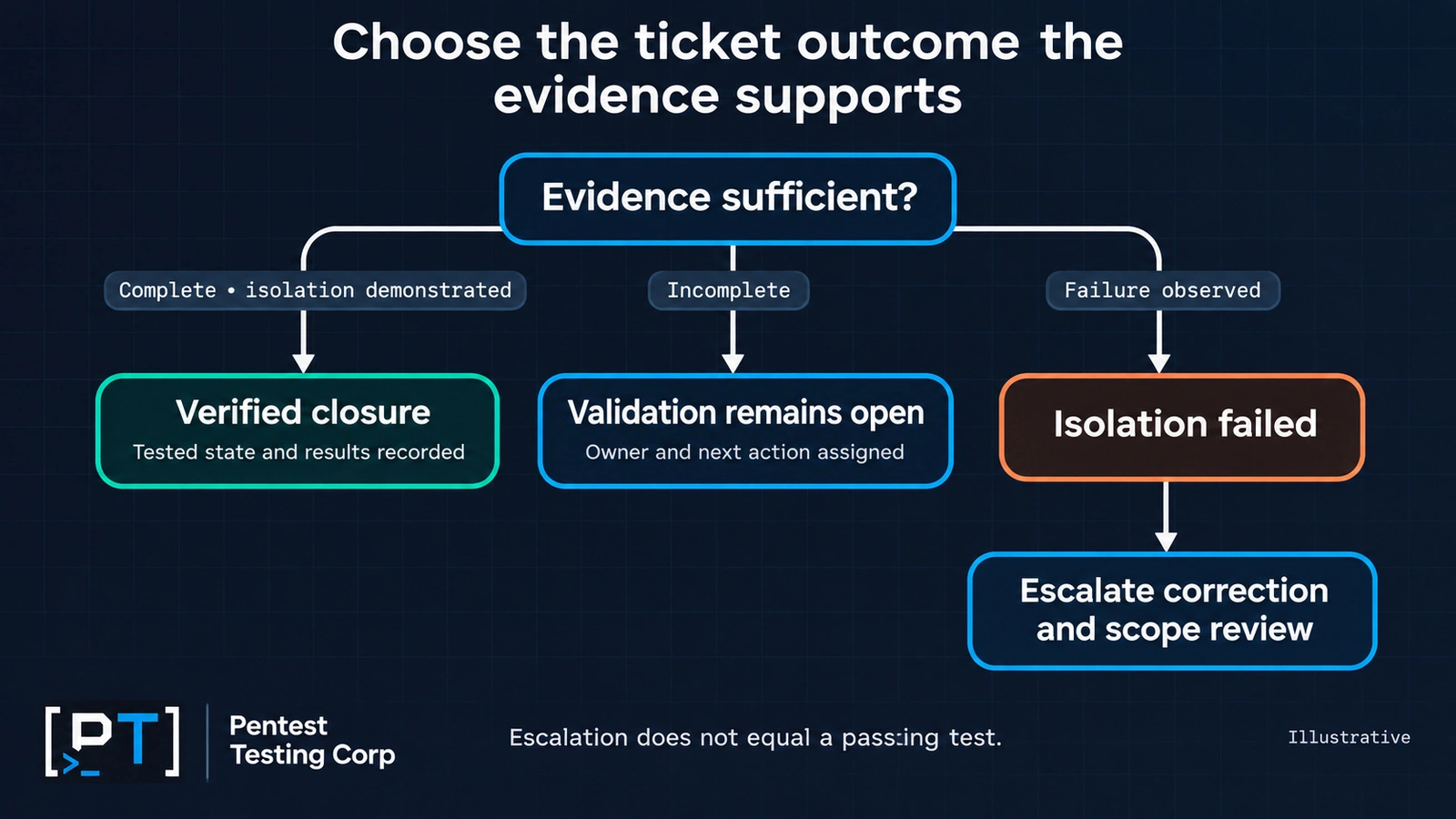
Use explicit outcomes in the closure note. A verified result identifies the tested state and supporting evidence. An unresolved limitation identifies what remains unknown. A failed boundary identifies the exposure and the responsible decision-maker. These descriptions are more useful than a single green status applied to several different conditions.
For cross-team work, the remediation ownership plan helps assign implementation, coordination and verification responsibilities. For this change, add a scope owner who can reconcile the test result with the payment environment’s documented boundary.
Internal risk acceptance does not waive an applicable PCI DSS requirement. PCI SSC’s requirement-applicability guidance distinguishes documented applicability from choosing requirements according to perceived risk. If a constraint prevents the defined approach, discuss the appropriate assessment treatment rather than relabeling a failed test as passed.
Compensating controls and the customized approach have separate conditions and validation expectations. The Council’s guidance on those approaches is relevant when such treatment is genuinely being considered. An approaching audit date or an internal exception form alone does not establish eligibility.
Plan PCI segmentation change testing evidence for assessor handoff
Estimate effort from the boundary and the evidence dependencies. Asset count alone is a poor guide. Several hosts behind one consistent mechanism may require less coordination than a smaller estate spanning different cloud accounts, firewall owners, provider restrictions and maintenance windows.
Ask the proposal to separate preparation, authorized testing, report review, remediation support and retesting. Confirm whether another window or a material scope expansion changes the fee. Do not assume a broad annual engagement automatically includes every after-change activity or unlimited verification attempts.
Use dependency-based checkpoints instead of promising a universal turnaround. Before deployment, agree the expected boundary and proof criteria. After deployment, reconcile the actual state and run the authorized assessment. After a correction, retest the affected condition. Before closure, reconcile the findings, limitations and scope record. These are recommended workflow gates, not PCI-imposed day counts.
Production constraints deserve an explicit evidence plan. Define payment availability safeguards, permitted activity, emergency contacts and stop conditions. If some work uses staging, identify the differences and the production verification still needed. A configuration match helps establish equivalence, but does not automatically demonstrate that production routing and enforcement behave identically.
Prepare one index for the assessor rather than a collection of unexplained attachments. Include the change reference, deployed-state identifier, scope decision, methodology, tester qualifications and independence, coverage matrix, results, limitations, correction trail and final disposition. Point to the actual artifact location and identify its owner.
Keep sensitive technical evidence in controlled storage. Share redacted material that preserves the reasoning without disclosing credentials, unnecessary cardholder data or unrestricted network detail. Make sure the intended recipient can access the indexed records. An inaccessible attachment can delay review even when the testing itself was sufficient.
Retain testing and remediation results for at least 12 months under 11.4.1, with longer retention where other obligations require it. If another deployment changes the tested boundary, record that dependency and review the evidence’s continuing relevance. An old report remains a historical record; its date does not make it proof of a later state.
What leadership should decide before closing the ticket
Require a clear answer to four questions: what scope assumption must hold, which evidence demonstrates it, what remains unresolved, and who owns the decision. Approving a deployment and accepting its security validation may be separate workflow actions. The organization can record both without pretending they mean the same thing.
Authorize closure as verified only when the agreed evidence supports the boundary conclusion and relevant findings have been addressed and verified. If coverage is incomplete, retain an open validation item with an owner and next action. If isolation fails, escalate containment, correction and scope review promptly. These are recommended governance outcomes, not a substitute for assessor judgment.
Give the compliance lead authority to challenge an incomplete pack, and give the network owner a realistic testing window and correction budget. The assessor should receive a coherent technical conclusion with its limitations, rather than being asked to reconcile contradictory statuses under deadline pressure.
Keep the change open until the agreed segmentation evidence is complete or formally escalated. To scope segmentation testing and PCI remediation, bring the changed-boundary diagram, implementation record, test-window constraints, and evidence recipient. Those inputs help define a reviewable closure package before the next change or assessment overtakes it.
Frequently asked questions
Does every change need an entirely new annual penetration test?
Not automatically. Distinguish changes to segmentation controls or methods from significant infrastructure or application changes, which have separate testing triggers. Agree on a documented coverage approach with the tester and assessor. A smaller change does not justify omitting segmentation methods that the applicable requirement expects testing to cover.
Can a cloud provider’s compliance report cover our changed policy?
It may support the provider-owned portion of the environment. Check the service, assessment scope, and responsibility allocation. A provider report should not be assumed to validate customer-managed routes, rules, or identities deployed after that report. Record who supplies evidence for each layer of the changed boundary.
What if the emergency change must happen before testing is available?
Record the emergency decision, affected scope assumption, interim safeguards, owner, and earliest authorized validation opportunity. Escalate the compliance implications through the appropriate process. Emergency deployment approval is not after-change testing evidence, and this article does not establish a universal grace period.
Can we anonymize systems in the assessor’s evidence pack?
Use consistent labels where redaction is appropriate, while retaining a controlled mapping to the actual systems. Agree the assessor’s access needs. Anonymization should protect sensitive details without preventing the reviewer from establishing which environment, boundary and deployment the evidence covers.
What should procurement require when comparing quotes?
Require a coverage statement, starting positions, method coverage, assumptions, deliverables, tester independence, correction support, and retest terms. Ask how unavailable paths and additional windows are handled. Compare those commitments before comparing prices, because apparently similar quotations may support different acceptance decisions.
Does a passed segmentation test mean the organization is PCI compliant?
No. It supports a defined isolation conclusion within the tested scope and conditions. The organization still needs the other applicable controls and its required validation process. A segmentation report, attestation letter, or closed change ticket does not independently establish overall PCI DSS compliance.