CRA Vulnerability Reporting Readiness: Test Your Product Incident Workflow
A customer sends your support team evidence of suspicious activity in a connected product on Friday evening. Engineering starts investigating. The CISO expects legal to decide whether notification is required; legal expects a confirmed product assessment. Nobody has recorded when the manufacturer became aware, and the person expected to report is unavailable. CRA vulnerability reporting readiness is the ability to resolve that handoff while containment and investigation continue.
This is now a live operational question. The European Commission’s 11 September 2026 announcement confirmed the start of Article 14 reporting. ENISA launched the Single Reporting Platform on the same date. For an in-scope manufacturer, the immediate decision is whether its product incident workflow can produce a timely, evidence-supported notification. Start by confirming applicability, then test the people, information and reporting route needed to act under pressure.
What changed, and what remains a separate workstream
Article 14 reporting applies from 11 September 2026; the CRA’s main product cybersecurity obligations apply from 11 December 2027. A reporting exercise addresses today’s notification capability. It does not establish complete product conformity or replace the wider work on secure design, vulnerability handling, technical documentation and applicable conformity assessment.
The Commission’s reporting obligations page identifies two mandatory reporting tracks: actively exploited vulnerabilities and severe incidents affecting product security. Notifications use the ENISA Single Reporting Platform, or SRP. An organization should therefore connect its incident process to a product-level decision rather than automatically turning every security ticket into an authority notification.
The business exposure is straightforward. A slow handoff can consume reporting time, an incomplete product inventory can make scope uncertain, and weak evidence can undermine the explanation of what the manufacturer knew. Meanwhile, customers still need useful protective information and engineering needs authority to contain the issue. Buying another detection tool will not necessarily resolve any of those decision gaps.
The supporting guidance is also moving. The Commission published implementation guidance on 27 July 2026. ENISA’s SRP glossary was updated on 1 October and its FAQ on 3 October. Those are reasons to refresh an existing runbook before exercising it, rather than assuming a pre-launch screenshot or template still matches the current reporting workflow.
Keep a reporting-readiness backlog and a broader product-security backlog with named owners. Connect them where the same evidence is useful, but define separate acceptance criteria. Leadership should be able to see whether the reporting route works today and which wider product obligations still need a longer program.
CRA vulnerability reporting readiness starts with applicability
CRA applicability starts with the product and the economic operator. The Commission’s summary of the Regulation describes products made available on the EU market whose intended purpose or reasonably foreseeable use includes a direct or indirect data connection to a device or network. Check the product definition, commercial supply, and relevant exclusions together.
A company-level label such as “SaaS vendor” is insufficient. The Commission’s implementation FAQ distinguishes standalone services from remote data processing that forms part of a product. Cloud functionality may need to be included where the manufacturer is responsible for it, and its absence would prevent a product function. Do not equate all SaaS with CRA products.
| Decision gate | Evidence to bring | Next action |
|---|---|---|
| What is the product? | Released software, device, component, version and marketed functionality. | Define the product boundary, including relevant remote processing. |
| Is it supplied on the EU market in commercial activity? | Distribution model, contracts and territories. | Document the supply route; assess uncertainty explicitly. |
| Does intended or foreseeable use involve a data connection? | Architecture and product use description. | Assess direct and indirect connections. |
| Does an exclusion or another product regime matter? | Product classification and applicable sector legislation. | Obtain a documented interpretation before declaring scope. |
| Who is the manufacturer for this product? | Branding, legal entity, development responsibility and supply-chain roles. | Assign the reporting decision and establish the correct authority route. |
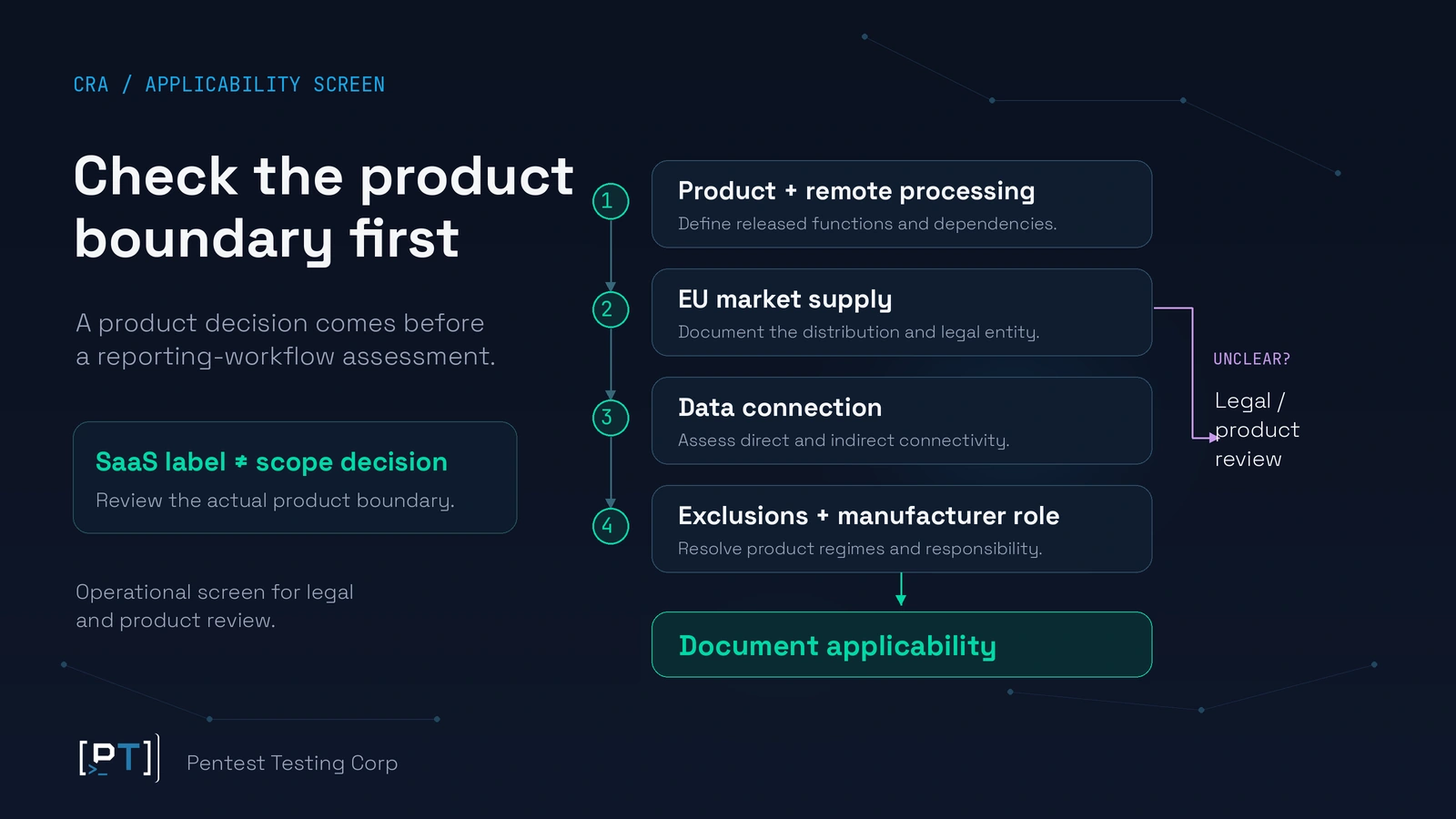
Use the screen as a decision tree: identify the product, assess supply and connectivity, check exclusions, then establish the responsible entity. A missing answer goes to a named reviewer with a deadline. It should not silently become “out of scope.” This is operational decision support; a fact-specific legal determination belongs with qualified counsel.
Do not exclude a product solely because it was released before the main 2027 application date. The Commission’s commencement announcement explicitly includes existing in-scope products in reporting. Your inventory therefore needs enough history to connect a current exploitation signal to older distributed versions.
Before commissioning an assessment, prepare one written scope note per product family. Pentest Testing Corp’s compliance and risk management services are a starting point for discussing evidence and readiness work. Agree the CRA-specific scope explicitly, including who will provide the applicability interpretation and what the exercise must demonstrate.
Separate vulnerability triage from incident triage
A high-severity pentest finding and an actively exploited vulnerability are different facts. The Commission’s implementation FAQ explains that good-faith testing without evidence of malicious exploitation does not, by itself, create that mandatory reporting trigger. A severity score helps prioritize remediation; it does not substitute for the exploitation assessment.
Maintain two assessment paths. The vulnerability path asks whether reliable evidence supports malicious exploitation of a vulnerability contained in the product. The incident path asks whether the event meets the severe-incident criteria in Article 14(5). Assess both where relevant. A lack of confirmed exploitation should not automatically end the incident assessment.
For severe incidents, the review should address the product’s ability to protect data or functions and use the statutory criteria, including the relevant impact and malicious-code conditions. Have legal and product security maintain the approved interpretation. Internal labels such as “P1,” customer count, or outage duration can help escalation, but they should not be presented as universal CRA thresholds.
The triage record should say which product and versions are implicated, what evidence supports the assessment, which facts remain uncertain, and who owns the next review. Record the source and time of incoming information. A customer message, a supplier advisory, and a validated internal observation may have different evidential weight; retain those differences when summarizing the case.
Dependency alerts need product context. Ask engineering to identify whether the component is present in the affected release, how the relevant functionality is used, and whether the information relates to this product’s exposure. Escalate reportability using the Commission’s component guidance rather than assuming that the upstream supplier’s report closes your own decision.
Organizations with a separate entity or service reporting obligation can reuse an evidence register, contact tree and exercise method. They should maintain distinct applicability and trigger assessments. Our separate NIS2 reporting drill addresses that different reporting regime. Copying its title or timing pattern into a CRA runbook would leave the product decision unresolved.
For leadership, the useful question is who can make and document this assessment on a weekend. A policy that only works when every senior stakeholder is online is a staffing dependency that the drill should expose.
CRA vulnerability reporting readiness needs two final-report clocks
The 24-hour and 72-hour limits run from awareness, with reporting required without undue delay. They are maximum windows, not targets for intentional waiting. The final-report trigger then differs by reporting track. The Commission’s reporting page sets out the distinction below.
| Stage | Actively exploited vulnerability | Severe incident | Suggested owner |
|---|---|---|---|
| Early warning | Without undue delay; within 24 hours of awareness. | Without undue delay; within 24 hours of awareness. | Reporting owner, supported by incident lead. |
| Notification | Without undue delay; within 72 hours of awareness. | Without undue delay; within 72 hours of awareness. | Reporting owner with product security and legal review. |
| Final report | No later than 14 days after a corrective or mitigating measure becomes available. | Within one month after the 72-hour notification. | Named follow-through owner with engineering and investigation inputs. |
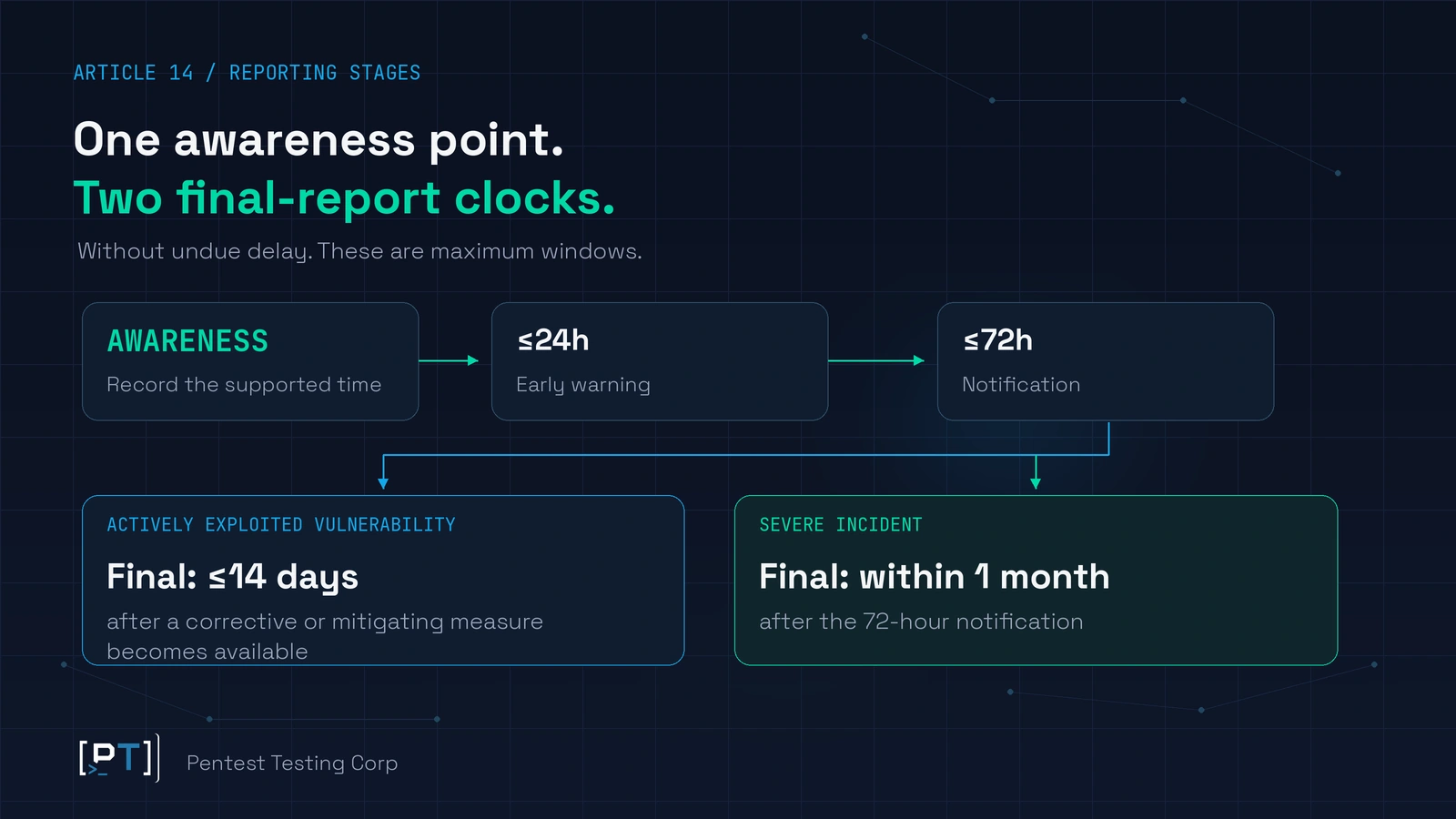
Keep the first observed activity, first incoming alert, awareness assessment, and submission timestamps as separate entries. They may coincide, but merging them hides the reasoning behind the deadline calculation. If the awareness time is uncertain, record the evidence, the supported estimate, and the person responsible for resolving it. Do not reset a clock because a different manager takes over.
For the vulnerability track, track when a corrective or mitigating measure becomes available. A patch planned for Friday, a completed internal build, and a measure available to users are different milestones. Record what the measure is, who can use it, its limitations, and the evidence of availability. Legal and product security should resolve disputed interpretations while engineering preserves the release record.
The reporting owner needs an authorized deputy, access to a controlled case summary, and a clear approval route. Engineering supplies product facts; the incident lead supplies the current assessment; legal reviews the notification decision; communications prepares user information. Put time limits on those internal handoffs so a notification does not remain in an unattended approval queue.
ENISA’s registration guidance requires personal EU Login accounts with MFA for Assigned Representatives. It advises initiating SRP registration when a notification is needed. Prepare the identities, authority, and manufacturer information beforehand; follow the current guidance for the actual registration. A drill should verify the readiness evidence without creating a fictitious report in the live SRP.
Preserve evidence that supports the reporting decision
The reporting workflow needs a concise factual record that can be updated as the investigation develops. It should show why the manufacturer classified the event, what it communicated, and what changed. A large archive with no index can slow that process just as much as missing logs.
Appoint an evidence custodian alongside the incident lead. Preserve relevant originals, keep analysis copies, restrict access, and record collection and transfer. Integrity hashes help identify changed files; a custody record explains who handled them and why. Neither automatically guarantees legal admissibility, but together they support a defensible account of the evidence.
| Record | Business question answered | Responsible input |
|---|---|---|
| Product/version and distribution record | Which released product and territories may be affected? | Product operations. |
| Source-referenced awareness timeline | What did the manufacturer know, and when? | Incident lead. |
| Triage decision and uncertainty log | Why was this track selected and what remains under review? | Product security with legal. |
| Preserved artifacts and custody history | Can important conclusions be traced to reliable inputs? | Evidence custodian. |
| Notification versions and receipts | What was submitted, by whom and at what time? | Reporting owner. |
| Measure availability and validation record | What protection became available and what was verified? | Engineering and release owner. |
| User communications record | What protective information reached affected users? | Communications and product support. |
This register is a recommended internal control, not a list of mandatory SRP attachments. Map the report to the current platform fields. ENISA’s SRP glossary distinguishes requirements by event type and reporting stage. An early warning should not be held until every fact expected in a later report is known.
Protect confidentiality when preparing the summary. Link conclusions to controlled evidence internally, and provide relevant information through the appropriate reporting channel. Avoid unnecessary customer identifiers, secrets, or speculative attribution. Keep unknowns visible and assign an owner to investigate them rather than replacing them with confident language.
Containment and preservation should proceed together under an agreed plan. Document changes that could affect the evidence and capture what can safely be preserved. Do not delay urgent protective action for a perfect forensic archive, and do not wipe useful records merely to simplify recovery. Our guide to evidence preservation and breach timeline reconstruction explains the supporting discipline.
Where actual compromise needs investigation, discuss digital forensic analysis and incident response separately from the tabletop. An exercise observes readiness; an investigation establishes incident facts from available evidence.
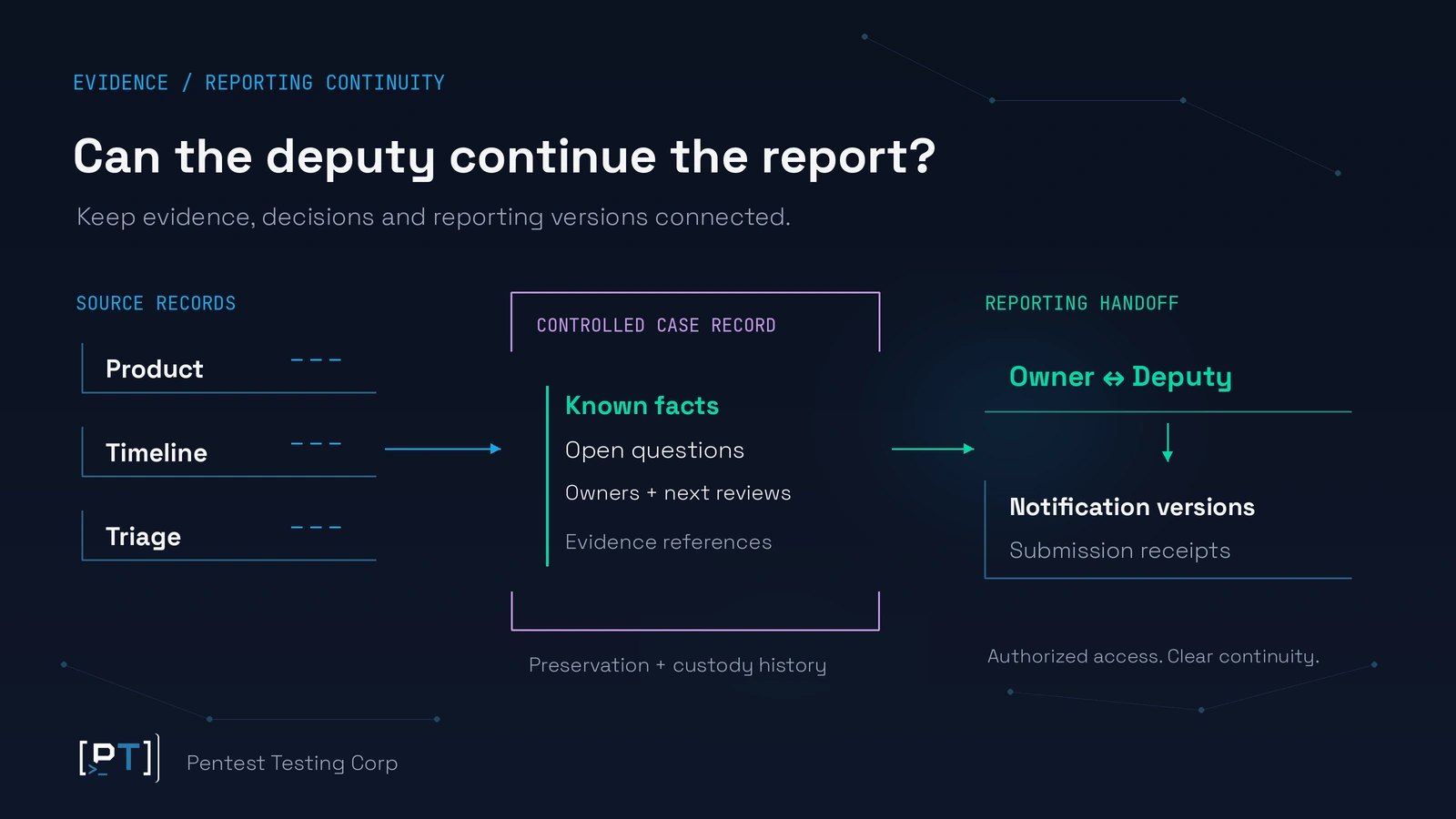
Test the product incident workflow with a bounded drill
Begin with one product family and one plausible event. The exercise brief should name the manufacturer, assumed applicability, released versions, reporting tracks to evaluate, participants, and expected outputs. State which legal decisions are already approved and which assumptions participants must challenge. Otherwise, the session can spend its entire duration arguing about scope.
A focused 90–120-minute tabletop is a reasonable planning option, with preparation and remediation scheduled separately. This is an exercise design suggestion, not a regulatory requirement or a promised service timeline. Use simulated timestamps to move through the reporting stages and assess the quality of decisions as well as their speed.
Hypothetical scenario: A manufacturer distributes a desktop connector to EU business customers. Support receives a credible customer report suggesting malicious use of a vulnerability in a released version. Engineering can prepare a protective measure, but the release inventory is fragmented, and the usual reporting owner is away. This scenario assumes applicability has been reviewed; it describes no client engagement.
The commercial consequence is a three-way coordination problem. Customers need a clear action, engineering needs an affected-version decision, and the reporting deputy needs a supported summary. If the teams maintain conflicting product lists, they can produce inconsistent notifications and user advice even while responding quickly.
| Exercise inject | Decision to test | Observable output |
|---|---|---|
| Credible customer exploitation report arrives. | Who establishes product relevance and records awareness? | Source-referenced triage entry and assigned decision owner. |
| Expected reporting owner is unavailable. | Can the deputy continue without shared credentials? | Documented authority, identity readiness and handoff. |
| Affected-version information is incomplete. | Can the team draft on known facts and track uncertainty? | Early-warning draft with evidence references and open questions. |
| New evidence changes impact assessment. | Does the notification stay consistent with the case record? | Updated notification draft and change history. |
| A corrective measure becomes available. | Who starts and follows through on the final-report milestone? | Availability evidence, deadline record and named owner. |
| Reporting access or platform availability is disrupted. | Can the team preserve its draft and follow current guidance? | Recovery plan, contact route and submission follow-through. |
Set acceptance criteria before the session. Each draft must be attributable to an owner, traceable to the current evidence and consistent with the correct reporting track. Participants should explain the deadline basis, identify the reporting route, and show how customer communications are coordinated. An observer should record where progress depends on an unavailable person or missing source.
Do not score success solely by whether everyone attended or a template was completed. Measure the handoff delays, unresolved decisions, inconsistent facts, and evidence that could not be retrieved. Agree an internal readiness target with sufficient margin inside the statutory windows; label that target as organizational policy.
NIST SP 800-61r3 supports integrating incident response into cybersecurity risk management. Use it to structure preparation, analysis, communications, and improvement. It supports the operating model, while CRA Article 14 supplies the reporting obligation. NIST alignment does not determine CRA applicability.
What leadership should decide next?
Leadership should approve a narrow, testable readiness scope and give its owners the authority to close the gaps. The scope decision is especially useful before an EU product launch, after a first credible exploitation signal, or when nobody can identify the reporting owner. Those are concrete triggers for action even if a broader product-security program is already underway.
Make five decisions: which products need an applicability determination; who owns reportability and submission; who can act in their absence; what evidence must be retrievable; and who funds remediation of the failed handoffs. Record these decisions in the exercise brief so the resulting findings can become assigned work.
Budget the work in separate parts. Applicability review depends on product models and legal complexity. Preparation depends on the quality of release inventories, contact trees, and evidence access. The tabletop consumes stakeholder time; remediation may require logging changes, supplier cooperation, or new approval arrangements. A targeted technical test is a separate item if a control must be validated. Request a scope-based quote rather than assuming one published package covers every part.
For a first planning cycle, organize preparation, the exercise, gap closure, and a repeat of the failed handoffs. Confirm dates after reviewing stakeholder availability and dependencies. Do not promise complete CRA readiness from one meeting. The useful deliverable is a decision record and prioritized remediation plan with an observable closure condition for each gap.
For example, “improve escalation” is too vague. “The deputy can retrieve the current notification draft and its evidence references during the reporting owner’s absence” can be demonstrated. Connect corrective actions to our guidance on remediation ownership and evidence gates, adapting the cadence to incident urgency.
CRA vulnerability reporting readiness becomes credible when the product boundary, reporting decision, and evidence handoff work together under pressure. To plan that work, discuss a product incident readiness scope with Pentest Testing Corp. Bring your product inventory, current incident runbook, and known reporting-owner gaps so the conversation can define a concrete assessment.
Frequently asked questions
Does a pentest finding without a CVE need to be assessed?
Yes. Assess the underlying facts rather than using a CVE as the gate. A controlled finding alone does not establish malicious exploitation, but additional evidence may change the assessment. Maintain the finding and the exploitation decision as separate records.
Can the team wait for a complete forensic report?
Build the workflow to prepare staged notifications on available facts while investigation continues. The early stages are not a substitute for final analysis, and incomplete analysis should be handled through explicit uncertainty and follow-up ownership.
Should we create a practice notification in the live SRP?
Use offline drafts and the published guidance for a tabletop. Do not submit a fictitious incident to the live mandatory reporting platform. If a supervised practice environment becomes available, confirm its permitted use before including it in the exercise.
What if the SRP is temporarily unavailable?
ENISA’s current FAQ says to submit once the platform is available again. If immediate communication is necessary meanwhile, contact the designated CSIRT directly. That contact does not replace the subsequent SRP submission. Preserve the attempted-submission and follow-through record.
Can an external adviser take reporting responsibility?
An adviser can support facts, drafting, and the exercise. Agree authority, confidentiality, and handoffs explicitly. Outsourcing support should not leave the manufacturer without a named decision owner or a way to continue if the adviser is unavailable.
Is a reporting drill proof of full CRA conformity?
No. It produces evidence about an exercised workflow and its limitations. The product’s wider conformity assessment is a separate process. Describe the tested scope accurately in procurement responses and avoid presenting a tabletop result as certification.