SaaS Token Theft Penetration Testing: What Your Next Pentest Must Cover
A SaaS security team preparing for an enterprise renewal gets a pointed question from the customer's security reviewer: if an attacker stole a valid OAuth token or session cookie today, how long would it stay usable, and what could it reach? The team pulls up last year's penetration test. It confirmed login flows, password complexity, and a handful of API endpoints. It never touched token lifetime, refresh-token scope, or what happens to a session after someone logs out.
That gap now shows up in real breaches. Mandiant's M-Trends 2026 report, built on more than 500,000 hours of 2025 incident response, found that attackers increasingly skip MFA altogether by harvesting long-lived OAuth tokens and session cookies instead of stealing passwords. The pattern kept surfacing through 2026, most recently when a compromised build pipeline at sales-enablement vendor Klue let attackers harvest OAuth tokens tied to customer Salesforce accounts, disclosed publicly this month. If your last SaaS token theft penetration testing engagement never asked what a stolen token can actually do, that is the gap to close next.
Why SaaS Token Theft Is Now the Default Breach Path
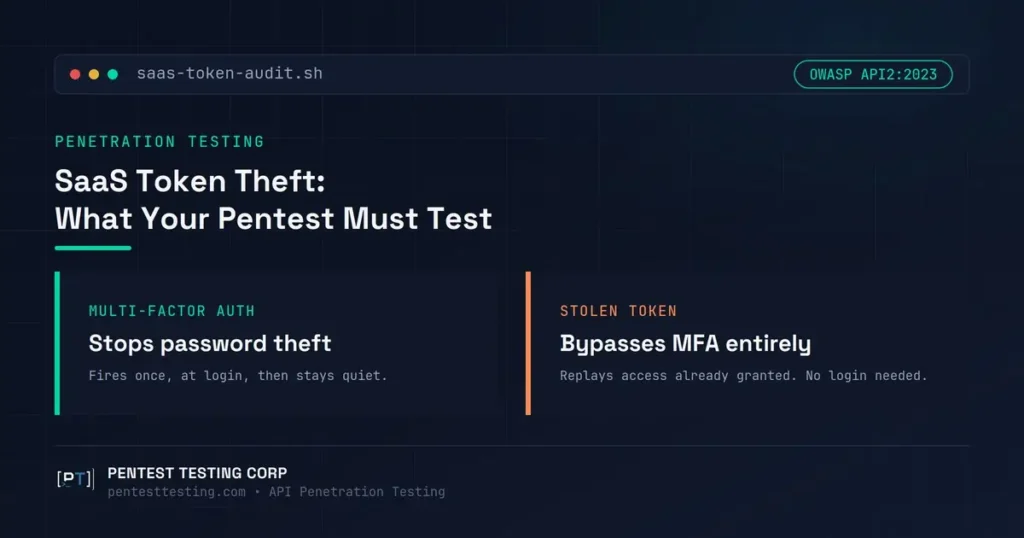
For years, the default breach narrative was credential theft: an attacker guesses or phishes a password, then gets stopped or slowed by MFA. That narrative no longer matches what incident responders are seeing. Mandiant's M-Trends 2026 report describes attackers bypassing MFA entirely by harvesting long-lived OAuth tokens and session cookies, many of which stay valid after logout or password reset. Once a token is in hand, MFA never fires again, because the attacker isn't authenticating. They are replaying access that was already granted.
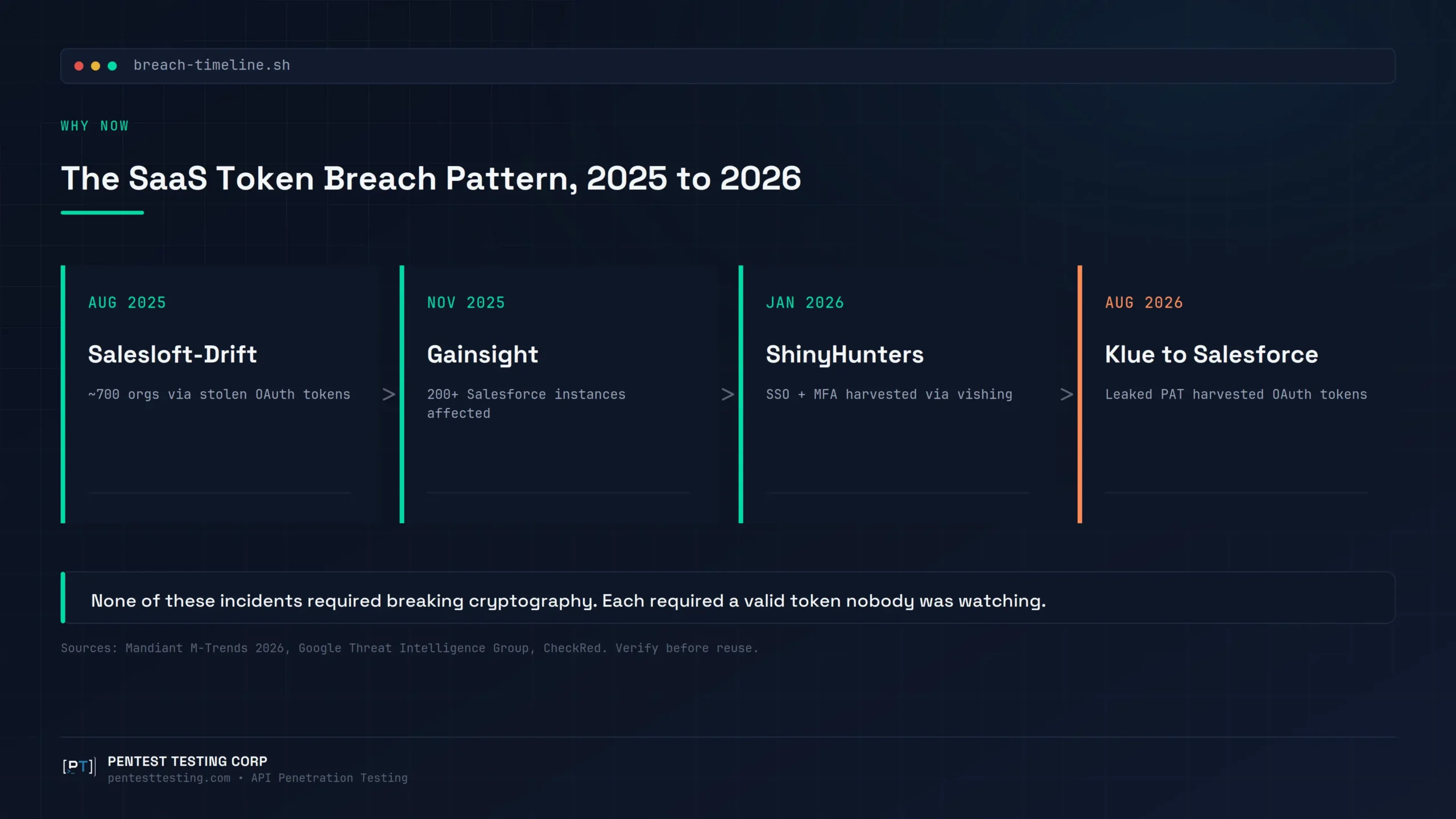
The 2025 and 2026 SaaS breach wave illustrates why this matters at scale. The Salesloft-Drift incident used stolen OAuth tokens tied to a third-party chatbot integration to reach Salesforce data across roughly 700 organizations. A follow-on campaign against Gainsight-published Salesforce apps used the same playbook months later. And Google's Threat Intelligence Group has tracked a cluster of ShinyHunters-branded actors using vishing to harvest SSO credentials and MFA codes, then registering their own MFA devices to maintain persistent SaaS access. None of these incidents required breaking cryptography or exploiting a zero-day. They required a valid token, a valid session, or a valid delegated grant that nobody was watching.
The Klue-Salesforce incident disclosed this month follows the same shape from a different angle. Attackers used a leaked GitHub personal access token to insert code into Klue's integration service, which then harvested the OAuth tokens that connected Klue to customer Salesforce accounts. Salesforce itself was never breached. The trust relationship between a vendor's token and a customer's data was. If your team is triaging a similar OAuth-driven incident right now, our OAuth Redirect Abuse: First 48 Hours guide walks through evidence preservation and scoping before containment decisions are made.
Speed compounds the problem. M-Trends 2026 also found that once an initial access broker hands off a foothold, follow-on operators can begin acting on it in roughly 22 seconds. A pentest scope built around "we'll notice the login" no longer matches how quickly a stolen token gets used once it changes hands. The practical takeaway for buyers and boards is not that every SaaS vendor is careless. It is that token possession, not password knowledge, is now the thing worth testing directly.
Where Standard Pentests Stop Short of Testing Token Security
Most annual pentests, especially ones scoped narrowly for a SOC 2 or vendor questionnaire checkbox, confirm that authentication exists: a login page requires a password, MFA is enforced, and a handful of endpoints reject unauthenticated requests. That is necessary, but it answers a much narrower question than the one your enterprise buyers or your own board are actually asking.
OWASP classifies the broader problem under API2:2023 Broken Authentication, which covers weak credential recovery, missing token expiry enforcement, and flawed session management, not just password strength. A pentest that stops at "can I log in without a password" rarely tests whether a JWT's signature is actually validated server-side, whether a refresh token rotates on use, or whether a session token issued before a password reset is still accepted afterward. Those are the exact conditions attackers exploited in the SaaS breaches described above.
This is why Pentest Testing Corp's API Penetration Testing Services scope OAuth 2.0 authorization code flow abuse, refresh token misuse, and session tokens that survive logout, role changes, or password resets as a standard part of the engagement, not an optional add-on. A token-lifecycle finding is only useful if someone actually tried to break the lifecycle, rather than assuming the framework defaults were secure.
For AI agents and ML services, token replay is only part of the exposure. The network position of the workload and the destinations reachable with that identity also determine impact. This internal segmentation guide for AI workloads shows how to test both conditions together.
The SaaS Token Lifecycle Your Pentest Must Cover
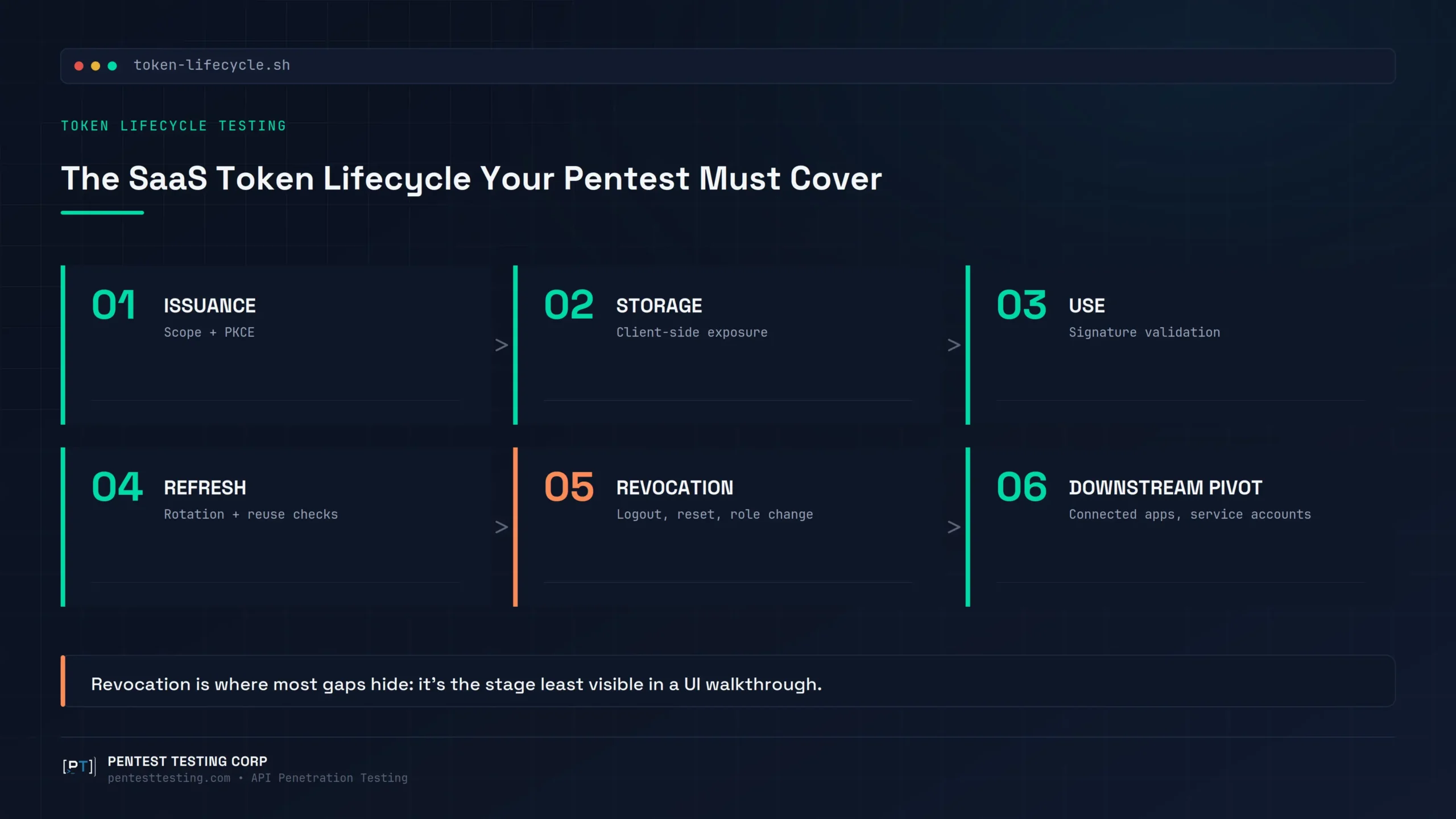
A token does not have one moment of risk. It has a full lifecycle, and a breach can start at any stage of it. Scoping a pentest around a single stage, usually issuance, leaves the rest untested.
| Lifecycle stage | What commonly goes wrong | What the pentest should validate |
|---|---|---|
| Issuance | Overly permissive OAuth scopes granted by default; implicit flow used where authorization code flow with PKCE is safer | Scope minimization, flow selection, and state/PKCE parameter enforcement across each supported grant type |
| Storage | Tokens persisted in local storage, exposed to XSS, or embedded in mobile app binaries or logs | Client-side storage location, exposure to script injection, and whether tokens appear in logs or crash reports |
| Use | JWT signature not validated server-side, or algorithm confusion accepted between RS256 and HS256 | Signature enforcement, algorithm pinning, and audience/issuer claim validation on every protected endpoint |
| Refresh | Refresh tokens with no expiry or no rotation, allowing indefinite reuse after a single theft | Refresh token rotation, reuse detection, and maximum lifetime enforcement |
| Revocation | Tokens or sessions that remain valid after logout, password reset, role change, or offboarding | Immediate revocation testing tied to each identity-state change, not just at natural expiry |
| Downstream pivot | A single compromised integration token reaching connected CRMs, data warehouses, or support tools | Blast-radius mapping across every third-party app, service account, and machine-to-machine credential tied to the token |
Revocation is where most gaps hide, because it is the stage least visible in a UI walkthrough. A logout button that clears a browser cookie does not necessarily invalidate the underlying access or refresh token on the server. Testing that distinction requires attempting to reuse a token after each identity-state change, not just confirming that a new login works. Pairing this with stronger session risk controls helps too; our risk-based authentication hardening guide covers the adaptive controls that reduce how much damage a still-valid token can do even before a pentest finds the gap.
A still-valid credential can also carry spending authority over model calls and paid integrations. Our API and AI cost-abuse testing guide explains how tenant allowances and workflow limits can bound that exposure while revocation controls are evaluated.
Scoping a Token-Focused Assessment: Roles, Flows, and Effort
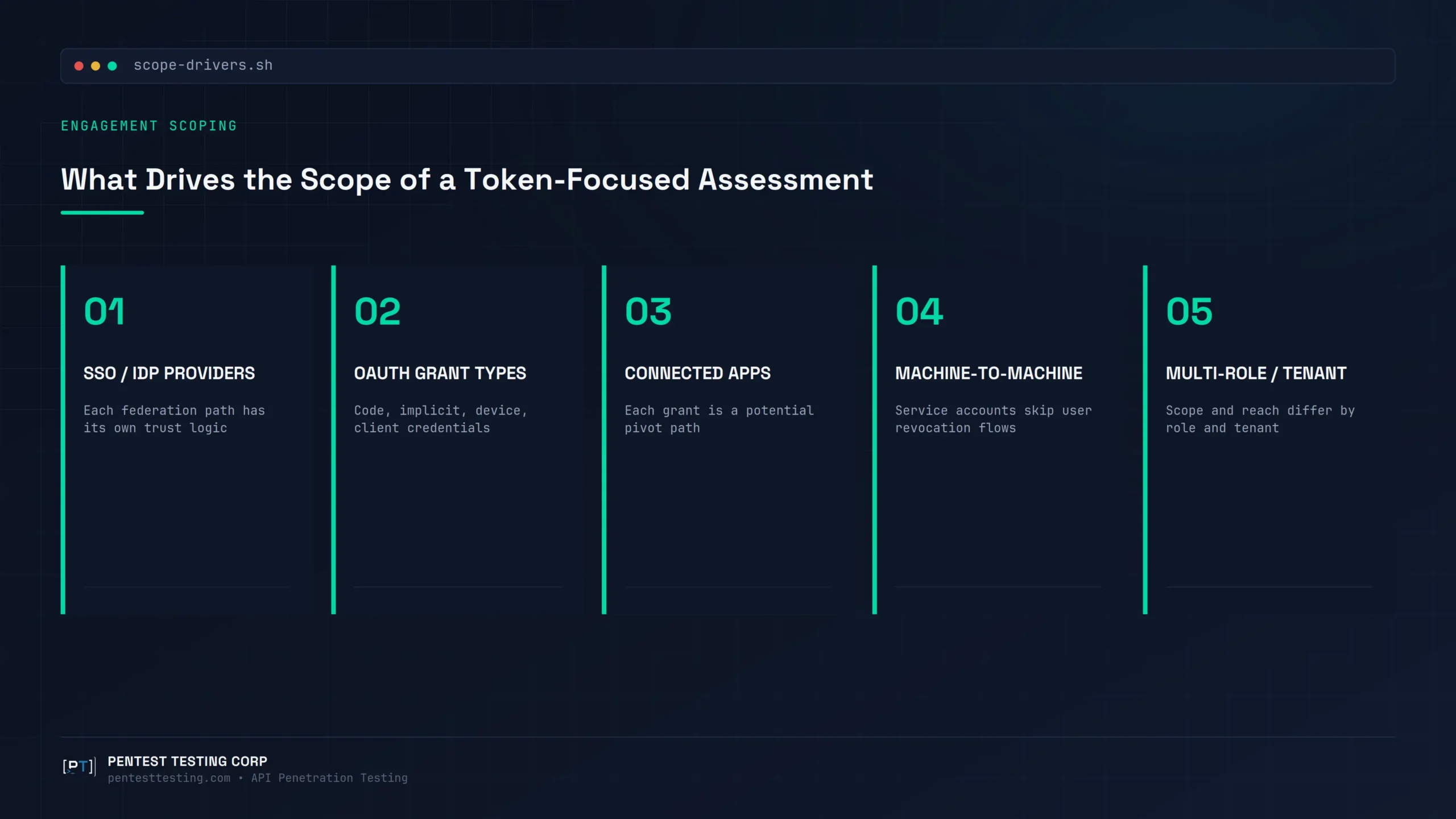
Token security testing is not priced the same way as a generic web app scan. The effort scales with how many identity paths and integrations actually touch a token, not with endpoint count alone.
| Scope driver | Why it changes effort | Leadership decision |
|---|---|---|
| SSO / IdP providers in use | Each federation path (SAML, OIDC) has its own trust and assertion validation logic to test | Confirm every production IdP integration, not just the primary one |
| OAuth grant types supported | Authorization code, implicit, device code, and client credentials flows each carry different abuse patterns | List every grant type your app or API actually issues today |
| Third-party / connected apps | Each app with a standing OAuth grant is a potential pivot path, as the Klue and Drift incidents showed | Provide an inventory of connected apps and their granted scopes before scoping |
| Machine-to-machine tokens | Service accounts and API keys often bypass the user-facing revocation flows tested elsewhere | Include service credentials in scope, not only human user sessions |
| Multi-role / multi-tenant coverage | Token scope and downstream access can differ meaningfully by role and tenant | Provision credentialed accounts across roles and, where relevant, tenants |
Multi-tenant products add another layer worth scoping deliberately: a token that is valid but scoped incorrectly can leak data across tenant boundaries even when the authentication itself is sound. Our multi-tenant SaaS authorization testing guide covers the tenant-role-object matrix approach that complements token lifecycle testing when your product serves more than one customer from shared infrastructure.
Environment choice matters too. Staging often uses relaxed token lifetimes or mock IdP configurations that do not reflect production behavior, so a token-lifecycle finding validated only in staging may not transfer cleanly to what customers actually run. Where production testing carries acceptable operational risk, it produces evidence buyers trust more directly; where it does not, plan for a staging environment that mirrors production identity configuration as closely as possible, and say so explicitly in the report's scope section.
Evidence Your Buyers and Auditors Will Actually Trust
A line in a pentest report that says "authentication tested" is weak evidence on its own. For token security specifically, buyers and auditors want to see that the lifecycle was actually exercised, not assumed secure because a framework default looked reasonable.
| Evidence component | Question it answers |
|---|---|
| Grant types and IdPs in scope | Did the assessment cover every path a token can be issued through, or only the primary login screen? |
| Revocation test results | Was token reuse actually attempted after logout, password reset, and role change, or only assumed? |
| Connected-app and scope inventory | Does the report show which third-party integrations were tested for downstream pivot risk? |
| Severity and business impact | What could a stolen token realistically reach, in plain business terms rather than a CVSS number alone? |
| Retest confirmation | Was a critical token-lifecycle finding independently revalidated after the fix shipped, not just marked resolved? |
Retest confirmation matters most here, because token-lifecycle fixes are easy to mark "done" in a ticket and still leave a stale code path unrevoked in a background job or a legacy mobile client. If your architecture also spans multiple tenants sharing infrastructure, our multi-tenant SaaS breach containment blueprint is a useful companion for building the evidence pack auditors expect around tenant isolation alongside token controls.
Framework Mapping: OWASP, MITRE ATT&CK, NIST, SOC 2, and PCI DSS
Mapping token-lifecycle findings to recognized frameworks makes the report easier for security and compliance teams to act on, without turning the engagement into a checkbox exercise.
| Framework / reference | Relevance to token security |
|---|---|
| OWASP API2:2023 Broken Authentication | Covers weak session management, token expiry failures, and credential-recovery flaws directly relevant to token theft |
| MITRE ATT&CK T1528 (Steal Application Access Token) | Provides a common technique reference for how adversaries obtain and reuse OAuth tokens |
| NIST SP 800-63-4 Digital Identity Guidelines | Defines authenticator and federation assurance expectations relevant to session and token strength |
| SOC 2 CC6 / CC7 (Trust Services Criteria) | Logical access controls and system monitoring criteria that a token-lifecycle pentest can supply technical evidence for |
| PCI DSS v4.0.1 Requirement 11.4 | Requires penetration testing of in-scope systems, including API and session layers that process payment data |
This is general compliance and framework information, not legal advice. Whether a given framework requirement applies to your environment, and how a QSA, auditor, or assessor will interpret it, depends on your specific scope and should be confirmed with your compliance advisor or assessor.
What Leadership Should Decide Before Scoping This Test
The most expensive time to discover a token-lifecycle gap is after an enterprise buyer or a real attacker finds it first. Leadership should settle five questions before the engagement is scoped.
- Define the claim you need to prove. If your security page promises that access is revoked immediately on logout or offboarding, the test must directly attempt to break that claim.
- Inventory every token-issuing path. List every OAuth grant type, SSO provider, and API key mechanism currently in production, not just the primary consumer login.
- Identify high-value downstream pivots. Flag which connected CRMs, data warehouses, or finance tools would cause the most damage if reached through a stolen token.
- Set the evidence bar. Decide whether the report needs framework mappings, revocation test evidence, and retest confirmation for procurement or audit purposes.
- Make closure a gate. A critical revocation failure should not be considered fixed until the original test condition is retried and confirmed closed.
Illustrative Scenario: A Token Left Alive After Logout
The following is a hypothetical, sanitized scenario reflecting a common pattern, not a specific client engagement. A mid-size SaaS company offboards an employee and immediately deactivates their SSO account. Routine monitoring shows no failed login attempts and no alerts. Weeks later, during a token-focused pentest requested ahead of a customer's security review, the tester attempts to reuse a previously issued API token belonging to that same offboarded account. The token still works. The identity provider correctly blocked new logins, but the application never checked whether previously issued long-lived tokens should also be revoked when the underlying account was deactivated.
No password was guessed. No MFA was bypassed. The gap sat entirely in the space between "the user can no longer log in" and "every credential the user was ever issued has been invalidated." For engineering, this is a lifecycle defect in the offboarding workflow. For the CISO, it is an access-control failure with regulatory relevance. For leadership, the decision is straightforward: fix the token revocation trigger, retest it directly, and check whether the same gap exists in any other identity-state change, such as role downgrades or password resets. Teams that suspect a similar gap may already be exploited in production should start with our rapid DFIR checklist to preserve evidence before making changes that could complicate an investigation.
If the credential belongs to a vendor-operated agent and activity is already suspected, the investigation must join customer API logs with vendor-held task and tool records. See our third-party AI agent incident response playbook for containment, preservation, and vendor coordination.
Frequently asked questions about SaaS Token Theft Penetration Testing
What is SaaS token theft penetration testing?
It is credentialed security testing focused on the full lifecycle of OAuth tokens, session cookies, and API keys, including issuance, storage, refresh, revocation, and downstream reach into connected applications, rather than only testing whether a login screen requires a password.
How is this different from a standard authentication test?
A standard test usually confirms that MFA and password policy exist. Token theft penetration testing goes further by attempting to reuse tokens after logout, password reset, or role change, and by checking whether refresh tokens rotate and whether JWT signatures are actually validated server-side.
Do we need to include every SSO and OAuth provider we use?
Ideally yes. Each identity provider and grant type has distinct trust logic, and a gap in one federation path does not mean the others are safe. Prioritize the providers and flows tied to your most sensitive data if a full inventory is not feasible in one engagement.
Can automated scanners find token lifecycle problems?
Automated tools can flag missing security headers or obviously misconfigured endpoints, but revocation timing, refresh token rotation, and downstream pivot risk generally require a human tester who understands your specific identity architecture and attempts real reuse scenarios.
How does this relate to API penetration testing?
Token security is a core component of API penetration testing, since OAuth flows, JWT validation, and session handling are typically exposed through API endpoints. A well-scoped API pentest should include token lifecycle testing rather than treating it as a separate engagement.
Is this required for SOC 2 or PCI DSS?
Neither framework mandates one specific token-lifecycle pentest by name. SOC 2 evaluates controls relevant to defined Trust Services Criteria, and PCI DSS v4.0.1 Requirement 11.4 requires penetration testing of in-scope systems. A focused token security assessment can supply strong technical evidence for both when tokens touch relevant data. This is not legal advice; confirm applicability with your assessor.
What is the fastest way to know if this has already been exploited?
Review identity provider and application logs for token or session activity that continued after an account was deactivated, a password was reset, or a role was downgraded. If you find evidence of continued access after any of those events, treat it as a potential incident and preserve logs before making further changes.
How long does a token-focused engagement typically take?
Scope depends on the number of SSO providers, OAuth grant types, and connected apps in play. A single-application engagement with one or two identity providers often fits a standard multi-role API testing timeline; environments with many third-party integrations or machine-to-machine credentials require additional time to map and test each pivot path.
Before your next customer security review or compliance renewal, confirm that your last pentest actually tried to break your token lifecycle rather than assuming the framework defaults held. Review Pentest Testing Corp's API Penetration Testing Services to scope a token-focused assessment, or book a 30-minute scoping call to walk through your specific SSO and OAuth footprint.