How AI Penetration Testing Maps to the NIST AI Risk Management Framework
A vendor security questionnaire lands in a CISO's inbox with one line that stops the review cold: "Describe how your AI risk assessments align with the NIST AI RMF." The team has a pentest report. It has findings, severity ratings, a remediation plan. What it doesn't have is a clean answer to which NIST function that report actually satisfies, or what's still missing. That gap is becoming a routine blocker in enterprise procurement and SOC 2 readiness cycles, and it's usually a mapping problem, not a testing problem. The work has already been done. It just hasn't been labeled in the language the auditor is reading from.
This post breaks down AI pentest NIST AI RMF mapping in practical terms: where AI penetration testing fits inside the framework's four functions, what each function needs as evidence, and how that maps to concrete OWASP LLM Top 10 findings like sensitive information disclosure (LLM02:2025) and data and model poisoning (LLM04:2025).
Why This Mapping Question Keeps Coming Up
NIST published the AI Risk Management Framework (AI RMF 1.0) in January 2023 as voluntary guidance, not a regulation. Voluntary status hasn't stopped it from becoming the default reference point. Enterprise procurement teams cite it in vendor questionnaires. Auditors bring it up during SOC 2 and ISO 27001 scoping calls when AI touches customer data. State and federal AI-related guidance increasingly points back to it as the baseline framework rather than inventing something new.
That creates a specific pressure for companies that have already shipped AI features: the technical testing might be solid, but the reporting structure was built for a different audience. A penetration test report organized by CVSS severity doesn't answer "which RMF function does this satisfy" without someone translating it first. Compliance-driven organizations, especially those working toward SOC 2 or preparing for enterprise vendor reviews, are the ones feeling this gap most acutely, because their timelines don't have room for a translation exercise after the fact.
It also isn't unique to companies building AI from scratch. Most of the organizations working through this mapping question are SaaS teams that wired a chatbot into an existing product, added an LLM API to a support workflow, or bolted a copilot onto a feature that already had customers. AI penetration testing exists precisely for that integration layer, the space between a third-party model and the systems, data, and permissions it's been connected to, which is also where most of the RMF's Map and Measure evidence needs to come from.
Financial services creates an especially useful example of why MAP and MEASURE must reach the workflow layer. A KYC or finance agent may combine regulated data, delegated identities, APIs, approval steps and record-changing capabilities, so the assessment has to test the complete control path rather than the model alone. Our guide to financial services AI agent security explains how that scope applies to KYC and month-end workflows.
What the NIST AI RMF Actually Asks For
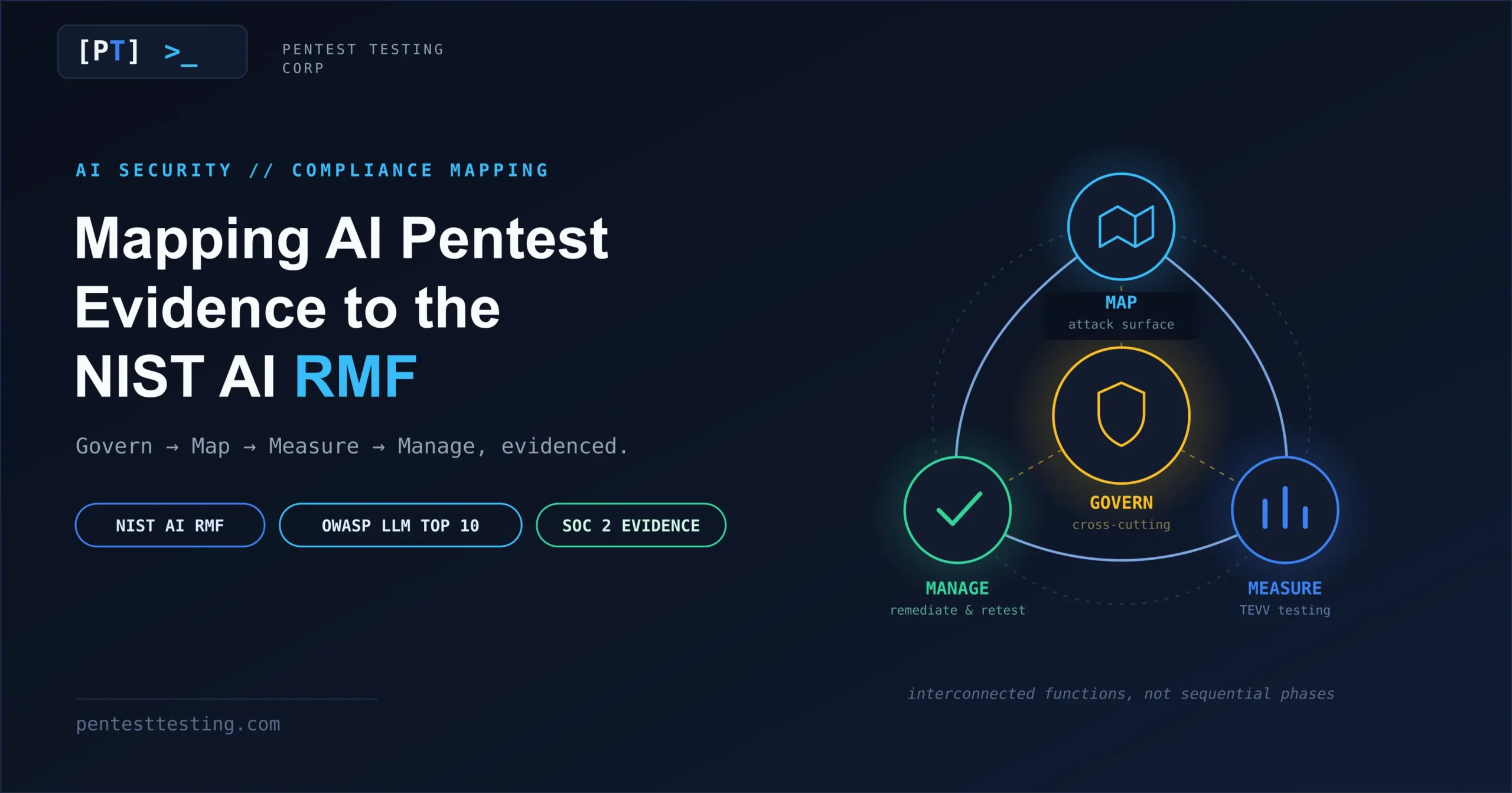
The NIST AI Risk Management Framework Core is organized into four functions: Govern, Map, Measure, and Manage. They're not sequential phases you complete once. NIST describes them as interconnected activities that repeat across the AI system's lifecycle, with Govern acting as the cross-cutting function that informs the other three.
Govern covers the organizational side: policies, accountability, roles, and risk culture. This is where an organization defines who signs off on a high-risk AI use case, how third-party models get vetted before adoption, and how AI risk gets folded into existing enterprise risk management. It's largely a documentation and process function, but it sets the ground rules the other three functions operate under.
Map is about context. What does this AI system actually do, who does it affect, what's the intended use versus the ways it could be misused, and what could go wrong technically, socially, or operationally. This is where an organization identifies the attack surface before anyone starts testing it.
Measure is where risk gets quantified and tested, using a mix of quantitative metrics and qualitative assessment. NIST is explicit that this function draws on testing, evaluation, verification, and validation (TEVV) practices. This is the function a technical security assessment speaks to most directly.
Manage is the response function: prioritizing identified risks, allocating resources to fix them, and tracking whether the fixes actually held. It closes the loop back into Govern.
AI Pentest NIST AI RMF Mapping: Where Testing Fits in the Lifecycle
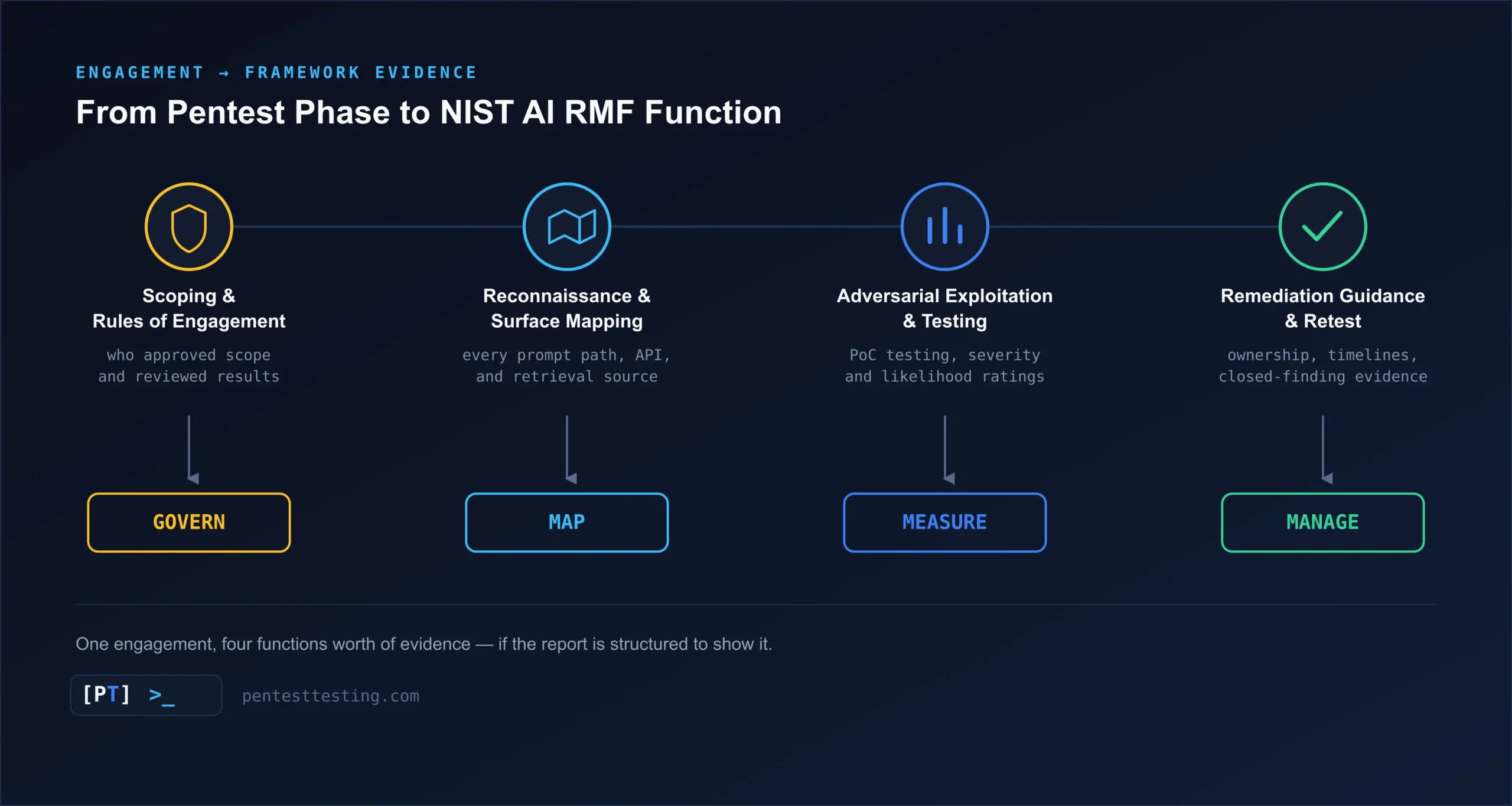
An AI penetration testing engagement doesn't map to a single NIST function. Different phases of the engagement produce evidence for different parts of the Core, which is exactly why a raw findings report doesn't answer the mapping question on its own. It needs to be read against the framework, not just handed over as-is.
| NIST AI RMF Function | What the Function Asks For | What an AI Pentest Engagement Contributes |
|---|---|---|
| Govern | Policies, accountability, risk culture, third-party model vetting | Documented rules of engagement, scoping decisions, and a report structure your governance committee can file against an existing control |
| Map | Context, attack surface, stakeholders, intended vs. possible misuse | Reconnaissance and surface mapping phase: every prompt path, API, file upload, retrieval source, and agent tool identified before exploitation begins |
| Measure | Quantitative and qualitative risk assessment, TEVV | Adversarial exploitation phase: proof-of-concept testing for prompt injection, data exposure, agent abuse, and poisoning vectors, each rated by severity and likelihood |
| Manage | Risk prioritization, remediation, validation that fixes hold | Prioritized remediation guidance plus a retest cycle confirming closed findings, which becomes the evidence Manage requires |
The Measure function is where most of the confusion sits, because it's the one people assume "testing" fully covers. It doesn't, on its own. Measure also expects the organization to track how measurement methods evolve as risks and models change, which is why a one-time pentest report needs to sit inside a recurring assessment cadence to actually satisfy the function over time rather than at a single point.
Two OWASP Findings That Sit Squarely in Measure and Map
Two categories from the OWASP LLM Top 10 (2025) illustrate how a technical finding becomes RMF evidence once it's framed correctly.
Sensitive information disclosure (LLM02:2025) shows up when a model exposes PII, credentials, internal business data, or another user's information through its outputs, whether that's a direct answer, a reasoning trace, or a retrieval result it wasn't supposed to surface. Testing for this sits in Measure. But the underlying question of what data the system can access in the first place, and who it belongs to, is a Map question that should have been answered before testing even started. When it wasn't, the pentest often surfaces both problems at once: a technical vulnerability and a gap in the organization's own system documentation.
Data and model poisoning (LLM04:2025) covers manipulation of the training, fine-tuning, or retrieval data that shapes model behavior. This one connects Measure and Manage directly. A finding here isn't just "the model can be nudged toward a bad output." It's a question of whether the pipeline feeding that model has integrity controls at all, which is a Manage-function gap: is there a process for vetting what data enters a fine-tuning cycle, and is anyone monitoring for drift after deployment.
A Sanitized Example: Where the Gap Usually Shows Up
A pattern we see often, illustrative rather than tied to any single engagement: a SaaS company adds a support copilot that pulls from an internal knowledge base through retrieval-augmented generation, and separately collects user feedback ("was this helpful?") to periodically fine-tune response quality. The team has documented the chatbot's intended use, which satisfies part of Map. What hasn't been documented is that the knowledge base includes documents scoped to different customer tiers, and that the feedback loop has no filtering for coordinated or low-quality input before it feeds back into tuning.
During testing, two things surface. First, the retrieval layer doesn't consistently enforce document-level access boundaries, so a support conversation can surface a snippet of another tenant's data, an LLM02 finding. Second, the feedback pipeline has no rate limiting or anomaly detection on submitted ratings, meaning a coordinated actor could bias future fine-tuning cycles, an LLM04 finding that's more about missing process controls than a single exploitable bug. Neither finding is dramatic on its own. Together, they point to the same root cause: the Map function was incomplete, because "what data can this system reach and who controls what feeds it" was never fully documented before the system went into production.
That's a common shape for these gaps. The technical fix is usually straightforward. The harder fix is going back and doing the Map-function work that should have happened first, so the next system doesn't repeat it.
Building the Evidence Package Auditors Actually Want
A pentest report that satisfies an auditor asking about NIST AI RMF alignment generally needs four things, organized by function rather than by finding:
- Govern evidence: scoping documentation, rules of engagement, and a written record of who approved the assessment and reviewed the results internally
- Map evidence: an asset and attack-surface inventory produced during reconnaissance, showing what was tested and why it was in scope
- Measure evidence: the technical findings themselves, mapped explicitly to OWASP LLM Top 10 categories, with severity, proof of concept, and business impact
- Manage evidence: a remediation plan with ownership and timelines, plus retest results confirming which findings are closed
Healthcare documentation offers a concrete example of system-specific mapping: the evidence must follow ePHI from capture through approval and the EHR. Our ambient scribe testing guide shows how to scope that path without treating a pentest as a compliance determination.
For tool-using agents, governance evidence is incomplete when the execution record loses the originating requester. A defensible privileged-action evidence chain should connect the requester, agent identity, effective authority, policy decision, tool call, business result, and subsequent review.
For MCP-enabled agents, that evidence can be made more specific by inventorying each MCP client, server, tool, delegated identity, and downstream authority path. Our MCP Top 10 pentest scope guide shows how MCP01–MCP10 can be converted into protocol-layer test objectives and evidence that can then be organized under Govern, Map, Measure, and Manage.
Most technical reports already contain the raw material for Map and Measure. Govern and Manage evidence is where organizations tend to fall short, because it depends on internal processes the testing firm can't generate on its own. This is worth raising with whoever runs your assessment before the engagement starts, not after the report lands.
For GCP deployments specifically, our guide to the Agent Identity auth manager GA details the credential-path evidence auditors should expect.
Skill-enabled agents need additional evidence artifacts: an installed-skill inventory, publisher and version provenance, a permission and identity matrix, runtime-isolation results, external-instruction dependencies, and a tested revocation procedure. Our AI agent skill security testing and OWASP AST10 v1.0 pre-approval plan shows how those controls support GOVERN, MAP, MEASURE, and MANAGE before a skill is approved for production.
For cloud-hosted agents, governance evidence should include more than a role inventory. The assessment should prove effective permissions, originating-user context, tenant isolation, tool authorization, and revocation across the full workflow. See our guide to AI agent identity security and what a cloud pentest must prove.
Why a Single Assessment Doesn't Close the Loop
NIST is explicit that Measure isn't a one-time checkbox. The framework expects organizations to keep applying it as models change, as new features ship, and as attack techniques evolve, which is a different mindset than the annual pentest cycle most security teams are used to running against their web applications. An AI system that passed testing in January can look different by June if the underlying model was upgraded, the retrieval sources changed, or a new agent tool was wired in.
For release teams, the operational question is how much new evidence a specific change requires. Our AI pentest retesting guide maps model, prompt, RAG, permission, identity, tool/MCP, and orchestration changes to a focused retest, targeted regression scope, or expanded assessment.
That has a direct effect on how Manage evidence should be structured. A single retest confirming that a specific finding is closed is necessary but not sufficient on its own. What auditors and enterprise security reviewers increasingly want to see is a cadence: an assessment schedule tied to material changes in the AI system, not just a point-in-time report sitting in a shared drive. Organizations that treat their AI penetration testing engagement as the first pass in a recurring program, rather than a one-off compliance artifact, tend to have a much easier time when the next vendor questionnaire or audit cycle comes around.
AI Pentest vs. Traditional Pentest, Mapped to Pricing Tiers
Because "how much does this cost" is usually the next question once the mapping is clear, here's how engagement scope typically breaks down.
| Tier | Scope | Typical Investment | Primary NIST Function Served |
|---|---|---|---|
| Starter - LLM baseline evaluation | Third-party model APIs (OpenAI, Anthropic, and similar) with limited backend integration | From $9,500 | Measure |
| Professional - Integrations and agentic abuse | Active plugins, internal tools, RAG pipelines | $15,000–$35,000 | Map and Measure |
| Enterprise - Adversarial and full pipeline review | Proprietary ML models, complex agentic systems, training-data exposure | $35,000–$75,000 | Map, Measure, and Manage |
A Starter-tier engagement can validate a narrow set of Measure-function controls. It generally can't produce the asset inventory and attack-surface documentation that Map expects, because that scope of work assumes a simpler integration to begin with. Enterprise-tier engagements are built to leave an organization with evidence across three of the four functions, which is usually what compliance-driven teams preparing for SOC 2 or a major vendor review actually need.
Tier selection isn't really a budget decision first. It's a question of what your AI system actually is. A chatbot sitting on top of a third-party model API with no internal tool access is a fundamentally smaller attack surface than an agentic system with database write permissions, and the RMF evidence each one needs to produce reflects that difference. A scoping call exists precisely to work through that distinction before a number gets attached to anything, since the wrong tier either leaves gaps in your Map documentation or pays for depth a simpler system doesn't need.
Frequently asked questions
Does passing an AI penetration test mean we're NIST AI RMF compliant?
No, and no vendor can honestly claim that. NIST AI RMF compliance isn't a pass/fail certification; the framework itself is voluntary and outcome-based. An AI pentest produces strong evidence for the Measure function and partial evidence for Map. Govern and Manage require internal organizational process that testing alone can't satisfy.
Which NIST AI RMF function does AI penetration testing map to most directly?
Measure. NIST explicitly references testing, evaluation, verification, and validation (TEVV) practices as part of Measure, which is the closest fit to what a technical adversarial assessment produces.
Do we need a NIST AI RMF assessment before or after an AI pentest?
Ideally, Map-function work (documenting your AI system's scope, data access, and intended use) happens before testing starts, since it directly informs what should be in scope. In practice, many organizations do both at once: the pentest's reconnaissance phase often surfaces Map-function gaps that hadn't been documented yet.
How does this connect to SOC 2 if we're not pursuing a separate AI certification?
SOC 2 auditors are increasingly referencing the AI RMF as the governance layer for AI-related controls, particularly around logical access (CC6.1, CC6.6) and change management (CC8.1) when AI systems touch customer data. A pentest report structured against NIST functions gives your auditor something to file directly against those criteria.
What OWASP LLM Top 10 categories come up most often during a NIST-mapped assessment?
It depends on the system, but sensitive information disclosure (LLM02:2025) and data and model poisoning (LLM04:2025) come up frequently because they connect directly to Map and Measure gaps: undocumented data access boundaries and unmonitored training or feedback pipelines.
Can a small team with one AI feature realistically get through this?
Yes. Most companies in this position aren't building foundation models. They've added a chatbot or copilot to an existing product, which usually fits a Starter or Professional-tier scope. The mapping exercise matters more than the size of the AI system.
How long does a NIST-mapped AI penetration test take?
It depends on scope. A single chatbot with third-party model integration moves faster than a multi-agent system with RAG and tool access. A scoping call is the fastest way to get a realistic timeline alongside the fixed-price quote.
Where to Go From Here
The mapping problem is solvable, and it's usually a matter of structuring evidence you may already have, not starting testing from scratch. Getting AI pentest NIST AI RMF mapping right comes down to organizing existing findings by function rather than by severity alone. Pentest Testing Corp's AI penetration testing service is built around the OWASP LLM Top 10 (2025) and structured so findings translate cleanly into NIST AI RMF language your auditor and your board can both work with. If you're heading into a SOC 2 readiness cycle or a vendor security review and need to know exactly where your AI systems stand, a short conversation is the fastest way to find out. Book a 30-minute scoping call and we'll walk through what your current documentation covers and what's missing before any work starts.