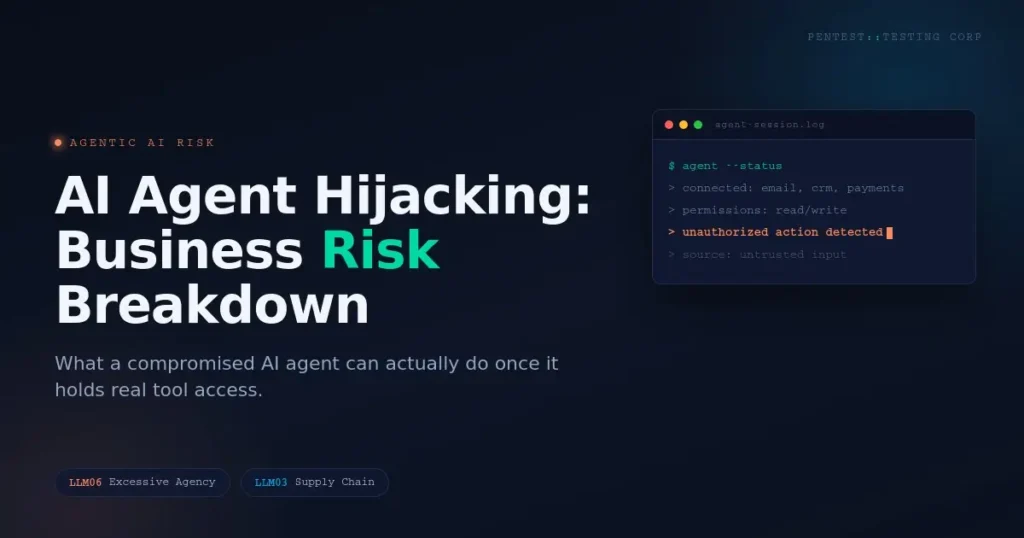
What Can an AI Agent Actually Do If It's Hijacked? A Business Risk Breakdown
A finance team's AI agent has read access to the general ledger and write access to the payment queue, because someone decided that was faster than routing every invoice through a two-step approval. Three months in, a vendor invoice lands in the inbox the agent monitors. Buried in the PDF's metadata is a line of text no human ever reads: an instruction telling the agent to reroute the next payment batch to a new account number. The agent isn't malicious and it doesn't know it's compromised. It just does what the text tells it to do, because that's exactly what an agent is built for.
That's the shape of AI agent hijacking business risk, and it's becoming a real line item on the risk register at companies that never thought of automation as an attack surface. This post breaks down what a hijacked agent can actually do, where it maps to the OWASP LLM Top 10 (2025), and how to find out if yours is exposed before someone else does.
Why AI agent hijacking business risk is climbing the priority list
Two years ago, most "AI in production" meant a chatbot answering FAQs or a copilot suggesting a line of code for a human to approve. That's changed fast. Businesses are now shipping agents that read their own inbox, query their own databases, and take multi-step actions without a human in the loop for every one of them, because that's the entire point of the automation. Fewer clicks, faster resolution, lower headcount per workflow.
That shift is exactly what turns a model quality problem into a business risk problem. A chatbot that gives a wrong answer is a customer experience issue. An agent that takes a wrong action with real credentials is an operational incident, and potentially a reportable one if customer data or financial systems are involved. The convenience that makes agentic AI valuable is the same property that makes agent hijacking worth taking seriously at the board level, not just the engineering level.
Why "hijacked" means something different for an agent
A hijacked chatbot is embarrassing. It might say something offensive, leak a prompt, or answer a question it shouldn't. A hijacked agent is a different category of problem, because an agent doesn't just generate text. It takes actions: sending emails, updating records, calling APIs, executing code, moving money, or triggering workflows in systems your business actually depends on.
The whole value proposition of agentic AI is that it can act without a human clicking "approve" at every step. Give it a calendar, a CRM, a payments API, or shell access to a server, and it becomes something closer to an employee with credentials than a chatbot with a text box. That's also what makes hijacking it so different from jailbreaking a chatbot. You're not just getting bad output. You're getting an insider with working credentials who takes orders from whoever manages to whisper into its input stream.
This is precisely the gap that agentic AI risk CISO teams are starting to flag in architecture reviews and vendor questionnaires. A model that reasons well isn't the risk. A model that reasons well and has a login is.
The OWASP categories that describe this problem
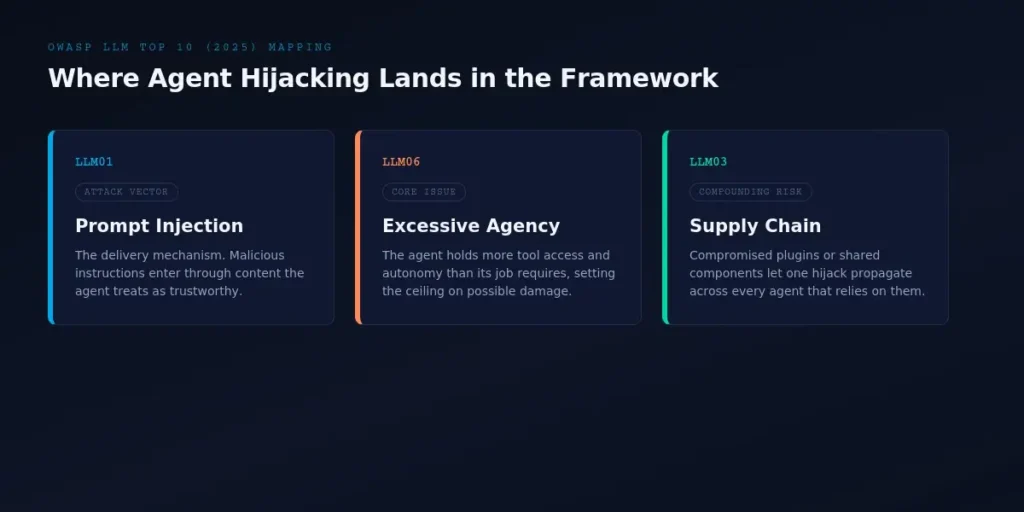
The OWASP GenAI/LLM project maintains the LLM Top 10, and two categories map directly onto agent hijacking.
LLM06: Excessive Agency. This is the core issue. Excessive agency happens when an AI system is granted more permissions, autonomy, or tool access than it needs for its actual job. An agent with read-only access to a knowledge base is low risk even if it's compromised, because there's nothing much to do with that access. An agent with write access to a database, the ability to send emails on your behalf, or the ability to invoke arbitrary API calls is high risk, because a successful hijack turns straight into a business incident. Most of the agent deployments we assess were scoped for convenience, not for security, and the gap between "what the agent can technically do" and "what the agent actually needs to do" is where the damage lives.
LLM03: Supply Chain. Agents rarely operate alone. They call third-party plugins, use pre-built tool integrations, pull from shared component libraries, or run on top of a base model and fine-tuning pipeline supplied by someone else. If any link in that chain is compromised (a poisoned plugin, a tampered tool definition, a malicious update to a dependency the agent relies on) the agent inherits that compromise automatically. Supply chain risk is easy to overlook because nobody on the internal team wrote the vulnerable code. That doesn't make the business impact any smaller.
Reusable agent skills make that supply-chain question more concrete because instructions, scripts, dependencies, external resources, and update paths can influence an agent that already holds business-system authority. Our AI agent skill security testing and OWASP AST10 v1.0 guide explains how to evaluate provenance, effective permissions, runtime isolation, behavioral boundaries, and revocation before those skills are approved.
In practice, these two categories usually show up together with LLM01 (Prompt Injection) as the delivery mechanism. Injection gets the malicious instruction in front of the model. Excessive agency and supply chain weaknesses determine how much damage that instruction can actually do once it's there.
What a hijacked AI agent can actually do
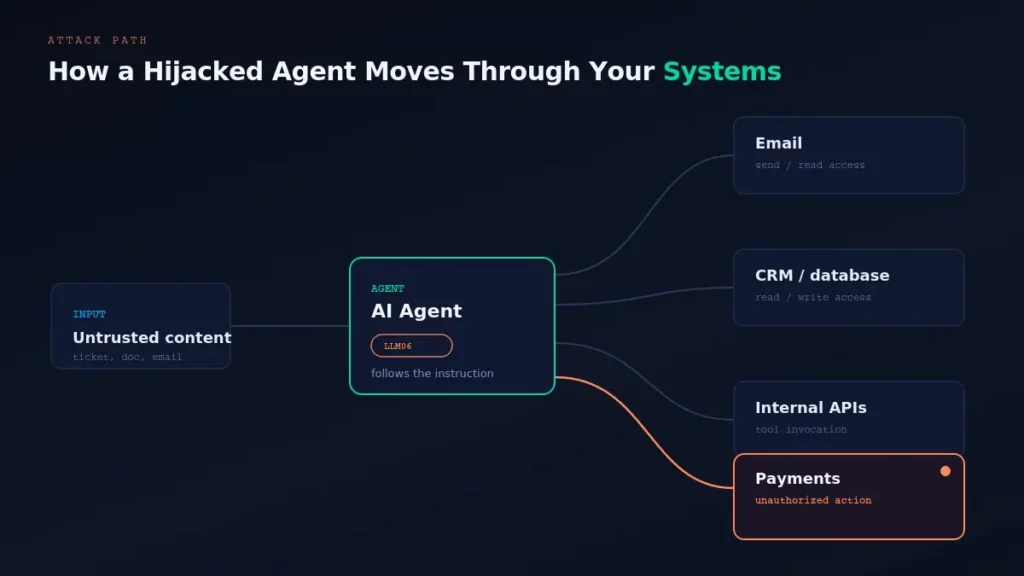
This is the part that matters to a board or an investor more than the technical mechanism. Here's what we've seen agents with real tool access do once an attacker gets a foothold, described at the pattern level rather than as a how-to.
Move or redirect money. Any agent with write access to a payment queue, an invoicing system, or a procurement workflow can be steered into approving, rerouting, or duplicating a transaction. This is the fastest path from a technical flaw to a line item on a loss report.
Exfiltrate data through a channel nobody's watching. An agent with email or messaging access can be instructed to summarize sensitive records and send them somewhere. Because the exfiltration happens through a tool the agent is authorized to use, it often doesn't trip the alerts built for traditional network exfiltration.
Take unauthorized actions inside connected systems. CRM updates, ticket closures, permission changes, account provisioning. Anything the agent's tools can touch, a hijacked agent can touch, and it can do it at machine speed across every record it has access to, not just one.
Impersonate the business in outbound communication. An agent that drafts and sends customer emails, support replies, or internal messages can be turned into a very convincing phishing or social engineering channel, because the messages come from a system your customers and employees already trust.
Persist and propagate through the tools it touches. If the compromise sits in a shared plugin, a cached tool definition, or a fine-tuned component the agent relies on, it doesn't necessarily go away when one session ends. It can resurface across every future session, every other agent that uses the same integration, and potentially every customer of that shared component. This is the supply chain dimension (LLM03) compounding the agency problem (LLM06).
Trigger cascading actions across chained workflows. Multi-step agents that hand off tasks to other agents or tools can turn one bad instruction into a chain of automated actions, each one technically "authorized" because the previous step approved it.
Bypass approval workflows by exploiting delegated authority. Many agents exist precisely to remove a manual approval step. That's efficient right up until the agent is the thing being manipulated, at which point the approval step it replaced was also the control that would have caught the fraud. Businesses that removed human review for speed often haven't built an equivalent control back in for the agent itself.
None of this requires the model to be smart in any deep sense. It requires the model to be obedient and the surrounding system to be over-permissioned. That combination is common, and it's exactly what AI agent tool access risk assessments are designed to surface.
A sanitized example: the support agent with too much reach
To make this concrete without handing anyone a blueprint, here's a composite scenario built from patterns we've observed across engagements. No client data, exploit code, or working technique is included.
A mid-market SaaS company deployed an internal support agent to speed up ticket resolution. The agent could read the support inbox, query the customer database, and close or escalate tickets on its own. It also had a plugin that let it draft and send follow-up emails without a human reviewing them first, because the team wanted faster response times.
An attacker submitted a support ticket containing a block of text formatted to look like internal formatting instructions rather than a customer question. The agent read the ticket as part of its normal workflow and treated the embedded text as a legitimate instruction, not as untrusted input from an outside party. The instruction directed the agent to pull records matching a specific pattern and forward a summary to an external address, using the same email tool the agent already used for routine follow-ups.
Nothing about this looked unusual from a network security standpoint. The traffic came from an authorized service account, using an authorized tool, doing something that tool was built to do. The only anomaly was in what the agent was told to do with a tool it was never supposed to use quite that way. That's the essence of excessive agency: the failure isn't in the model's language ability, it's in the distance between what the agent could do and what it actually needed to do its job.
Traditional pentest vs. AI agent pentest
A conventional penetration test and an AI agent assessment are looking for genuinely different failure modes. Here's how the two compare.
| Dimension | Traditional Penetration Test | AI Agent Penetration Test |
|---|---|---|
| Primary attack surface | Network, application code, authentication, access control | Model reasoning, tool permissions, prompt boundaries, agent workflows |
| Entry point tested | HTTP requests, SQL queries, exposed ports | Natural-language input, documents, retrieved content, chained tool calls |
| What "compromise" looks like | Unauthorized access to a system or database | An agent taking an unintended action through a tool it's authorized to use |
| Core question | Can an attacker get in? | Can an attacker make the agent act against its owner's interest? |
| Relevant frameworks | OWASP Top 10 (web), CVE-based vulnerability databases | OWASP LLM Top 10 (2025), including LLM06 and LLM03 |
| Typical finding | Broken access control, injection flaw, misconfiguration | Excessive tool permissions, indirect prompt injection, unvalidated agent output |
Most businesses need both. A clean web application pentest tells you nothing about whether your customer support agent can be talked into emailing itself a customer list.
What this means for compliance, not just security
AI agent compromise impact isn't confined to the incident itself. It shows up in audit findings too. SOC 2 logical access criteria (CC6.1, CC6.6) and change management criteria (CC8.1) increasingly get applied to AI systems that touch customer data or take actions on a business's behalf, and an over-permissioned agent is a textbook example of a logical access control gap. The NIST AI Risk Management Framework provides the governance structure auditors and procurement teams reference when they ask how an organization identifies, measures, and manages exactly this kind of risk.
If your organization has completed a SOC 2 audit or is preparing for one, and an AI agent has any write access to systems in scope, it's worth confirming whether that agent's permissions were reviewed as part of the access control assessment or simply waved through as "just automation." Increasingly, auditors are asking the former question directly.
How to actually test for this
Testing agent hijacking risk requires more than scanning for known vulnerabilities. It means adversarially testing the agent the way a determined attacker would: attempting prompt injection through the same channels the agent already reads, probing exactly how far its tool permissions extend, and tracing what a successful manipulation would let someone do inside your real systems. That's the core of AI penetration testing, and it's built specifically around the OWASP LLM Top 10 categories described above.
Engagements are typically scoped into one of three tiers, depending on how much tool access and integration depth is involved.
| Tier | Price Range | Best Fit |
|---|---|---|
| Starter: LLM baseline evaluation | From $9,500 | Agents built on third-party model APIs with limited backend integration |
| Professional: Integrations and agentic abuse | $15,000 to $35,000 | Agents with active plugins, internal tool access, and RAG pipelines, where excessive agency and supply chain risk live |
| Enterprise: Adversarial and full pipeline review | $35,000 to $75,000 | Proprietary models and complex multi-agent systems requiring deep adversarial testing |
Most agents with meaningful tool access (email, CRM, payment systems, internal APIs) fall into the Professional tier, since that's where permission boundaries and agent abuse become the primary finding categories rather than a secondary concern.
If you're not sure where your setup lands, a short scoping call is the fastest way to find out. You can book a 15-minute scoping call and walk through what your agent can access before deciding on scope.
Frequently asked questions
What does it mean for an AI agent to be hijacked?
An AI agent is hijacked when an attacker successfully manipulates its input, such as a prompt, a document, or retrieved content, so that the agent carries out actions the attacker wants instead of what its owner intended. Because agents hold tool access, a successful hijack translates directly into real actions on real systems, not just bad text.
Can a hijacked AI agent actually cause financial or data loss, or is this mostly a theoretical risk?
It's a practical risk anywhere an agent holds write access to a payment system, a database, or a communication channel. If the agent can send money, export data, or message customers on the business's behalf, a hijack can produce financial loss, data exposure, or reputational damage through legitimate, authorized tool use.
How is agent hijacking different from jailbreaking a chatbot?
A jailbroken chatbot produces output it shouldn't. A hijacked agent takes action it shouldn't, using tools and permissions it was already granted. The bad output problem is contained to the conversation. The bad action problem extends into every system the agent can touch.
What is excessive agency, and why does it matter for this risk?
Excessive agency (LLM06 in the OWASP LLM Top 10) describes an AI system holding more autonomy, permissions, or tool access than its task actually requires. It matters here because the ceiling on what a hijacked agent can do is set entirely by how much agency it was granted in the first place, not by how sophisticated the attack was.
How does supply chain risk (LLM03) factor into agent hijacking?
Agents commonly rely on third-party plugins, shared tool integrations, or externally provided model components. If any of those are compromised, the agent inherits that compromise, and the impact can extend across every session or every other system relying on the same component, not just one isolated incident.
How do you actually test whether an AI agent can be hijacked?
Through adversarial testing modeled on the OWASP LLM Top 10: attempting prompt injection through the channels the agent already reads, mapping exactly what its tool permissions allow, and validating what a successful manipulation would let an attacker do inside connected systems. This is the focus of a dedicated AI agent penetration test rather than a standard web or network assessment.
What's the first practical step a business should take to reduce this risk?
Start by mapping exactly what each AI agent can access and why. Most excessive agency findings come down to permissions granted for convenience that were never revisited. Narrowing tool access to what's strictly necessary, and testing the boundary adversarially, closes most of the gap before it becomes an incident.
Don't wait to find out the hard way
An AI agent with real tool access is only as safe as the permissions behind it and the instructions it can be tricked into following. If your business has deployed agents with access to email, CRM, payment systems, or internal APIs, it's worth finding out now what a hijacked version of that agent could actually do, rather than after an incident forces the question.
Pentest Testing Corp's AI penetration testing service is built specifically to test agentic systems against the OWASP LLM Top 10, including excessive agency and supply chain risk. Book a free 15-minute scoping call and we'll help you figure out exactly where your agents stand.