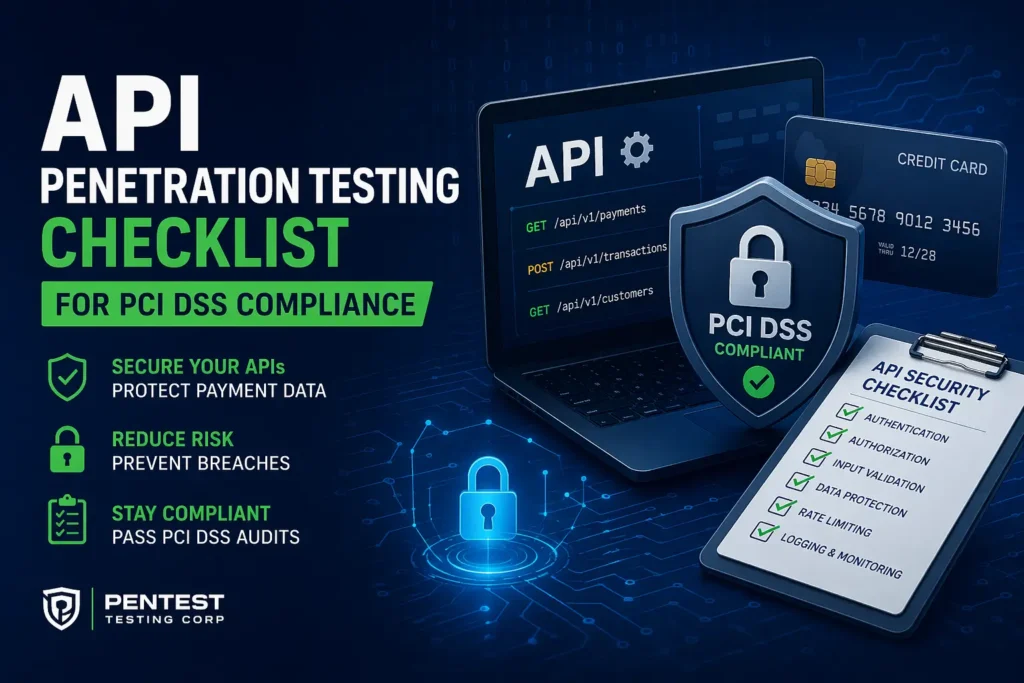
API Penetration Testing Checklist for PCI DSS Compliance
If your APIs touch payment data, you’re already exposed. Not hypothetically. Right now.
Most PCI DSS failures don’t come from obvious gaps like missing encryption. They come from APIs quietly leaking data through broken access control, weak authentication, or logic flaws. These aren’t edge cases. They’re common, and attackers know exactly where to look.
For SaaS founders and CTOs, this becomes a business blocker. Failed PCI audits delay partnerships. Security questionnaires stall deals. A single breach can wipe out trust and revenue overnight.
The Real Problem: APIs Expand Your PCI Attack Surface
Modern applications are API-driven. Payments, mobile apps, third-party integrations. Everything talks through APIs.
But here’s the issue:
APIs are rarely tested the same way as web apps.
Developers rely on functional testing. Security teams rely on automated scanners. Neither approach catches business logic flaws or authorization issues, which are exactly what PCI DSS auditors care about.
According to the OWASP API Security Top 10, the most critical risks include broken object-level authorization (IDOR), excessive data exposure, and security misconfigurations. These are not theoretical. They are actively exploited.
If you’re unsure how exposed your APIs are, run a quick security check using a free scanner like our Website Vulnerability Scanner to identify obvious risks before they escalate.
Risk: What Happens When API Security Fails
When APIs are not properly tested for PCI DSS, the consequences go beyond technical issues:
- Unauthorized access to cardholder data (CHD)
- Account takeover via weak authentication flows
- Data leakage through poorly designed endpoints
- Compliance failure during PCI DSS audits
- Lost enterprise deals due to failed security reviews
Even worse, many of these vulnerabilities don’t trigger alerts. They look like normal API traffic.
If you’re preparing for a product release, timing your security testing is critical. Read our guide on when to do penetration testing before launch to avoid last-minute risks and compliance issues.
Real-World Attack Scenario (How It Actually Happens)
Let’s break this down.
A SaaS billing platform exposes an endpoint:
GET /api/v1/invoices/{invoice_id}The API validates authentication but does not verify ownership of the invoice.
An attacker simply changes the invoice_id parameter.
Result?
They can access invoices of other customers, including payment details. No brute force. No malware. Just a logic flaw.
This is a classic IDOR (Insecure Direct Object Reference). It directly violates PCI DSS requirements for access control.
Now combine this with:
- Weak rate limiting → API abuse
- Improper input validation → SQL injection
- Broken session handling → account takeover
This is how small issues turn into reportable breaches.
How Attackers Exploit These Weaknesses
Attackers don’t “hack” APIs in the traditional sense. They analyze behavior.
Here’s what they typically do:
- Enumerate endpoints using tools like Burp Suite
- Manipulate parameters to test authorization boundaries
- Replay requests with modified tokens
- Chain multiple low-risk issues into a critical exploit
For example:
A minor SQL injection in an API parameter might not dump a database immediately. But combined with weak access control, it can expose sensitive financial records.
This aligns closely with the broader OWASP Top 10 risks, especially broken access control and injection flaws.
Why Automated Tools Miss Critical API Vulnerabilities
Most companies rely heavily on scanners. The problem is simple.
Scanners don’t understand business logic.
They can detect:
- Known CVEs
- Basic injection patterns
- Misconfigurations
But they cannot:
- Identify IDOR vulnerabilities
- Test multi-step workflows
- Validate authorization logic across roles
- Detect chained attack paths
That’s why companies pass automated scans and still fail PCI audits.
The Solution: Manual API Penetration Testing for PCI DSS
This is where structured, manual testing becomes essential.
A proper API pentest for PCI DSS goes beyond surface-level scanning. It simulates how an attacker actually interacts with your system.
At Pentest Testing Corp, API testing includes:
- Deep authorization testing (IDOR, BOLA)
- Authentication bypass attempts
- Injection testing (SQLi, NoSQL, command injection)
- Rate limiting and abuse scenarios
- Business logic validation
- Data exposure analysis
If your APIs connect to web applications, this is often combined with full-stack testing through services like https://www.pentesttesting.com/web-app-penetration-testing-services/.
For API-specific risks, a focused assessment, such as https://www.pentesttesting.com/api-pentest-testing-services/, ensures PCI-relevant coverage.
If your APIs handle payments or sensitive data, delaying testing increases both compliance risk and the likelihood of a breach. A targeted API pentest now is significantly cheaper than an incident response later.
API Penetration Testing Checklist for PCI DSS
Here’s a practical checklist aligned with PCI DSS expectations:
1. Authentication & Session Management
- Enforce strong authentication (OAuth, JWT validation)
- Test token expiration and reuse
- Detect session fixation or hijacking risks
2. Authorization Controls (Critical)
- Validate object-level access (IDOR testing)
- Test role-based access control (RBAC)
- Ensure least privilege enforcement
3. Input Validation & Injection Testing
- SQL injection in API parameters
- NoSQL injection (MongoDB, etc.)
- Command and template injection
4. Data Exposure & Encryption
- Ensure no sensitive data in responses
- Mask or tokenize cardholder data
- Enforce TLS for all endpoints
5. Rate Limiting & Abuse Prevention
- Test brute force protections
- Validate API throttling mechanisms
- Detect scraping or automation abuse
6. Logging & Monitoring
- Ensure API access logs are captured
- Validate alerting for suspicious behavior
- Align with PCI DSS logging requirements
7. Third-Party & Integration Risks
- Assess exposed partner APIs
- Validate webhook security
- Check external dependencies
What to Look for in a PCI-Focused Penetration Testing Company
Not all pentests are equal. For PCI DSS and SOC 2 alignment, focus on:
- Proven experience with compliance-driven testing
- Manual testing methodology, not just automated reports
- Clear, actionable reporting (developer + executive level)
- Ability to map findings to PCI DSS requirements
- Support for remediation and retesting
For companies also pursuing SOC 2, referencing guidance from https://www.aicpa.org/resources/article/what-is-soc-2 can help align expectations across audits.
A strong provider will bridge both security and compliance, not treat them separately.
Final Thoughts
APIs are now the primary attack surface for payment-driven applications. PCI DSS compliance isn’t just about passing an audit. It’s about proving your system can withstand real-world attacks.
If your APIs haven’t been manually tested, you’re operating with blind spots.
Schedule a focused API security assessment with Pentest Testing Corp and get a PCI-aligned evaluation that goes beyond automated scans.
🔐 Frequently Asked Questions (FAQs)
Find answers to commonly asked questions about API Pentest PCI DSS.