Web Application Penetration Testing Cost in 2026 (Detailed Breakdown)
Introduction: The real cost isn’t the pentest. It’s the breach you didn’t catch.
If you’re a SaaS founder or CTO, you’re not asking about web app pentest cost out of curiosity. You’re trying to answer a more serious question:
“Are we secure enough to close deals, pass audits, and avoid a breach?”
Because right now, attackers aren’t guessing. They’re systematically exploiting common weaknesses like broken access control, insecure APIs, and injection flaws—issues that still dominate modern applications according to OWASP Top 10.
A single missed vulnerability can lead to:
- Failed SOC 2 audits
- Lost enterprise deals
- Customer data exposure
- Long-term brand damage
Before diving into pricing, you can quickly assess your exposure using a free scanner like the one available on https://free.pentesttesting.com/ — it’s a practical first step to understand where you stand.
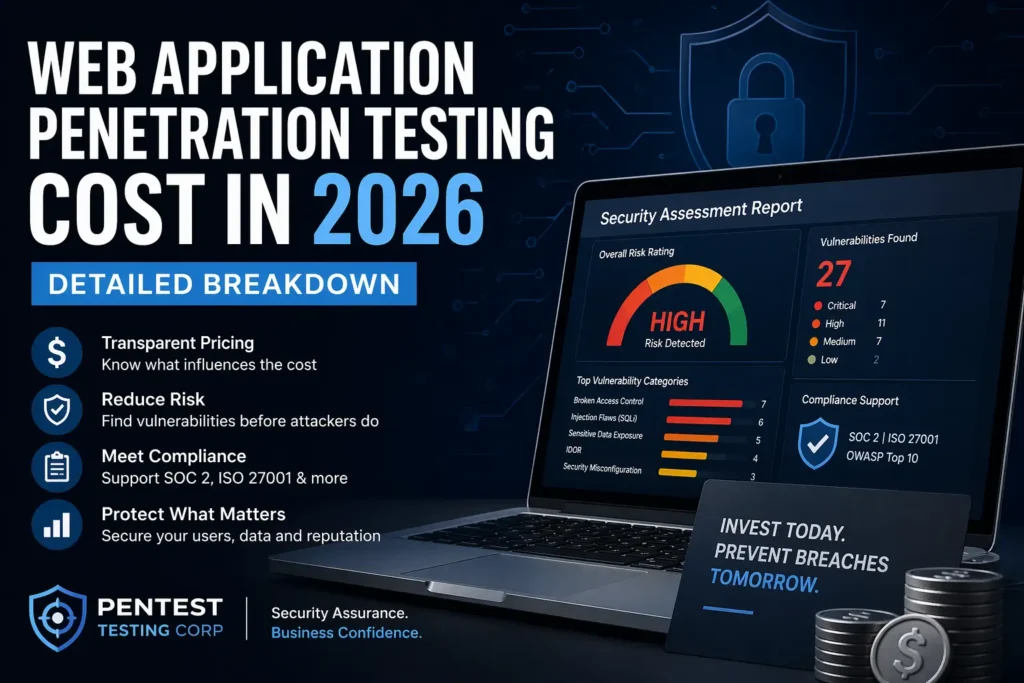
What Does Web App Pentest Cost in 2026?
The short answer:
$3,000 to $25,000+ per application
But that range doesn’t tell you much. Let’s break it down based on real-world engagements.
Key Pricing Factors
1. Application Size & Complexity
- Small app (5–10 pages, basic auth): $3K–$6K
- Mid-size SaaS platform: $6K–$15K
- Large enterprise system (multi-role, APIs, integrations): $15K–$25K+
2. Authentication & Roles
Complex role-based systems (admin, user, partner, API keys) increase testing depth significantly.
3. API Surface Area
If your platform exposes APIs, you’re effectively doubling your attack surface. That’s why combining web testing with API penetration testing is often necessary.
4. Compliance Requirements
SOC 2, PCI DSS, ISO 27001 all require:
- Evidence-based testing
- Manual validation
- Structured reporting
Compliance-driven pentests cost more because they go deeper and produce audit-ready documentation.
The Real Risk Behind the Price
How attackers actually exploit your app
Let’s make this practical.
Scenario: IDOR + Broken Access Control
An attacker logs in as a normal user and changes:
/api/user/123 → /api/user/124If your backend doesn’t enforce proper authorization, they now access another user’s data.
This is not theoretical. Broken access control remains the #1 risk in modern applications
Scenario: SQL Injection in Search
A poorly sanitized query:
?q=' OR 1=1--Result:
- Full database dump
- Credentials exposed
- Potential full system compromise
Scenario: API Abuse
Attackers:
- Enumerate endpoints
- Abuse rate limits
- Extract data silently over time
These aren’t caught by surface-level scans.
If your application handles customer data, payment flows, or authentication logic, delaying a proper pentest isn’t a cost-saving decision. It’s a risk multiplier. A targeted assessment now is significantly cheaper than incident response later.
Why Automated Tools Miss Critical Vulnerabilities
Automated scanners are useful. But they have limits.
They typically:
- Detect known patterns
- Miss business logic flaws
- Fail to chain vulnerabilities
- Ignore context-based access issues
For example:
- A scanner might detect an endpoint
- But it won’t test privilege escalation across roles
- Or abuse workflows like password reset logic
That’s why relying only on automation creates a false sense of security
Even frameworks like the OWASP ASVS standard emphasize structured, manual verification for real assurance.
How Penetration Testing Solves This
A proper pentest goes beyond scanning.
It simulates a real attacker:
- Manual testing of authentication flows
- Privilege escalation attempts
- API abuse scenarios
- Chained exploit paths
- Data exfiltration simulations
At Pentest Testing Corp’s web penetration testing, testing is aligned with:
- OWASP Top 10
- Real-world attack techniques
- Compliance expectations (SOC 2, ISO 27001)
This produces:
- Actionable vulnerabilities
- Clear business impact
- Remediation guidance your dev team can use immediately
What to Look for in a Pentesting Company (SOC 2 Focused)
Not all pentests are equal. If your goal is compliance and risk reduction, look for:
1. Manual Testing Depth
Avoid “scan-only” providers.
2. Clear Risk Mapping
Findings should connect to business impact, not just CVSS scores.
3. Compliance Alignment
Testing should support:
- SOC 2 evidence requirements
- Audit documentation
- Risk treatment processes
4. API + Web Coverage
Modern apps are API-first. Testing only the frontend is incomplete.
5. Developer-Friendly Reports
Your team should be able to fix issues quickly without guesswork.
Internal Resources You Should Explore
- Try the free vulnerability scanner
- Learn about web application pentesting services
- Explore API security testing
These help you understand your current exposure before committing to a full engagement.
Final Thoughts: Cost vs Risk
The real question isn’t:
“How much does a web app pentest cost?”
It’s:
“What’s the cost of missing a critical vulnerability?”
If your application is:
- Handling sensitive data
- Preparing for SOC 2
- Scaling with enterprise clients
Then a proper pentest isn’t optional. It’s part of doing business.
If you’re evaluating your security posture seriously, the next step is a manual, expert-led assessment. Schedule a consultation with Pentest Testing Corp and get a clear, actionable view of your real risk before attackers find it first.
🔐 Frequently Asked Questions (FAQs)
Find answers to commonly asked questions about Web App Pentest Cost & Buying Decisions.