Cisco SD-WAN Emergency Directive — 24-Hour Triage, Evidence Preservation, and Hardening Checklist
CISA’s Emergency Directive 26-03 and related guidance have turned Cisco SD-WAN vulnerability into an executive-level issue, not just a network engineering task. The immediate concern is not only patching. It is whether your organization can quickly identify exposed control components, preserve evidence before disruptive changes, determine whether compromise already occurred, and then harden the environment without creating blind spots in audit, legal, or customer communications. Cisco’s own advisory describes CVE-2026-20127 as a critical authentication bypass with a CVSS score of 10.0, and CISA says observed activity involved that flaw for initial access before privilege escalation and longer-term persistence activity.
For security buyers, IT leaders, and operations teams, the real risk is treating this as “just another patch cycle.” In practice, this is a control-plane trust problem. If a Cisco SD-WAN management or controller layer is exposed and mishandled, you may be dealing with unauthorized administrative access, privilege escalation, root-level impact, or persistence that survives a rushed response. Cisco’s remediation guidance explicitly says all SD-WAN deployments are vulnerable and require immediate action, while also noting that not every environment will show signs of compromise.
That is why the first 24 hours matter so much.
What happened, and why this bulletin matters beyond federal agencies
CISA issued ED 26-03 for Federal Civilian Executive Branch agencies, but the operational lessons apply far more broadly. Its public guidance tells affected organizations to inventory in-scope Cisco SD-WAN systems, collect artifacts such as logs and virtual snapshots, patch for CVE-2026-20127 and CVE-2022-20775, hunt for evidence of compromise, and implement Cisco hardening guidance. Even if you are not under the directive, that sequence is the right buyer-facing response model: know what is exposed, preserve evidence, assess compromise, remediate, and harden.
Cisco’s public advisory states that CVE-2026-20127 affects Cisco Catalyst SD-WAN Controller and Cisco Catalyst SD-WAN Manager, formerly vSmart and vManage, and could let an unauthenticated remote attacker bypass authentication and obtain administrative privileges. Cisco also published a separate remediation workflow that centers on evidence collection, TAC assessment, and fixed-version upgrades rather than improvised patching.
Which systems and teams should care first
You should prioritize this issue immediately if your organization operates any of the following:
- Cisco SD-WAN control components such as vManage, vSmart, or vBond
- Internet-reachable management interfaces, admin portals, or controller paths
- Hybrid environments where SD-WAN connects branch, cloud, and data center traffic
- Managed service or multi-tenant operational models where a single control issue may affect multiple locations or customers
The first teams that need to be aligned are network engineering, security operations, incident response, platform or infrastructure leadership, identity and access administrators, and any compliance or legal stakeholders who may later need a defensible incident timeline. CISA’s guidance focuses on identifying in-scope systems, collecting evidence, patching, hunting, and reporting unusual activity. Cisco’s remediation workflow centers on collecting admin-tech bundles from all control components and using that evidence to guide the next step.
The first 24 hours: containment, access review, and triage
A strong first-day response is not complicated, but it must be disciplined.
1) Inventory every in-scope SD-WAN control component
Start by building a verified asset list. Include production, standby, disaster recovery, lab, and cloud-hosted instances. Do not stop at the most visible management node. Cisco’s remediation guidance explicitly calls for collection from all controllers, managers, and validators.
At this stage, answer four questions:
- Which vManage, vSmart, and vBond systems exist?
- Which ones are internet reachable or reachable from less-trusted segments?
- Which identities, service accounts, certificates, and peer relationships are trusted by those systems?
- Which logging sources exist today for auth activity, system changes, and controller communications?
2) Preserve evidence before you patch, rebuild, or rotate everything
This is where many teams make their biggest mistake. If you patch first and investigate second, you may close the door on the attacker while also destroying the timeline you need for root-cause analysis, insurance, legal review, or regulator questions.
Cisco’s remediation note says to collect admin-tech files from all control components before opening a TAC case, and CISA’s public guidance calls out collecting artifacts including virtual snapshots and logs before patching. That is the right order of operations.
3) Tighten access without destroying the scene
During triage, reduce exposure to the management plane. Restrict who can reach administrative interfaces. Freeze nonessential configuration changes. Review recent administrative access, peer changes, RBAC changes, API usage, and remote access paths. Avoid “cleanup by instinct.” You want measured containment, not accidental evidence loss.
4) Decide whether this is only exposure or an actual incident
The key operational fork is simple:
- No indicators of compromise found: move to guided upgrade and hardening
- Indicators of compromise found or suspected: treat the environment as an incident, escalate evidence handling, and move under DFIR discipline
Cisco’s remediation path makes this distinction explicit: if TAC confirms no indicators of compromise, upgrade to the fixed release within the supported path; if compromise indicators are present, remediation becomes PSIRT-guided and environment-specific.
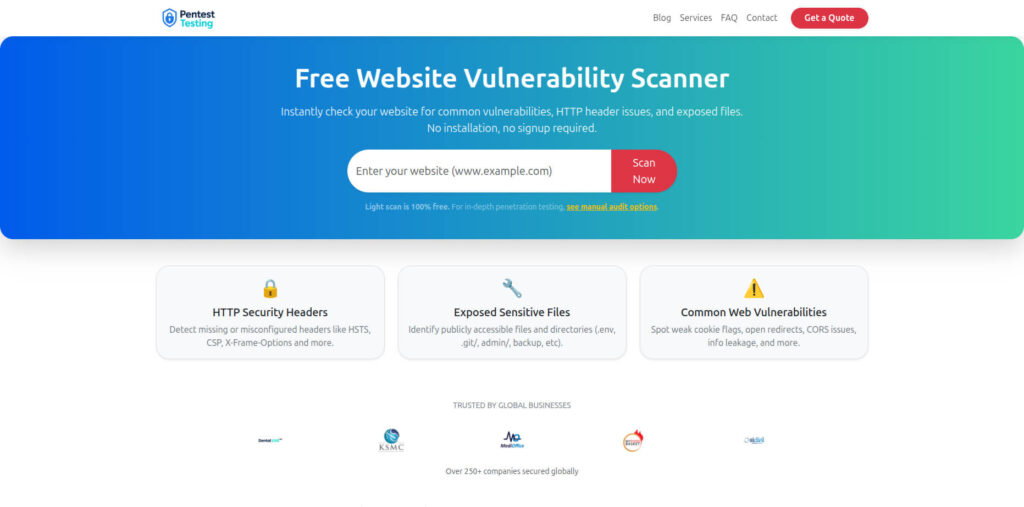
Screenshot of the Pentest Testing Corp Free Website Vulnerability Scanner showing quick checks for exposed files, weak headers, and other internet-facing hygiene issues. The scanner page highlights checks for HTTP security headers, exposed sensitive files, weak cookie settings, open redirects, and information leakage.
What evidence to preserve before patching or rebuilding
If your team only preserves “some logs,” assume you preserved too little.
A practical evidence-first set should include:
- Virtual snapshots of affected SD-WAN systems where operationally safe
- Cisco admin-tech bundles from all control components
- Authentication logs, system logs, controller syslogs, and exported SIEM data
- Configuration backups and recent change history
- Local admin lists, RBAC assignments, API tokens, SSH keys, and certificate details
- Identity-provider logs for SSO, MFA, or administrative role changes
- Firewall, VPN, reverse proxy, and bastion access records for management paths
- A timestamped list of emergency actions already taken
Cisco specifically instructs customers to collect admin-tech files from all control components and notes manual verification paths when that is not possible. It also calls out checks for unauthorized SSH logins and unauthorized peer connections.
A simple evidence manifest helps keep the response defensible:
# Example: hash collected evidence bundles before transfer
mkdir -p evidence/hashes
sha256sum *.tar.gz *.tgz *.log > evidence/hashes/SHA256SUMS.txt
date -u +"%Y-%m-%dT%H:%M:%SZ" > evidence/hashes/COLLECTION_UTC.txt
And a minimal manifest can look like this:
asset,artifact,collector,utc_time,hash,status
vmanage-01,admin-tech-vmanage-01.tgz,IR-team,2026-03-10T08:15:00Z,<sha256>,collected
vsmart-01,admin-tech-vsmart-01.tgz,IR-team,2026-03-10T08:42:00Z,<sha256>,collected
vbond-01,syslog-export-vbond-01.log,SOC,2026-03-10T08:47:00Z,<sha256>,collected
idp-tenant,admin-login-audit.csv,Identity-team,2026-03-10T09:03:00Z,<sha256>,collected
That level of structure matters. Pentest Testing Corp’s Digital Forensic Analysis Services page emphasizes evidence preservation, timeline reconstruction, root-cause analysis, and impact assessment, which is exactly the mindset this type of event requires. The firm’s recent post, 7 Proven Digital Forensic Analysis Steps for Legal Evidence, is also directly aligned with evidence-safe incident handling.
Hunt priorities after initial containment
Once evidence is preserved, your hunt should focus on administrative access and controller trust, not just generic vulnerability scanning.
Look for:
- Unexpected or unexplained admin logins
- “root” or system-level login events that do not match approved operations
- Unauthorized peer relationships or controller communication changes
- New local users, altered RBAC roles, or emergency accounts
- Suspicious SSH keys, API tokens, or certificate changes
- Configuration drift that does not match approved change windows
- Signs of persistence, especially if the environment was internet exposed
Cisco’s remediation documentation explicitly references manual verification for unauthorized SSH logins and unauthorized peer connections, and even includes example discussion of root-user log entries.
A generic SIEM query pattern might look like this:
index=network OR index=sdwan
(host=vmanage* OR host=vsmart* OR host=vbond*)
("system-login-change" OR "Accepted" OR "Failed password" OR "user-name:\"root\"")
| stats count earliest(_time) as first_seen latest(_time) as last_seen by host, src_ip, user, message
| sort - last_seen
And for change review:
index=network OR index=sdwan
(host=vmanage* OR host=vsmart* OR host=vbond*)
("role" OR "rbac" OR "certificate" OR "ssh" OR "api token" OR "peer")
| table _time, host, user, src_ip, message
| sort - _time
Field names will vary by collector, but the intent should not.
Hardening and remediation priorities after initial containment
After you have either ruled out compromise or stabilized the incident, move into hardening. Cisco’s SD-WAN hardening guidance emphasizes perimeter controls, RBAC, certificates, strong passwords, SSO and MFA, session timeouts, logging, and SSH access practices. Those are not theoretical recommendations in this context. They are the post-incident control set.
The practical priority order should look like this:
Isolate and reduce management-plane exposure
If an interface does not need broad reachability, remove that reachability. Management paths should be tightly restricted, ideally through controlled administration networks, bastions, or explicit allowlists.
Upgrade only through supported remediation paths
Cisco’s remediation workflow says upgrades should stay within the current major release unless TAC explicitly directs otherwise. It also lists fixed software versions for affected trains, including 20.9.8.2, 20.12.5.3, and 20.12.6.1 for specific current-version paths.
Rotate access material after evidence capture
That means local admin credentials, privileged API tokens, service account secrets, SSH keys, and any related management credentials. If identity federation is involved, review SSO trust, MFA enforcement, and emergency-break-glass procedures.
Review trust relationships and peer assumptions
A control-plane issue is often also a trust issue. Revalidate who and what your controllers trust, which identities can administer them, and which peers can communicate with them.
Improve logging and alerting depth
If you cannot easily answer who logged in, from where, what changed, and whether that change was approved, your hardening is incomplete. CISA’s and Cisco’s guidance both point toward stronger artifact collection and ongoing hunt visibility.
Validate the broader perimeter
When a control component is at risk, you should assume adjacent public assets deserve scrutiny too. Pentest Testing Corp’s External Network Penetration Testing service is built around validating perimeter exposure and exploitable entry points across public assets, while Internal Network Penetration Testing is a better fit when you need to understand what lateral movement or post-compromise paths may exist behind the edge.
When to bring in external pentesting or DFIR support
This is where many organizations wait too long.
Bring in outside support when:
- You need an evidence-backed answer on whether compromise happened
- Your team has already patched but cannot explain prior exposure or access
- You need help preserving artifacts before rebuilding
- You have executive, legal, customer, or auditor reporting pressure
- You want independent validation that exposed systems and adjacent assets are now hardened
- You suspect the problem extends beyond a single SD-WAN component
A natural response model is:
- DFIR first when compromise is suspected
Use Digital Forensic Analysis Services to preserve evidence, reconstruct the timeline, and scope impact. - Remediation next when the issue is confirmed or the environment needs structured fixes
Use Remediation Services when you need coordinated technical, documentation, and control improvements. - Pentesting after stabilization to validate that the fix actually reduced attack paths
Use External Network Penetration Testing and Internal Network Penetration Testing to check for remaining exposure and lateral movement risk.
That sequence is especially useful for compliance-driven teams that need more than “patched” as an answer.
Pentest Testing Corp Sample Report showing risk rating, proof-of-concept evidence, and remediation guidance. Pentest Testing Corp’s report show executive-ready summaries, detailed findings, risk mapping, recommendations, and proof-of-concept evidence.
Why this post is different from generic hardening advice
Most security content about edge devices stops at “patch now.” That is not enough here.
The real operational challenge is balancing four needs at once:
- Rapid containment
- Evidence preservation
- Executive-grade communication
- Independent validation after change
That is why this Cisco SD-WAN vulnerability deserves a buyer-facing response plan, not just a maintenance ticket. CISA’s public actions and Cisco’s remediation workflow both reinforce the same point: inventory, collect artifacts, assess compromise, remediate through supported paths, and harden deliberately.
Final takeaway
If your organization runs Cisco SD-WAN, the first question is no longer whether this bulletin matters. The question is whether your team can respond in a way that preserves evidence, reduces exposure, and proves the environment is safe afterward.
That is the difference between a rushed patch and a defensible security response.
Need urgent validation or incident support for Cisco-facing infrastructure? Contact Pentest Testing Corp for pentest, remediation, or DFIR assistance.
🔐 Frequently Asked Questions (FAQs)
Find answers to commonly asked questions about our products and services.