SaaS Account Recovery Security Testing: Test Support Overrides
A customer’s administrator loses access to their MFA device during an enterprise rollout. Support wants to restore access quickly. The escalation console can change the verified email address, clear an authentication factor and send a recovery invitation. The ticket closes successfully, but nobody has checked whether that agent was authorized to make every change, whether the customer approved the correct account, or whether previously issued sessions still work.
SaaS account recovery security testing examines that complete workflow. For a CTO, CISO or support operations lead, the question is whether a legitimate recovery can restore access without handing equivalent authority to an unverified requester.
The practical trigger is a workflow change: enterprise SSO, expanded support permissions, outsourced escalation or a new recovery procedure. Before enabling it, establish who can override identity controls, what evidence permits the override, and how the application returns the account to a known security state.
Map the recovery workflow as an authority change
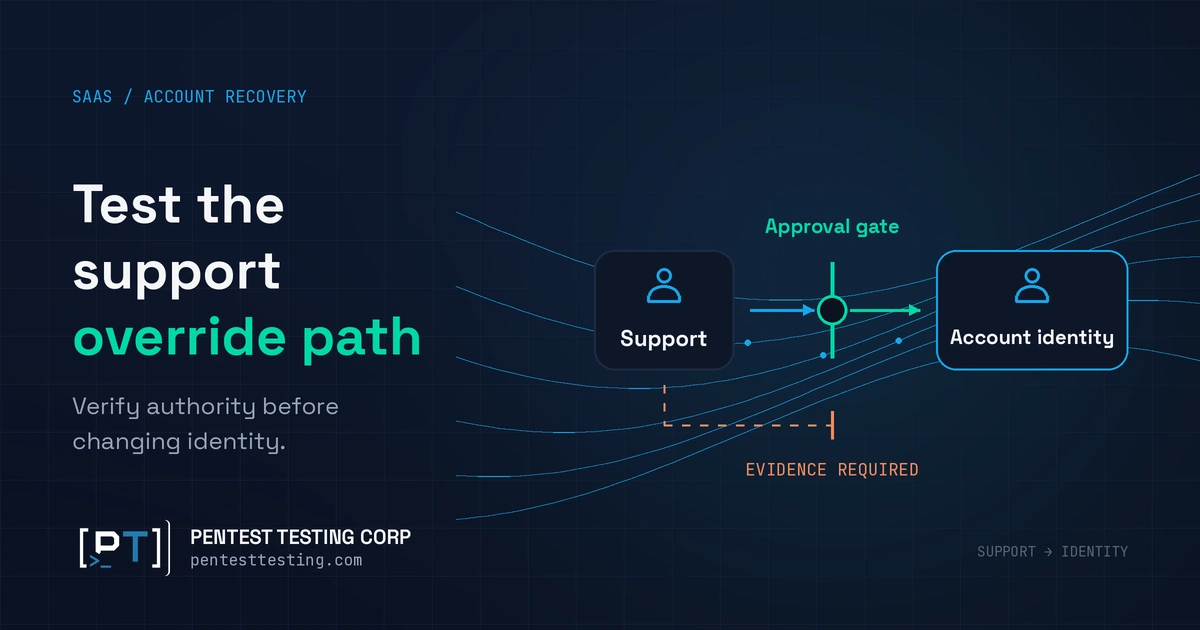
Support-assisted recovery is more than a customer-service action. It can alter the information and authenticators that determine account control. Changing a verified email address may redirect future recovery messages. Removing MFA may allow a weaker sign-in method. Reassigning an account to a different organization can affect customer data and administrative authority.
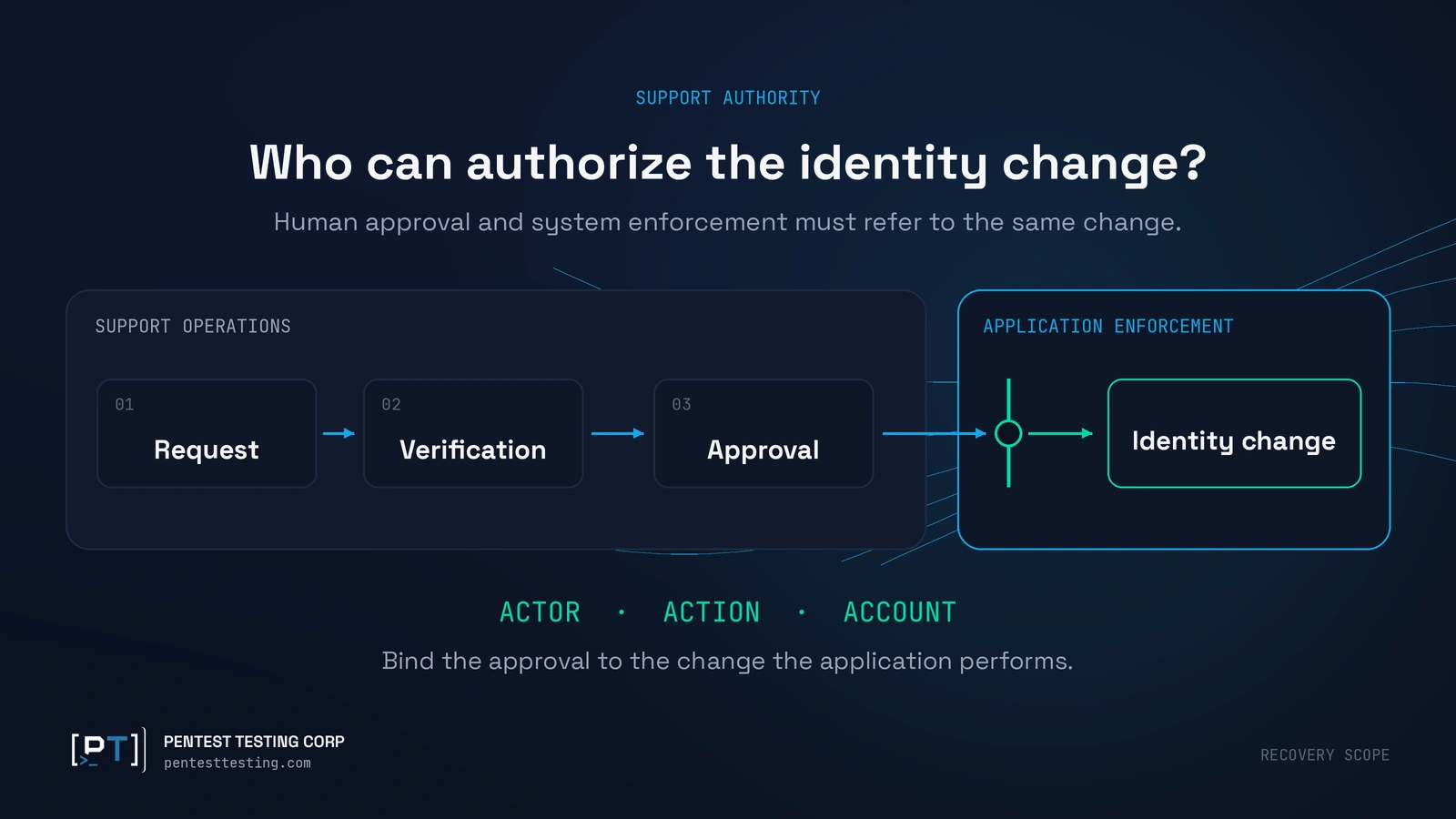
Start with an inventory of those decisions rather than a list of reset screens. Identify every actor who can initiate, approve and execute a recovery: the account holder, a customer administrator, a frontline agent, an escalation specialist and any privileged automation. A support role that can request a change should not automatically inherit permission to approve or execute it.
The handoff matters. A ticket might contain adequate verification notes while the backend accepts a recovery change without checking them. Conversely, an application may enforce an approval gate while an emergency administrative procedure bypasses it. The assessment needs to connect the human decision to the identity change the system actually performs.
Document each supported account state. A local-password user, a passkey user and an SSO-only administrator may require different recovery owners. Record suspended accounts, departed employees and users who belong to more than one tenant. Recovery should preserve restrictions that still apply to those accounts.
Also distinguish restoring a person’s access from transferring organizational ownership. A customer asking to recover an employee’s login may be requesting a separate administrative operation. Treating both requests as one informal support procedure creates uncertainty over whose approval is required and what records the requester may receive.
The output should be an authority map: actor, permitted action, affected account and tenant, evidence required, approval owner and resulting access. Leadership can then identify where the product has delegated identity decisions to people or services without a sufficiently clear boundary.
Why existing controls can leave the override path exposed
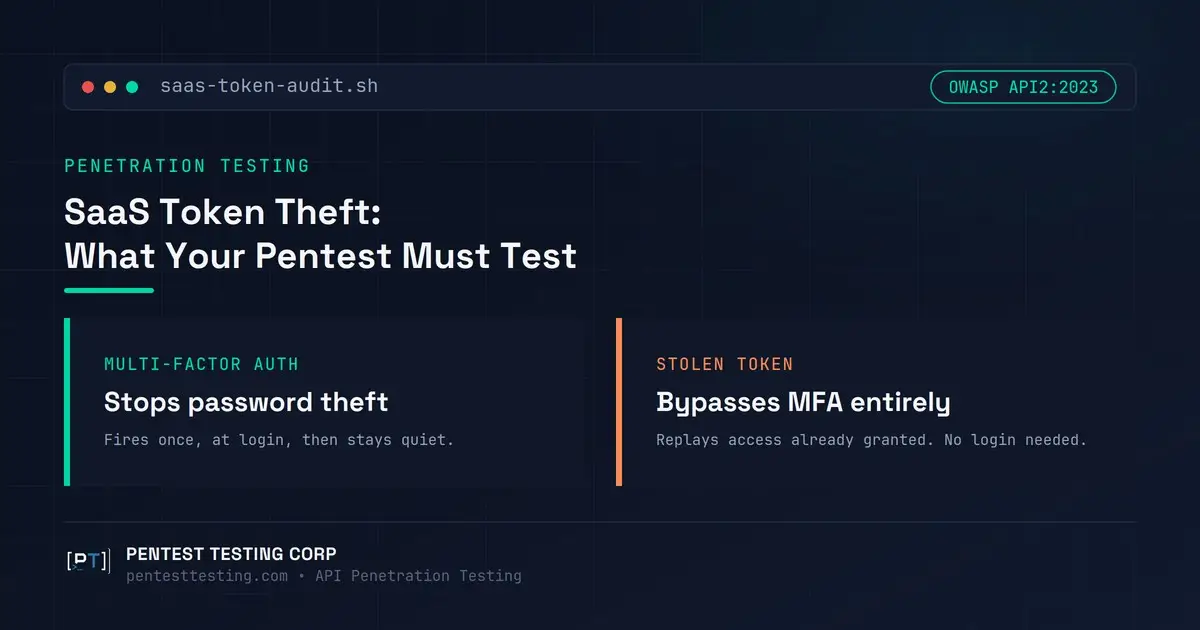
MFA protects a defined authentication path. Its presence does not establish that a support agent cannot remove it under weaker conditions. Similarly, an SSO deployment does not prove that a legacy local account, administrative recovery route or support invitation respects the customer’s identity policy.
OWASP API2:2023 Broken Authentication treats credential recovery as part of authentication security. Recovery therefore belongs in the assessment even when the primary login uses a mature identity provider. The relevant exposure may sit in the SaaS application’s own support console or API.
Written procedures are useful, but they answer a different question from technical enforcement. A policy may require manager approval for an MFA reset. Testing must establish whether an unapproved change is rejected, whether the approval applies to the actual requested action, and whether a different support role can reach the same function.
Training also cannot resolve every ambiguity. If an agent’s console permits unrestricted changes to verified identity information, a convincing ticket or a compromised staff account may have more authority than the business intended. Reducing that authority often requires a product change alongside revised support instructions.
Our guide to risk-based authentication hardening explains the surrounding authentication controls. This assessment asks a narrower operational question: does the recovery exception preserve the intended assurance, and can the organization prove the decision that allowed it?
Scanning can help identify exposed components, but a scanner result does not resolve whether customer-admin approval covers the right employee or whether a closed ticket corresponds to a completed revocation event. Those are business-logic and evidence questions requiring a defined workflow and representative roles.
SaaS account recovery security testing scope matrix
A defensible scope names the recovery actions and the boundaries being tested. “Authentication testing” is too broad to show whether the support override was exercised. Include the support console, its relevant backend functions, approval mechanism and identity integrations within the agreed assessment boundary.
Pentest Testing Corp’s web application penetration testing services cover authentication, access control and business logic. When commissioning a recovery-focused assessment, explicitly identify the support workflow and test roles so coverage is reviewable before work begins.
| Recovery path | Boundary to test | Evidence to request | Business decision |
|---|---|---|---|
| Support changes verified email | Requester verification, tenant ownership and authorization to change identity | Approved change linked to the correct account; unauthorized requests rejected; notification result | Which roles may authorize an identity-address change? |
| Lost MFA factor escalation | Evidence for recovery and permission to remove or replace a factor | Verification and approval records; restored authentication policy | Which account types require specialist approval? |
| Customer-admin-assisted recovery | Administrator authority over the specific tenant and user | Permitted recovery demonstrated; cross-tenant and out-of-role actions denied | Where does customer authority end and vendor authority begin? |
| SSO-only account recovery | Division of responsibility between the SaaS provider and customer IdP | Local fallback behavior and coordinated session outcomes | Can vendor support ever enable local authentication? |
| Emergency override | Exceptional authority, duration and required independent approval | Bounded access, expiry and attributable exception record | Who owns the exception and when must it close? |
| Suspected account compromise | Recovery evidence, compromised factors and previously issued access | Credential review, notification and measured revocation outcomes | Who declares restored control and approves closure? |
Provision controlled accounts across relevant customer and support roles, including separate test tenants where isolation matters. Provide the recovery policy, representative tickets and identity configuration. Without these inputs, the team may spend much of the engagement discovering how recovery is intended to work.
Agree whether the work includes staff participation, a tabletop exercise or an expressly authorized social-engineering component. Technical authorization to assess an application does not automatically authorize contacting unsuspecting employees. A controlled exercise with designated participants can still reveal whether the human approval and system enforcement agree.
Use a representative environment and record its differences from production. A staging console with broader support rights or a simulated identity provider cannot establish production recovery behavior without additional validation. If web and mobile clients share identities, extend the boundary using the lifecycle considerations in passkey security testing for mobile apps.
Prove notification and recovery session revocation
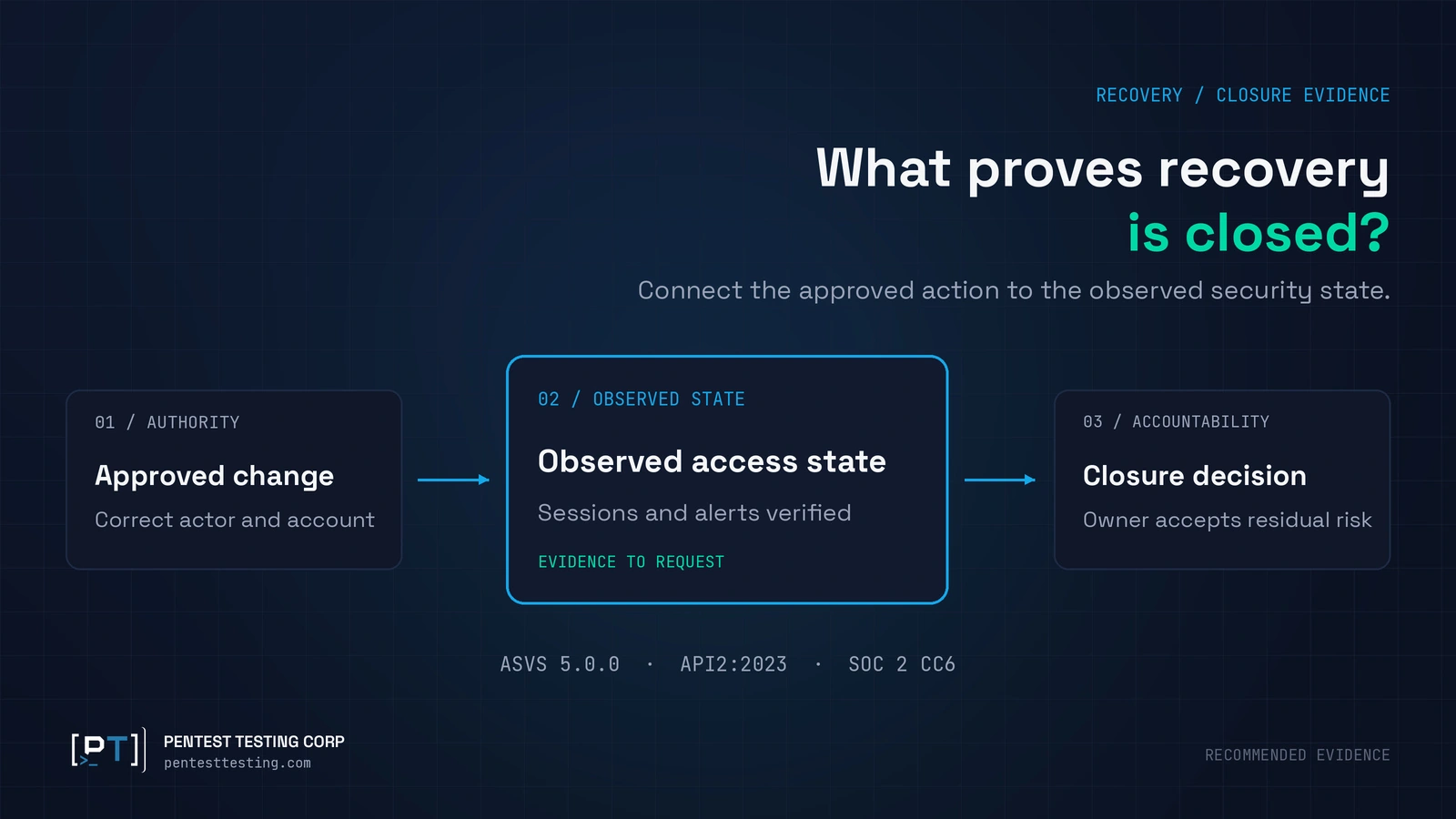
The recovered user’s successful login is only one outcome. The assessment should also establish what changed for previously issued access and who received a notification. Otherwise, support may restore access for the rightful user while leaving an unauthorized session able to continue acting.
Check the identity evidence and notification destination
A request arriving from a company domain or containing familiar billing information can help route a ticket, but leadership should not treat that context as sufficient evidence of control over a sensitive account. Define acceptable recovery evidence before the agent faces an urgent request. Separate individual identity from authority to act for the customer organization.
For suspected compromise, recently changed recovery information may itself be untrustworthy. The OWASP Forgot Password Cheat Sheet recommends established independent recovery evidence, reviewing unauthorized identity changes and invalidating existing sessions after successful recovery. Routine password changes and compromise recovery need different closure criteria.
Record where notifications go when an address changes. A message sent only to the newly supplied address may confirm delivery to the requester while failing to alert the legitimate owner. Define established safe notification channels, any customer-admin notification and the route for reporting an unauthorized change.
The evidence should distinguish a notification being queued, accepted by a delivery service and observed in a controlled mailbox. Testing cannot guarantee that every future customer reads an alert. It can verify the application’s routing and delivery behavior within the assessed environment.
Measure surviving access rather than assuming revocation
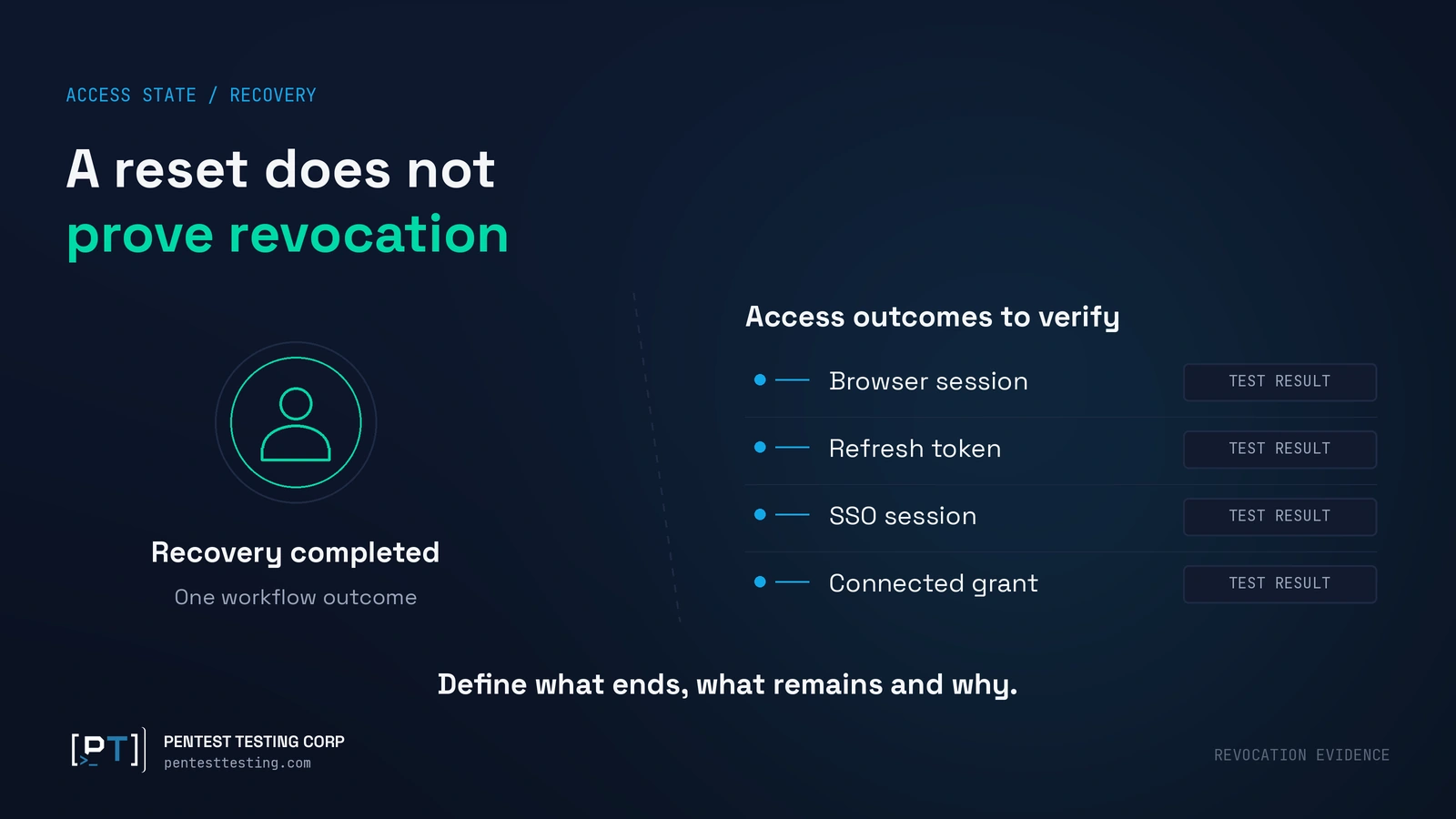
Inventory browser sessions, mobile sessions, refresh tokens, remembered-device states and pending recovery grants. Record whether each is terminated, re-evaluated or intentionally retained after each recovery action. The expected result should be agreed by account risk and event type.
Connected OAuth grants and API keys require separate decisions. They may continue operating independently of a user’s browser session. Where those credentials could preserve unauthorized access, include their review and revocation behavior in scope. Where legitimate integrations must continue, document the owner and the reason for retention.
For SSO, distinguish the identity-provider session from the application session. Ending one does not establish that the other ended or that a subsequent federation event cannot create new access. Require evidence of the coordinated behavior promised by the product, including any measurable propagation delay.
The broader SaaS token theft penetration testing guide covers token lifecycle scope. Recovery testing ties those outcomes to a specific support action and closure decision. A result should state which access stopped, which remained, when the state changed and whether the result matched the approved policy.
Illustrative scenario: the ticket closes before control is restored
Hypothetical scenario, not a client finding: a B2B SaaS platform introduces an escalation role to reduce delays for enterprise customers. The role can replace a verified email address and remove an MFA factor after a customer administrator approves a ticket. The affected account can export sensitive customer records.
In a controlled assessment, the approval record identifies the right employee but does not bind approval to the specific identity changes. The recovery action also leaves an existing application session active. The ticket shows “access restored,” while the account’s effective security state is still ambiguous.
The realistic business consequence depends on the session holder and account permissions. If an unauthorized person already controlled that session, they might retain the account’s export capability after recovery. If nobody had unauthorized access, the same defect still prevents the team from proving the intended containment outcome. Neither condition automatically establishes a broader tenant compromise.
The remediation has separate owners. Product engineering binds authorization to the approved action and account. Support operations clarifies escalation evidence. The identity owner defines the session response, while security establishes evidence required for closure. Treating the issue as an agent-training problem would leave the system behavior unresolved.
A meaningful retest checks that the approved recovery remains usable, unauthorized changes are denied, the specified old access is invalidated and the notification reaches the expected destination. Leadership receives a bounded conclusion about restored control rather than a generic statement that the reset function works.
SaaS account recovery security testing evidence and frameworks
Frameworks help turn recovery policy into testable expectations. They do not replace the role and workflow inventory. Record the version and the actual controls assessed so a reviewer can distinguish targeted verification from an assertion of full standards coverage.
OWASP ASVS 5.0.0 supplies authentication and session requirements relevant to recovery. Use version-qualified identifiers; the following is a selected mapping, not a complete ASVS assessment.
| Reference | Relevant expectation | Evidence application |
|---|---|---|
| ASVS v5.0.0-6.4.3 and 6.4.4 | Password reset preserves enabled MFA; lost-factor recovery uses identity proofing consistent with enrollment | Verification records and observed factor state |
| ASVS v5.0.0-6.4.6 | Administrators initiate reset without choosing the user’s password | Support-role capability review |
| ASVS v5.0.0-7.5.1 | Full reauthentication protects sensitive identity-attribute changes | Self-service boundary test; separate approved recovery exception |
| ASVS v5.0.0-7.4.1, 7.4.3 and 7.6.1 | Termination works; factor changes offer termination of other sessions; federation follows documented behavior | Session-state results against the selected policy |
| OWASP API2:2023 | Recovery and sensitive identity changes belong within authentication security | Recovery API coverage and authorization outcomes |
| SOC 2 CC6 | Logical-access control context | Recovery permissions, approvals and access-removal evidence for auditor review |
ASVS’s option to terminate other sessions after a factor change is not a blanket requirement for automatic termination after every routine event. Suspected compromise warrants a stronger recovery policy. State the chosen behavior explicitly and test it.
NIST SP 800-63B-4 addresses account recovery, notifications and risk-documented alternative recovery methods. Its applicability depends on the service and assurance model. A private SaaS product should use that guidance deliberately rather than claim an assurance level solely because it offers MFA.
The AICPA Trust Services Criteria provide the SOC 2 context. A recovery assessment can contribute technical evidence relevant to CC6; it does not establish SOC 2 compliance or replace the auditor’s evaluation of control design and operation.
Ask for an evidence pack linking each tested action to account state, actor, tenant, expected outcome, observed result and limitations. Include denial results as well as successful recovery. Keep approval history and application audit events attributable and protected from casual editing; avoid copying raw secrets or unnecessary identity documents into reports.
Review the redacted SaaS/API sample report for reporting depth. A sample demonstrates how evidence and remediation can be presented. The recovery paths included in your engagement must still be named in its own scope and results.
What leadership should decide before rollout
The immediate decision is whether the new recovery authority is ready for customer use. Agree the permitted overrides, evidence standards and closure conditions before expanding support access. An undocumented exception should not become normal policy simply because it resolves tickets quickly.
For higher-impact accounts, consider requiring independent approval for sensitive identity changes and recording the exact action authorized. Customer administrators, finance users and tenant owners may justify different controls from ordinary users. Preserve a legitimate recovery route for each category so stronger verification does not leave customers permanently locked out.
Define release gates around business consequences. An unverified requester obtaining account control, an agent crossing a tenant boundary or an emergency override surviving its approved duration should trigger a release decision. Missing evidence or notification failures also need an owner, a documented risk decision and a closure date appropriate to their impact.
Budget follows workflow complexity. More identity providers, account states, approval paths, support roles and session types create more combinations to validate. A focused recovery review can be bounded when those inputs are stable. Undocumented exceptions and late identity changes increase discovery effort and may require scope revision.
Ask the provider to distinguish preparation, test execution, reporting and retesting in the proposal. Require assumptions about test accounts, support participation, notification access and identity-provider cooperation. A testing window should not be confused with the time engineering needs to change the recovery design and deploy it safely.
Assign one owner for final security closure, even when engineering, support and the customer’s identity team contribute. Closure should reference the approved policy, retest results, residual limitations and any surviving access accepted by the business. A support ticket’s resolution status alone is insufficient.
Before your next recovery change, map who can override MFA or verified email and which access is intended to survive. Bring that inventory to Pentest Testing Corp to scope support-assisted recovery testing. The goal is a usable recovery process with authority and closure evidence the business can defend.
Frequently asked questions
Can outsourced support be included without giving testers access to customer data?
Yes. Use designated participants, synthetic tickets, and controlled accounts that represent the outsourced team’s permissions. Agree participation and data boundaries with the provider first. Record any production differences that prevent the exercise from establishing real-world behavior.
What if customer contracts promise immediate account recovery?
Review that promise against the evidence needed for each account type. A response-time commitment can cover prompt triage without guaranteeing an identity override before verification. Product, support, and commercial owners should agree on wording that matches the recovery process they can safely operate.
How should recovery handle a customer with no available administrator?
Define a separate organizational escalation route with pre-established evidence and an accountable approval owner. Avoid letting support improvise ownership transfer from an ordinary user ticket. Test the legitimate route and document circumstances where recovery must pause for additional verification.
Can we review recovery before the workflow is built?
Yes. A design review can identify unclear authority, missing approvals, and undefined session outcomes before implementation. It cannot prove runtime enforcement. Follow it with testing of the implemented workflow and its identity integrations before relying on the control.
Should agents collect government identity documents for every request?
Not by default. Match evidence to the enrollment model, account risk, and applicable privacy requirements. Collecting more sensitive information can create a separate data-handling burden without resolving organizational authority. Have privacy and security owners approve the evidence and retention approach.
How often should the support override path be retested?
Retest after material changes to support permissions, recovery evidence, SSO integration, account ownership, or session behavior, and after relevant remediation. A periodic assessment can supplement these triggers. Its frequency should reflect account impact and change cadence rather than an arbitrary universal interval.