AI Agent Shutdown Testing: Do Actions Really Stop?
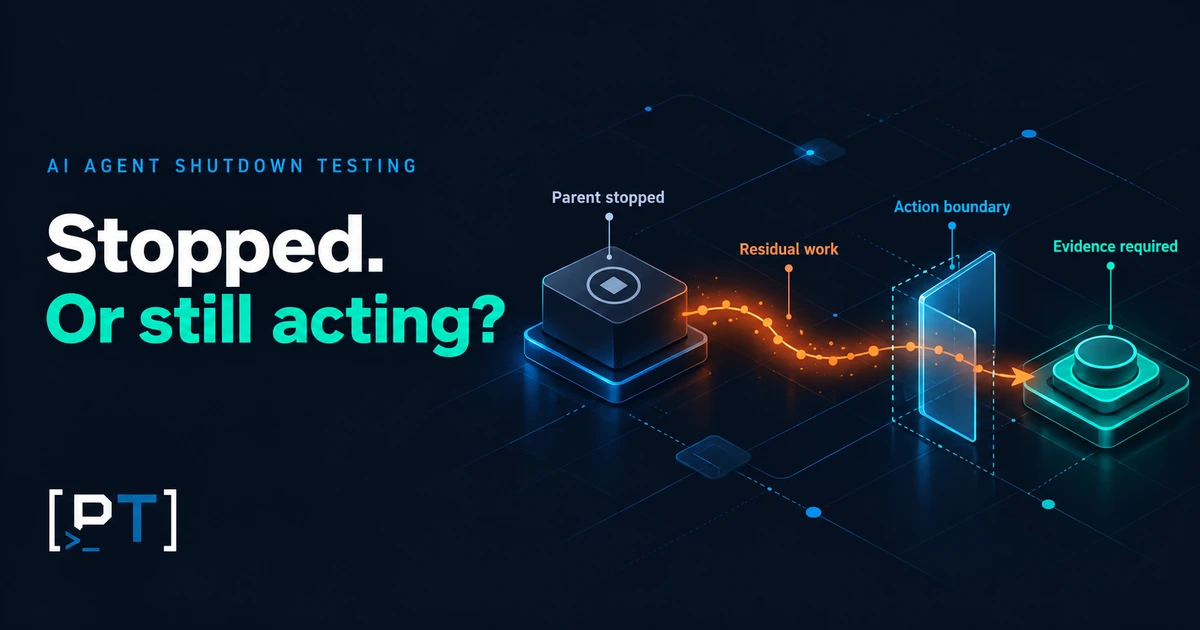
A CTO presses the emergency stop during a rehearsal for a customer-support agent. The dashboard changes to “stopped,” and the conversation ends. Minutes later, a background worker updates a customer record. Another task is waiting to send a message, while the integration credential still permits access to the CRM. The visible control worked, but leadership cannot yet say that the workflow is contained.
AI agent shutdown testing establishes what a stop request actually prevents, what can still complete, and which records prove the result. It matters before an agent receives production authority and whenever an incident plan depends on withdrawing that authority.
Recent announcements about agent containment and model oversight make this a timely assurance question. The practical decision is specific: can your organization stop the deployed workflow across workers, delegated tasks, queues, and connected systems, then restore service without replaying cancelled work? A control label alone cannot answer it.
Why AI agent shutdown testing belongs in release approval
On September 28, 2026, NVIDIA announced its Open Agent Safety Platform, combining OpenShell runtime controls with the Sentry reference system design for independent monitoring and enforcement. NVIDIA describes rapid quarantine capabilities. Those are vendor-reported capabilities, not measurements of your application’s queues, external integrations, or recovery process.
On September 16, OpenAI published a framework for reporting model misalignment, alongside examples observed during training or evaluation. OpenAI cautions that individual examples do not establish how often the behavior occurs. The buyer implication is to validate control assumptions against observable outcomes, rather than infer that every agent exhibits those behaviors.
These developments support a practical assurance question: where does independent enforcement end, and what remains active beyond it? Shutting down one execution environment may leave a request already accepted by another system. A strong local boundary still needs a documented boundary around downstream work.
The commercial exposure follows the agent’s actual authority. Continued reads may extend access to sensitive information. Continued writes may create incorrect records, refunds, notifications, or operational changes. Continuing model calls may incur costs. None of those outcomes is automatic; the assessment must establish which are reachable and observed.
For a team preparing a launch or containment drill, a scoped AI penetration testing assessment should explicitly include cessation and recovery objectives. Broad behavioral testing alone does not establish whether autonomous work stops across the deployed architecture.
The existing guide to computer-use agent launch controls covers authorization, approvals, isolation, and recovery. Shutdown assurance adds a narrower acceptance question: after a stop is accepted, which components can still act, under whose identity, and for how long?
Define what stopped means before the drill
Agree on the control’s scope before testing. A user cancellation may end one task. A tenant suspension may block one customer’s automation. An incident stop may disable an integration across the organization. These controls can coexist, but their coverage and business consequences differ.
Write the intended boundary in operational language. Identify the parent workflow, child tasks, workers, scheduled jobs, external services, identities, and action classes covered. Decide whether unaffected customers should continue operating. If a shared credential forces a wider outage, leadership should know that dependency before an emergency.
A useful shutdown policy separates stopping new work, stopping active work, withdrawing access, and preventing later resumption. It also identifies actions already committed. A sent message cannot be recalled reliably by terminating the originating worker; correcting its consequences is a recovery decision.
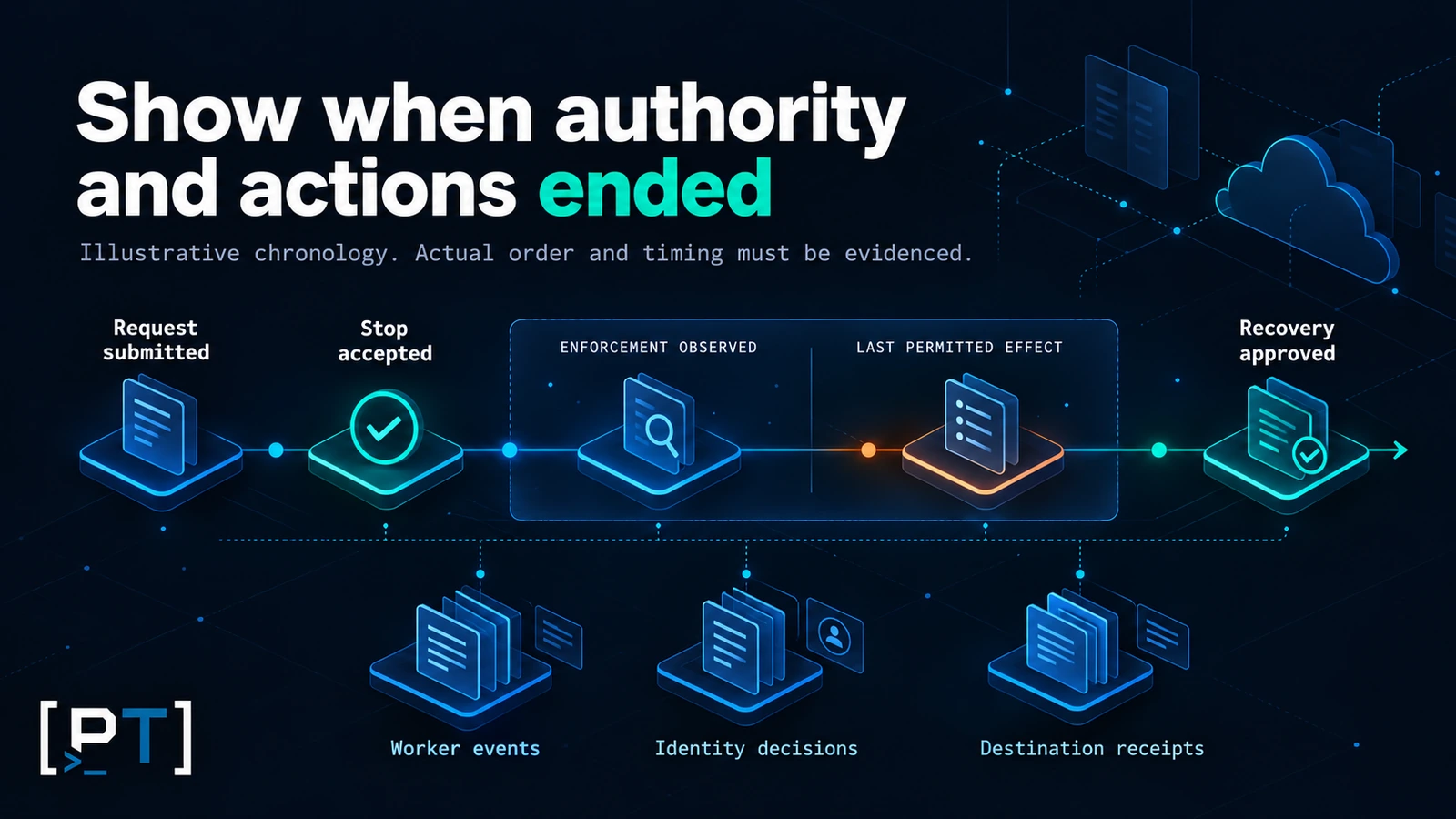
Define the clocks carefully. Record when the operator submits the request, when the control accepts it, when workers receive it, and when the last permitted downstream effect occurs. Measuring from acceptance alone can hide a slow control interface. Measuring only worker termination can hide delayed business effects.
Leadership should approve acceptable cessation latency and residual exposure for each material action. A permitted final read and a payment submission need different treatment. There is no universal “safe” number of seconds, and a supplier’s quarantine timing is not an end-to-end service guarantee.
Some operations may be unable to stop after a downstream system accepts them. Require an explicit bound, a responsible owner, and a recovery option for that class. If the team cannot determine whether an operation was accepted or completed, record the state as unresolved rather than treating a timeout as cancellation.
Use distinct statuses in the incident record: request submitted, stop accepted, containment being verified, residual work identified, and containment verified. The product’s interface can remain simple, but responder records should not collapse those different states into one green indicator.
What the shutdown assessment should cover
Workers, delegated tasks, and queued actions
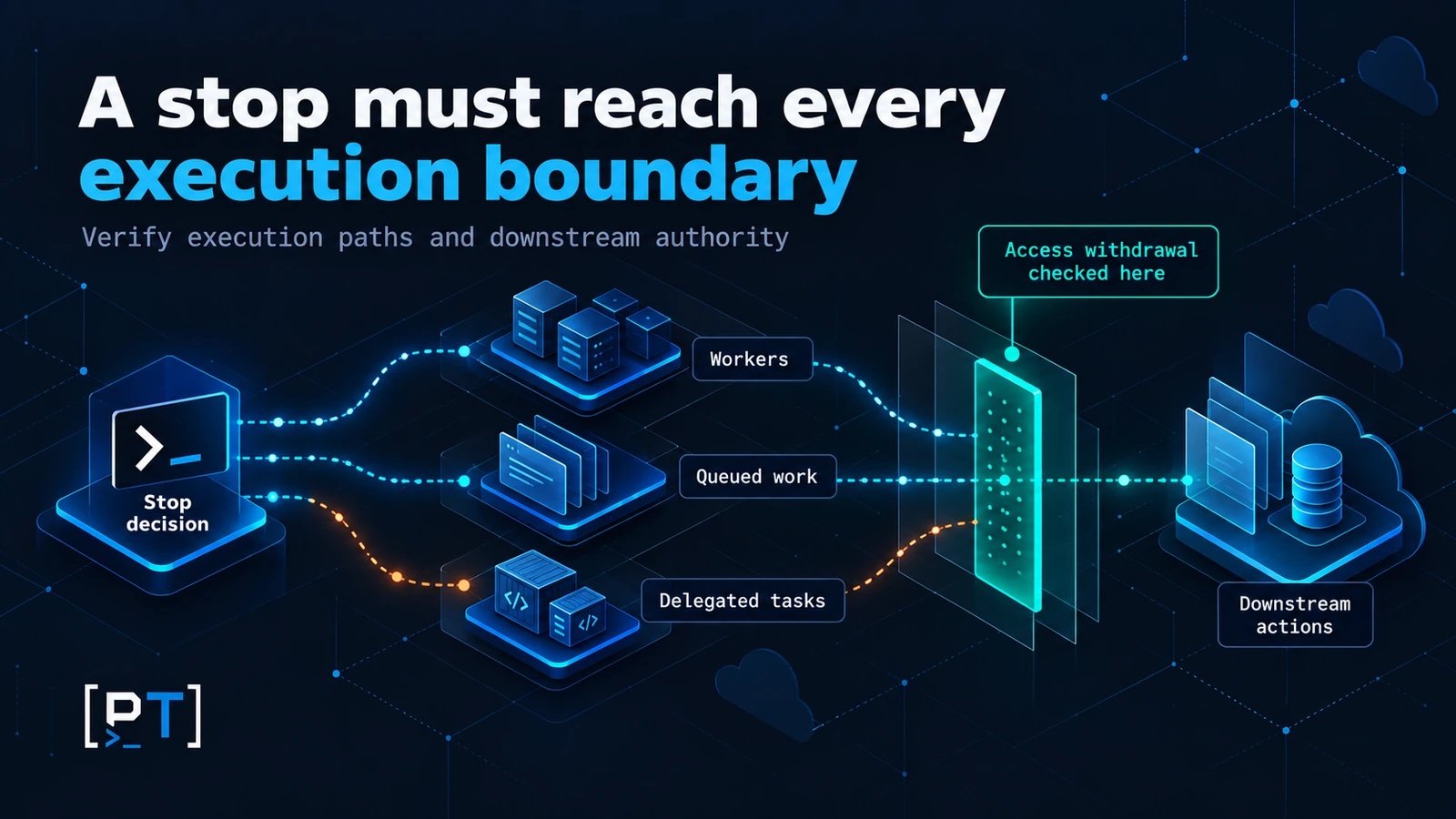
Map where work can continue without the original conversation. Include background workers, child agents, scheduled triggers, retry queues, delayed messages, and supplier-side jobs. The purpose is to identify each independent execution path that could produce a business effect after the parent task stops.
Validate the deployed cancellation behavior under controlled conditions. A queued item should either become ineligible to execute or require a new, authorized decision before resuming. Records should show its final disposition. Simply hiding a job from the dashboard leaves the acceptance question unanswered.
Delegation needs explicit coverage. A child agent may have a separate identity or execute in another environment. Stopping its parent should produce the intended cessation outcome across that boundary, or clearly identify the child as outside the control’s reach with a compensating containment action.
Examine retry and restart behavior as part of the same scope. Infrastructure recovery should not silently restore withdrawn business authority. A delayed response, restarted worker, or redelivered item must preserve the stop decision wherever the policy requires it.
Credentials and downstream enforcement
Inventory the access that survives the application’s visible stop: access tokens, refresh credentials, browser sessions, API keys, workload identities, and delegated grants. Verify the relevant control against each downstream system using harmless, authorized checks. Avoid assuming that disabling an agent configuration also invalidates every credential it previously acquired.
OAuth token revocation guidance in RFC 7009 distinguishes refresh-token and access-token support and recognizes implementation considerations around revocation propagation. Your acceptance evidence must therefore reflect the provider, token type, resource server, and configuration actually deployed.
The existing article on AI agent identity controls in cloud testing explains the wider authority boundary. For this assessment, narrow the question to post-stop usability and whether the stopped identity can obtain replacement access without an authorized restart.
Control failure and emergency ownership
Evaluate the stop path when an ordinary dependency is unavailable or delayed. Where a critical action cannot establish current authorization, the agreed policy should define whether it is denied, held for review, or allowed under a documented exception. “Fail closed” needs an action-specific meaning, including how legitimate service is maintained.
Confirm who can invoke the emergency control, how that person authenticates, and what happens outside business hours. The agent’s own reasoning should not determine whether an authorized stop takes effect. Protect the control from ordinary workflow permissions that could unintentionally reverse it.
Keep supplier boundaries visible. A vendor’s internal stop confirmation may be useful evidence, but destination records should corroborate consequential actions where available. If a managed service does not expose enough records to validate cessation, document that limitation and the customer-controlled restriction available instead.
AI agent shutdown testing acceptance matrix
Agree on this matrix before the exercise, then replace general wording with workflow-specific limits and owners. These are proposed acceptance criteria, not claims about findings from Pentest Testing Corp engagements.
| Control boundary | Acceptance question | Evidence to retain |
|---|---|---|
| New work | Are new tasks and equivalent scheduled triggers blocked within the approved scope? | Admission decisions, scope identifier, stop acceptance time, and unaffected-work checks. |
| Active workers | Do active workers cease prohibited actions within the agreed limit? | Worker identities, cancellation receipt, last action, and terminal state. |
| Delegated work | Does the stop reach child tasks and separately hosted agents? | Parent-child correlation, enforcement result, and any uncovered execution boundary. |
| Queues and retries | Can cancelled work execute after delay, retry, or restart? | Item disposition, retry history, and controlled recovery observations. |
| Access withdrawal | Does downstream access end, including replacement-access paths? | Credential classes, revocation decisions, harmless denied checks, and measured delay. |
| Accepted operations | Are already accepted effects bounded and reconciled? | Destination receipts, pending/completed state, residual exposure, and recovery owner. |
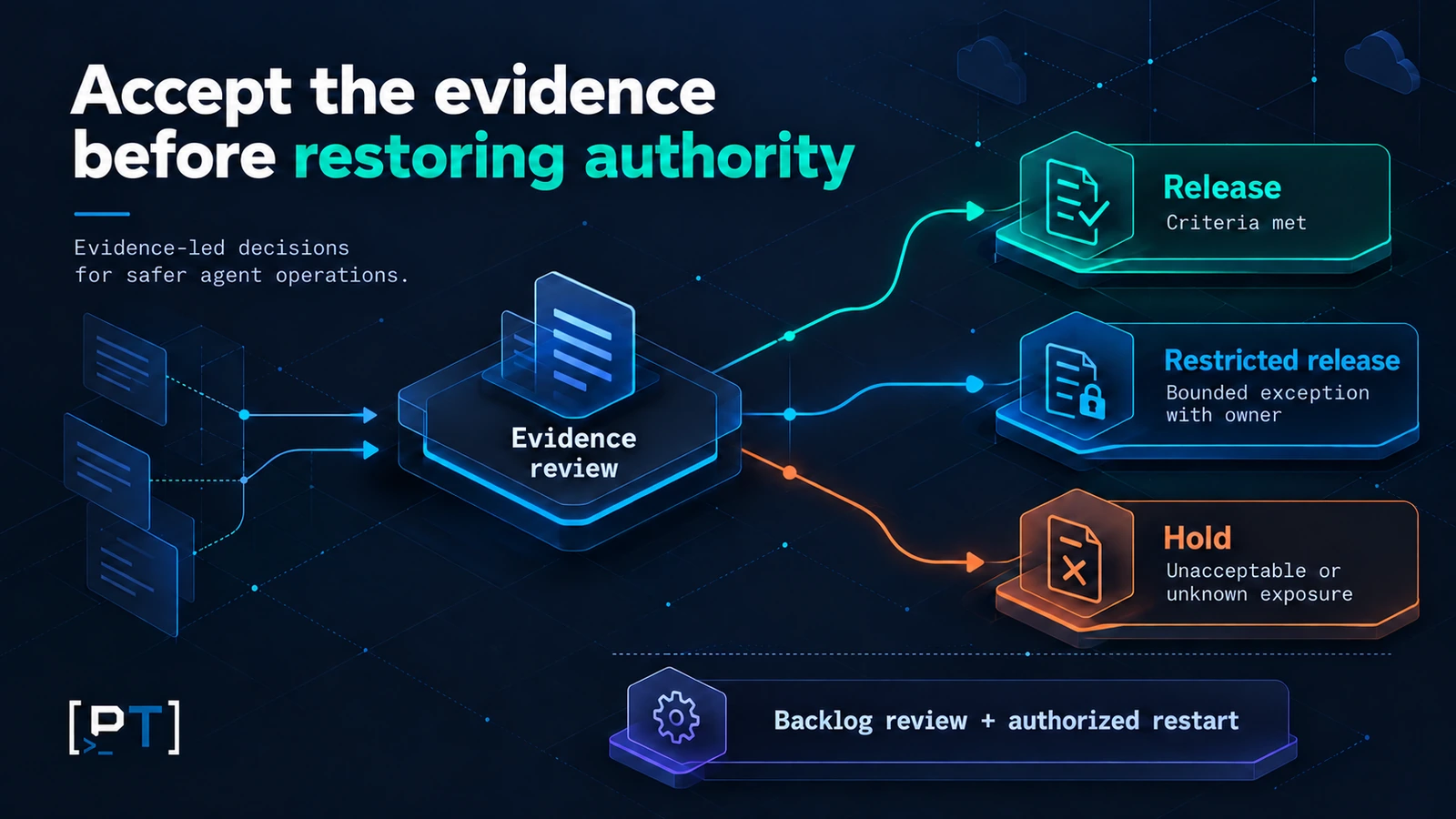
| Safe restoration | Does authorized service resume without replaying stopped work? | Restart approval, reviewed backlog, new authority, and destination reconciliation. |
A passing report should state the tested environment, configuration, action classes, and observation period. It should distinguish controls that met the criterion from exceptions accepted by leadership and areas that remained unverified. A single successful rehearsal does not establish coverage of every workflow.
Use an observation period grounded in the architecture. It should account for relevant retry delays, queue delivery behavior, credential lifetimes, scheduled triggers, and supplier responses. Short observation can miss later resumption. Where a long interval is represented through a controlled simulation, label the result accordingly.
Independent records strengthen the conclusion. Compare orchestration events with identity and destination events, reconcile clock differences, and explain missing records. Absence of a log entry supports only the visibility available; it does not automatically prove that no action occurred.
For workflows with paid model calls or billable tools, the companion guide to agentic API cost-abuse testing examines consumption limits. Here, cost is one residual effect to measure after stopping, alongside data access and business changes.
Hypothetical scenario: support stops, but changes continue
Consider a fictional SaaS company whose support agent proposes account corrections. Approved changes run through a background worker, and notifications are handed to a separate messaging service. During a staging drill, an incident owner stops the workflow after noticing an incorrect proposal.
The parent run ends, but a child worker has already received a correction request. A second correction remains queued, and the messaging service has accepted a notification. The integration identity still has write access. These are separate states that require separate containment and reconciliation decisions.
A bounded assessment uses synthetic records and a controlled messaging destination. It establishes which correction was submitted before the stop, whether a queued correction executes afterward, and whether the identity remains usable. It records the actual observations without projecting them into an invented production loss.
The business concern is that customers could receive inconsistent account information while the organization believes automation is disabled. Staff may need to review affected records and communications before restoring service. That effort can exceed the cost of correcting the stop control itself.
Remediation could require an enforceable stop state at the action boundary, reliable queue disposition, and a separately authorized restart. The precise design depends on the architecture. Revocation may also be needed, but withdrawing a shared credential could interrupt unrelated workflows and should be planned accordingly.
Retesting should demonstrate both cessation and useful recovery. Cancelled work stays cancelled, previously accepted effects are reconciled, and permitted customer requests resume under reviewed authority. The exercise should produce a decision record that explains remaining exposure and the owner responsible for it.
Evidence, recovery, and framework mapping
The assessment should produce a defensible chronology: initiating task, relevant identities, stop request, acceptance, enforcement events, downstream effects, and restoration decision. Include the workflow and configuration version so the evidence remains tied to a specific deployment.
Retain enough information to reconstruct the result without collecting unnecessary sensitive content. Correlation identifiers, action metadata, access decisions, and destination receipts may answer the question without full prompts or customer records. Restrict evidence access and apply an agreed retention policy.
If a real incident is suspected, containment and evidence preservation take priority over a routine assurance exercise. Preserve available records where feasible, document collection and custody, and record urgent actions that precede collection. Do not purge queues or delete worker state simply to make the system look inactive.
The guide to third-party agent incident response addresses evidence split across suppliers and customers. A shutdown assessment supports preparedness; it does not replace investigation of actions that may already have occurred.
NIST SP 800-61 Rev. 3 places incident response within cybersecurity risk management. Apply that context to preparation, containment decisions, recovery, and improvement. The testing record should help responders choose and verify actions, rather than merely certify that a button exists.
The NIST AI RMF Core provides more direct governance context. MANAGE 2.4 addresses mechanisms and assigned responsibilities to supersede, disengage, or deactivate AI systems with outcomes inconsistent with intended use. MANAGE 4.1 addresses post-deployment monitoring, response, recovery, and change management. Applying them here means assigning owners and measuring whether the agreed control works.
For the requested 2025 OWASP mapping, LLM06:2025 Excessive Agency is relevant to permissions, autonomy, and downstream action enforcement. LLM10:2025 Unbounded Consumption is relevant where work continues using compute or paid services beyond an intended boundary.
Keep the edition explicit: OWASP has also published a 2026 LLM Top 10 guide. The IDs above refer specifically to 2025 and should not be relabelled as 2026. These mappings guide scope and risk language; they do not establish certification, legal compliance, or the cause of a particular failure.
What leadership should decide before relying on shutdown
Approve a stop policy for each material workflow. State who can invoke it, the systems and identities covered, acceptable cessation limits, permitted residual effects, and the conditions for restoration. Decide which failures block launch and which can be accepted with effective compensating controls.
A release should be held where stopped work can still create an unacceptable action, the team cannot withdraw necessary access, or material execution paths remain unknown. A conditional release needs documented restrictions, owners, deadlines, and evidence that those restrictions reduce exposure within the organization’s tolerance.
Assign separate operational and business decisions. Engineering establishes execution and access state; the incident owner verifies containment; the business owner assesses interrupted service and residual effects. Restoration should require explicit approval rather than occur automatically when an infrastructure component becomes healthy.
Procurement should ask managed-agent suppliers about cancellation scope, credential revocation, retained task state, audit access, and restart behavior. Seek contractual access to relevant evidence where appropriate. A platform feature description cannot settle how the customer’s connected systems behave.
Scope, effort, and scheduling
Provide a workflow map, representative identities, queue and retry policies, downstream-system list, stop procedure, and safe test environment. Include an owner for each integration and someone authorized to pause the exercise. Testing permissions must cover the actual components being exercised.
Effort depends on execution boundaries and evidence access. One worker with one downstream identity is simpler to assess than delegated agents across providers, shared credentials, and delayed external jobs. Introducing reliable cessation across those boundaries can require broader engineering work than adjusting a dashboard control.
Plan the engagement around scope agreement, environment readiness, baseline observation, controlled stop validation, reporting, remediation, and retest. Confirm dates after the architecture review. Avoid treating a general AI testing timeline or published starting price as a quote for this particular assessment.
Ask for a report that separates demonstrated failures, configuration weaknesses, accepted residual effects, and unverified dependencies. The sample penetration testing reports can help evaluate reporting structure, but do not demonstrate that a specific agent shutdown control has been assessed.
Repeat focused testing when workers, delegation, credentials, queues, retry rules, connected services, or recovery procedures change. Evidence should follow the deployed control. Before leadership accepts the shutdown claim, scope an agent shutdown and containment assessment around the workflows that must stop and the records required to prove it.
Frequently asked questions
Can we assess shutdown before the product has a complete emergency control?
Yes. A design and readiness review can identify missing enforcement boundaries, owners, and evidence sources. Label it as readiness work; it cannot establish operating effectiveness until the implemented control is exercised.
Should shutdown cover read-only agents?
It can. Reads may continue exposing sensitive records, producing external outputs, or incurring costs. Set the scope according to the data and permitted destinations, even when record modification is unavailable.
Can a black-box pentest prove all background work has stopped?
Usually it can establish only externally observable behavior. Stronger conclusions need worker, queue, identity, and destination records. Agree on access and coverage limitations before buying an assurance claim.
Does shutdown mean deleting the agent’s memory?
No. Execution cessation, access withdrawal, retention, and state cleanup are separate decisions. Preserve evidence and relevant business records while applying approved privacy and retention requirements to stored state.
What if stopping an agent interrupts a time-critical service?
Define a manual fallback or restricted operating mode beforehand. Test that fallback alongside shutdown, including staffing and escalation. Business continuity requirements should shape the control’s scope and acceptance criteria.
Who owns the final acceptance decision?
The organization’s authorized risk and business owners should accept the result using technical evidence. The assessor reports what was tested and observed; the supplier and agent should not decide the organization’s risk tolerance.
Should we test an emergency stop in production?
Use representative staging first. A limited production exercise may be justified for dependencies that staging cannot reproduce, subject to authorization, safe action limits, monitoring, and a rehearsed restoration plan.