9 Powerful Webhook Security Patterns That Stop Breaches
Webhooks power modern SaaS integrations, CI/CD pipelines, payment events, and event-driven backends. They’re fast and convenient—but they also create a “trusted-by-default” entry point that attackers love: a public endpoint that triggers internal automation.
This guide breaks down a practical webhook threat model, the real-world risks we see in assessments, and webhook security best practices you can implement today—complete with reference code you can drop into production.

If you’re unsure whether your integrations are exposed, start by scanning your public surface for quick wins (headers, exposed files, misconfigurations) using our Free Website Vulnerability Scanner.
1) Threat model your webhooks (don’t assume “the vendor is secure”)
A good webhook threat model starts with one question:
“If anyone on the internet can hit this endpoint, what prevents damage?”
Common webhook threats:
- Replay attacks: attacker re-sends a valid webhook to re-trigger a refund, privilege change, CI deploy, etc.
- Signature bypass / verification mistakes: using parsed JSON instead of raw bytes, weak comparisons, missing timestamp checks.
- Untrusted payload injection: webhook content becomes a command, a template, a URL fetch, or a database write.
- Event spoofing: attacker fabricates “payment_succeeded” or “user_verified” style events.
- DoS & queue floods: uncontrolled inbound event volume.
- Forensics gaps: no correlation IDs, missing raw evidence, no durable logs.
When teams get breached through webhooks, it’s rarely “crypto broken.” It’s usually implementation shortcuts.
If you want a structured evaluation and prioritized fixes, consider a formal gap review via our Risk Assessment Services:
https://www.pentesttesting.com/risk-assessment-services/
2) Verify signatures correctly (raw body + constant-time compare)
Signature verification fails most often due to payload canonicalization:
- You verify the HMAC of
JSON.stringify(req.body)(wrong) - The provider signed the raw request bytes (right)
Node.js (Express): keep the raw body
import express from "express";
import crypto from "crypto";

const app = express();

// Capture raw body for HMAC verification
app.use(
  express.json({
    verify: (req, res, buf) => {
      req.rawBody = buf; // Buffer
    },
  })
);

function timingSafeEqual(a, b) {
  const ba = Buffer.from(a);
  const bb = Buffer.from(b);
  if (ba.length !== bb.length) return false;
  return crypto.timingSafeEqual(ba, bb);
}
HMAC verification (timestamp + raw bytes)
Recommended signing input: timestamp + "." + rawBody
function verifyWebhookSignature({ rawBody, timestamp, signature, secret }) {
  const msg = Buffer.concat([Buffer.from(`${timestamp}.`), rawBody]);
  const digest = crypto.createHmac("sha256", secret).update(msg).digest("hex");

  // Support common formats like: "sha256=<hex>"
  const sig = signature.startsWith("sha256=") ? signature.slice(7) : signature;

  return timingSafeEqual(digest, sig);
}
3) Stop replay attacks (timestamp windows + idempotency)
A signature alone doesn’t prevent replays. Two layers help most:
A) Timestamp window
function assertFreshTimestamp(tsHeader, maxSkewSeconds = 300) {
  const ts = Number(tsHeader);
  if (!Number.isFinite(ts)) throw new Error("Invalid timestamp");
  const now = Math.floor(Date.now() / 1000);
  if (Math.abs(now - ts) > maxSkewSeconds) throw new Error("Stale webhook");
}
B) Idempotency token (event ID) + durable store
Use a provider event ID header (or your own) and store it with TTL.
Redis example (Node.js):
import { createClient } from "redis";
const redis = createClient({ url: process.env.REDIS_URL });
await redis.connect();

async function assertIdempotent(eventId, ttlSeconds = 86400) {
  if (!eventId) throw new Error("Missing event id");
  const key = `webhook:seen:${eventId}`;
  const ok = await redis.set(key, "1", { NX: true, EX: ttlSeconds });
  if (ok !== "OK") throw new Error("Duplicate webhook (replay)");
}
Webhook security best practice: reject duplicates before triggering side effects.
4) Reference “secure receiver” route (Node.js end-to-end)
app.post("/webhooks/vendor", async (req, res) => {
  try {
    const signature = req.header("x-webhook-signature") || "";
    const timestamp = req.header("x-webhook-timestamp") || "";
    const eventId = req.header("x-webhook-id") || "";

    assertFreshTimestamp(timestamp, 300);
    await assertIdempotent(eventId, 86400);

    const secret = process.env.WEBHOOK_SIGNING_SECRET;
    if (!secret) throw new Error("Server misconfigured");

    const ok = verifyWebhookSignature({
      rawBody: req.rawBody,
      timestamp,
      signature,
      secret,
    });
    if (!ok) return res.status(401).json({ error: "Invalid signature" });

    // Now it’s “trusted enough” to parse and process
    const event = req.body;

    // Minimal allowlist pattern
    const allowedTypes = new Set(["build.completed", "invoice.paid", "user.updated"]);
    if (!allowedTypes.has(event.type)) return res.status(400).json({ error: "Unsupported event type" });

    // TODO: enqueue for async processing
    return res.status(200).json({ received: true });
  } catch (e) {
    return res.status(400).json({ error: e.message });
  }
});
5) Python (FastAPI) signature verification example
import hmac, hashlib, time
from fastapi import FastAPI, Header, Request, HTTPException

app = FastAPI()

def verify(ts: str, sig: str, raw: bytes, secret: str) -> bool:
    msg = f"{ts}.".encode() + raw
    digest = hmac.new(secret.encode(), msg, hashlib.sha256).hexdigest()
    if sig.startswith("sha256="):
        sig = sig[7:]
    return hmac.compare_digest(digest, sig)

@app.post("/webhooks/vendor")
async def webhook(
    request: Request,
    x_webhook_signature: str = Header(default=""),
    x_webhook_timestamp: str = Header(default=""),
):
    raw = await request.body()

    try:
        ts = int(x_webhook_timestamp)
    except Exception:
        raise HTTPException(400, "Invalid timestamp")

    now = int(time.time())
    if abs(now - ts) > 300:
        raise HTTPException(400, "Stale webhook")

    secret = "CHANGE_ME"  # load from env/secret manager
    if not verify(x_webhook_timestamp, x_webhook_signature, raw, secret):
        raise HTTPException(401, "Invalid signature")

    # Only now: parse JSON safely
    payload = await request.json()
    return {"received": True, "type": payload.get("type")}
6) Schema enforcement (block untrusted payload injection)
Treat webhook payloads as untrusted input even after verification. Attackers often:
- exploit downstream template rendering
- trigger internal URL fetches
- inject unexpected object shapes (“prototype pollution”-style issues in some stacks)
- exploit type confusion (“amount”: “999999999999”)
Node.js with JSON Schema (AJV)
import Ajv from "ajv";
const ajv = new Ajv({ allErrors: true, removeAdditional: "failing" });

const schema = {
  type: "object",
  additionalProperties: false,
  required: ["type", "id", "data"],
  properties: {
    type: { type: "string", maxLength: 64 },
    id: { type: "string", maxLength: 128 },
    data: {
      type: "object",
      additionalProperties: false,
      required: ["customerId"],
      properties: {
        customerId: { type: "string", maxLength: 64 },
      },
    },
  },
};

const validate = ajv.compile(schema);

function assertSchema(payload) {
  if (!validate(payload)) {
    const msg = ajv.errorsText(validate.errors);
    throw new Error(`Schema rejected: ${msg}`);
  }
}
Webhook verification + schema enforcement is one of the highest ROI webhook security best practices.
7) Network defenses: IP allowlists, mTLS, and rate limiting
Application checks are essential—but don’t leave your webhook endpoint naked at L4/L7.
Nginx IP allowlist (example pattern)
location /webhooks/vendor {
  allow 203.0.113.10;
  allow 203.0.113.11;
  deny all;

  proxy_pass http://app_upstream;
}
Nginx rate limiting (example pattern)
limit_req_zone $binary_remote_addr zone=webhooks:10m rate=10r/s;

location /webhooks/vendor {
  limit_req zone=webhooks burst=20 nodelay;
  proxy_pass http://app_upstream;
}
Mutual TLS (mTLS) termination (conceptual config)
server {
  listen 443 ssl;

  ssl_certificate     /etc/ssl/certs/server.crt;
  ssl_certificate_key /etc/ssl/private/server.key;

  ssl_client_certificate /etc/ssl/certs/vendor-ca.crt;
  ssl_verify_client on;

  location /webhooks/vendor {
    proxy_pass http://app_upstream;
  }
}
If you’re hardening after findings or want these controls done safely (without breaking integrations), use our Remediation Services:
https://www.pentesttesting.com/remediation-services/
8) Forensics-ready logging (evidence capture you’ll actually need)
When webhook abuse happens, you need to answer fast:
- Which event ID was replayed?
- From which IP / ASN / geo?
- What did the payload contain (and can you prove it)?
- Which internal actions did it trigger?
Log a cryptographic hash of the raw payload
Store raw payloads only if your compliance allows it. Otherwise, store:
- request ID
- event ID
- timestamp
- signature validity
- SHA-256 hash of raw body
- key ID (if you rotate secrets)
- minimal metadata (IP, UA)
import crypto from "crypto";

function sha256(buf) {
  return crypto.createHash("sha256").update(buf).digest("hex");
}

function logWebhookAttempt({ eventId, ok, rawBody, ip, ua }) {
  console.log(
    JSON.stringify({
      kind: "webhook_delivery",
      eventId,
      verified: ok,
      bodySha256: sha256(rawBody),
      sourceIp: ip,
      userAgent: ua,
      ts: new Date().toISOString(),
    })
  );
}
If you suspect webhook-driven compromise and need defensible investigation support, see:
https://www.pentesttesting.com/digital-forensic-analysis-services/
9) Post-incident tracing: how to follow a compromised delivery
Once you detect suspicious webhook activity, your immediate goals are:
- Contain: disable the signing secret, rotate keys, block abusive IPs, pause automation
- Prove scope: identify all events processed (including replays)
- Trace side effects: what internal jobs/actions did those events trigger?
Example SQL for tracing (conceptual)
-- Find all deliveries for an eventId
SELECT ts, source_ip, verified, body_sha256
FROM webhook_deliveries
WHERE event_id = :event_id
ORDER BY ts ASC;

-- Identify replays (same event_id multiple times)
SELECT event_id, COUNT(*) as hits
FROM webhook_deliveries
WHERE ts >= NOW() - INTERVAL '7 days'
GROUP BY event_id
HAVING COUNT(*) > 1
ORDER BY hits DESC;
A solid webhook incident workflow looks like:
- Pull deliveries by
event_id - Confirm signature behavior and timestamp skew
- Validate idempotency store behavior (was Redis down? TTL too short?)
- Trace queue jobs and outbound calls triggered by the event
- Decide whether you need a full DFIR timeline and endpoint review
Add external proofing with our free scanner
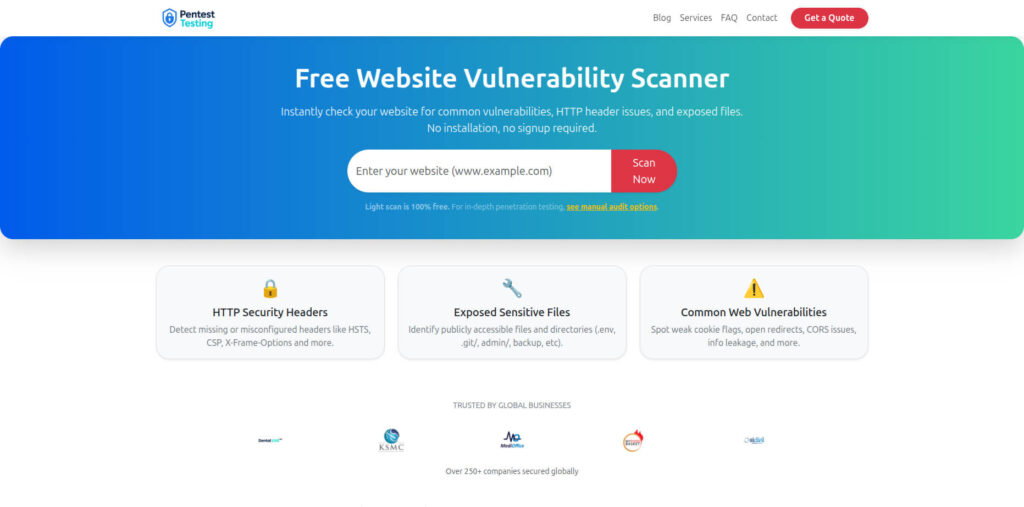
Our Free Website Vulnerability Scanner Dashboard (tool page)
Sample report to check Website Vulnerability (from the scanner)
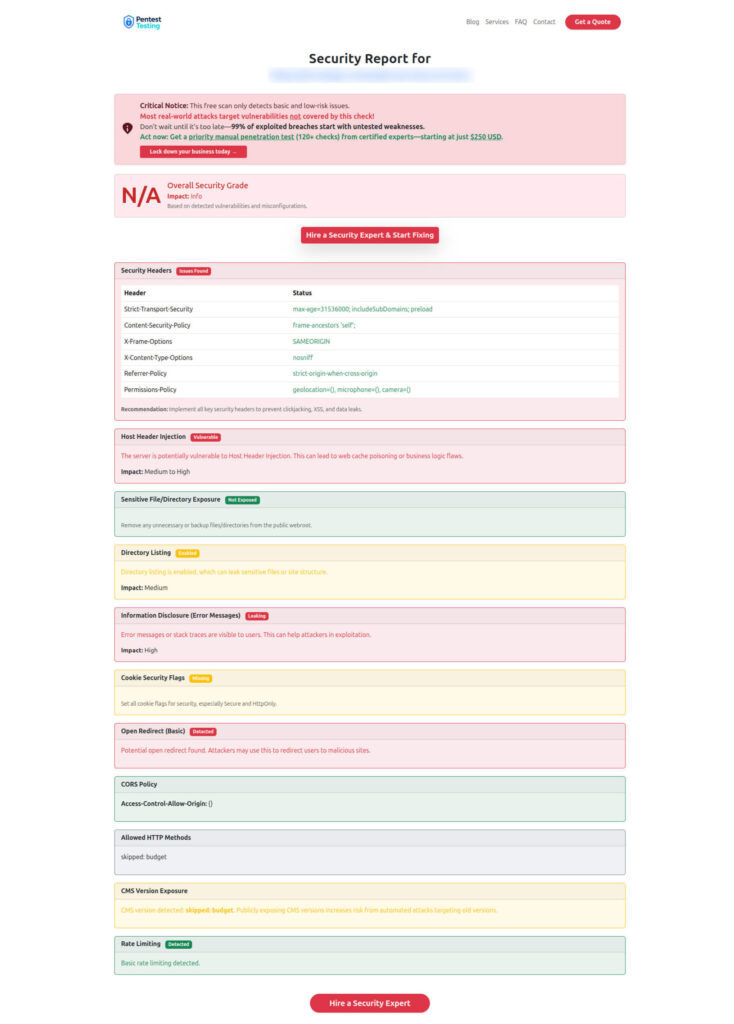
Tool page: https://free.pentesttesting.com/
Related recent reads from our blog
If you’re building a stronger detection + response posture around webhooks, these recent posts pair well with the controls above:
- https://www.pentesttesting.com/endpoint-deception-strategies/
- https://www.pentesttesting.com/forensic-readiness-smb-log-retention/
- https://www.pentesttesting.com/forensic-driven-security-hardening/
- https://www.pentesttesting.com/post-patch-forensics-playbook-2026/
Practical “this week” webhook security checklist
- Verify HMAC against raw request bytes
- Enforce timestamp window (±5 minutes)
- Implement idempotency (event ID + TTL in Redis/db)
- Schema-validate payloads (reject unknown fields)
- Allowlist event types and required state transitions
- Add rate limiting + (where possible) IP allowlisting or mTLS
- Log event ID, verification result, and body hash for forensics
- Run remediation after findings: https://www.pentesttesting.com/remediation-services/
🔐 Frequently Asked Questions (FAQs)
Find answers to commonly asked questions about Webhook Security Patterns.