30-Day Multi-Tenant SaaS Breach Containment Blueprint
If you run a B2B multi-tenant SaaS, you’re one sloppy access check away from a cross-tenant data leak—and a regulator-facing incident.
At Pentest Testing Corp, we see “tenant drift” all the time: apps that started life with clean tenant boundaries but slowly accumulated edge-cases, admin shortcuts, and legacy integrations across web, API, and cloud surfaces.
This guide gives you a 30-day multi-tenant SaaS breach containment sprint you can drop into your roadmap:
- Map where tenant boundaries actually live (not just in your architecture diagram).
- See how broken access control and IDOR become multi-tenant incidents.
- Run a Week-by-Week tenant isolation & RBAC hardening plan with code examples.
- Produce SOC 2 / ISO 27001 / HIPAA / GDPR–ready evidence that fits into your existing risk register and remediation flows.
Throughout the post, we’ll link to deeper fix-first playbooks from our Cybersecurity Insights & News hub.
Want an audit-friendly way to close actively exploited vulnerabilities fast? Use our CISA KEV remediation sprint playbook: https://www.pentesttesting.com/cisa-kev-remediation-sprint-in-30-days/
1. Map Where Tenant Boundaries Really Live
Most “multi-tenant SaaS breach containment” plans fail because they only look at the primary database. Real tenant boundaries live across:
- Primary relational DB (row-level
tenant_idororg_id). - Object storage (buckets, prefixes, folders).
- Search indexes (Elasticsearch, OpenSearch, Meilisearch).
- Analytics & BI (data warehouses, telemetry, dashboards).
- Logs & traces (central logging, SIEM, APM, error trackers).
- Caches & queues (Redis, message brokers, background jobs).
Your first job is to build a tenant boundary map that your engineers and auditors can both understand.
1.1 Model tenants explicitly in the database
Start with an honest data model:
-- tenants table
CREATE TABLE tenants (
    id           UUID PRIMARY KEY,
    slug         TEXT UNIQUE NOT NULL,
    name         TEXT NOT NULL,
    created_at   TIMESTAMPTZ NOT NULL DEFAULT now()
);

-- example multi-tenant table
CREATE TABLE accounts (
    id          UUID PRIMARY KEY,
    tenant_id   UUID NOT NULL REFERENCES tenants(id),
    email       CITEXT NOT NULL,
    role        TEXT NOT NULL,
    created_at  TIMESTAMPTZ NOT NULL DEFAULT now()
);

-- any table that contains customer data should be tenant-scoped
CREATE TABLE invoices (
    id          UUID PRIMARY KEY,
    tenant_id   UUID NOT NULL REFERENCES tenants(id),
    account_id  UUID NOT NULL REFERENCES accounts(id),
    amount_cents BIGINT NOT NULL,
    currency    TEXT NOT NULL,
    created_at  TIMESTAMPTZ NOT NULL DEFAULT now()
);
Now add PostgreSQL Row Level Security (RLS) to codify tenant isolation:
ALTER TABLE accounts ENABLE ROW LEVEL SECURITY;
ALTER TABLE invoices ENABLE ROW LEVEL SECURITY;

-- assume we set app.current_tenant_id per request
CREATE POLICY tenant_isolation_accounts ON accounts
  USING (tenant_id = current_setting('app.current_tenant_id')::uuid);

CREATE POLICY tenant_isolation_invoices ON invoices
  USING (tenant_id = current_setting('app.current_tenant_id')::uuid);
This pushes multi-tenant SaaS breach containment down into the data layer instead of relying on every query to “remember” the tenant_id filter.
1.2 Find tables that silently ignore tenants
Quick SQL to list tables in public that don’t have a tenant_id column:
SELECT t.table_name
FROM information_schema.tables t
WHERE t.table_schema = 'public'
  AND t.table_type = 'BASE TABLE'
  AND NOT EXISTS (
    SELECT 1
    FROM information_schema.columns c
    WHERE c.table_schema = t.table_schema
      AND c.table_name   = t.table_name
      AND c.column_name  = 'tenant_id'
)
ORDER BY t.table_name;
By the end of Week 1, you want a list of:
- Tenant-aware tables (with
tenant_id+ RLS). - Tenant-adjacent tables (logs, configs) where cross-tenant access is acceptable but must be explicitly justified.
- Tenant-ignored tables that need redesign or de-scoping.
2. How BAC & IDOR Become Cross-Tenant Breaches
Most real-world multi-tenant SaaS breaches we see are just Broken Access Control (BAC) and IDOR in a tenant context:
- “Global admin” endpoints that skip tenant checks.
- Per-object checks that trust user-supplied IDs.
- Background jobs that process cross-tenant data with no isolation.
2.1 Insecure vs secure tenant-scoped endpoint (Node.js / Express)
Insecure version (classic IDOR):
// GET /api/invoices/:invoiceId
app.get("/api/invoices/:invoiceId", async (req, res) => {
  const { invoiceId } = req.params;

  // ❌ no tenant or ownership check
  const invoice = await db("invoices").where({ id: invoiceId }).first();

  if (!invoice) return res.sendStatus(404);
  return res.json(invoice);
});
An attacker can enumerate invoiceId across tenants and exfiltrate data.
Secure version with tenant isolation + RBAC:
// tiny helper for authorization failures
class ForbiddenError extends Error {}

// central auth context from your JWT/session
function getAuthContext(req) {
  return {
    userId: req.user.sub,
    tenantId: req.user.tenant_id,
    roles: req.user.roles || []
  };
}

function requireRole(roles, needed) {
  if (!needed.length) return true;
  return needed.some((r) => roles.includes(r));
}

// GET /api/tenants/:tenantId/invoices/:invoiceId
app.get("/api/tenants/:tenantId/invoices/:invoiceId", async (req, res, next) => {
  try {
    const { tenantId, invoiceId } = req.params;
    const auth = getAuthContext(req);

    if (!auth.tenantId || auth.tenantId !== tenantId) {
      throw new ForbiddenError("Tenant mismatch");
    }

    const invoice = await db("invoices")
      .where({ id: invoiceId, tenant_id: tenantId })
      .first();

    if (!invoice) return res.sendStatus(404);

    // basic RBAC: only finance / admins can read invoices
    if (!requireRole(auth.roles, ["tenant_admin", "finance_read"])) {
      throw new ForbiddenError("Missing invoice read permission");
    }

    return res.json(invoice);
  } catch (err) {
    if (err instanceof ForbiddenError) return res.sendStatus(403);
    return next(err);
  }
});
Key ideas for multi-tenant SaaS security:
- Tenant in the URL + ROW filter:
tenant_idis both part of the route and the DB predicate. - RBAC sits on top of tenant isolation (never instead of it).
- Forbidden by default whenever the tenant or role context is missing.
3. 30-Day Multi-Tenant SaaS Breach Containment Sprint
Here’s the 30-day sprint we recommend to engineering/security leaders who need fast multi-tenant SaaS breach containment and tenant isolation hardening.
Week 1 (Days 1–7): Inventory trust boundaries & tenant mapping
Goal: one consistent, code-backed map of every place tenants live in your system.
- Create a
tenant_assets.yml
- id: db-main
  layer: "database"
  tech: "postgres"
  description: "Primary app database"
  tenant_boundary: "tenant_id + RLS"
  owner: "platform_team"

- id: s3-invoices
  layer: "object_storage"
  tech: "s3"
  description: "PDF invoice exports"
  tenant_boundary: "s3 key prefix 'tenants/{tenant_id}/...'"
  owner: "finops"

- id: es-logs
  layer: "search"
  tech: "opensearch"
  description: "Centralized log index"
  tenant_boundary: "mixed-tenant, controlled via Kibana RBAC"
owner: "observability_team"- Auto-discover references to
tenant_idin your codebase (Python helper)
import os, re, json

TENANT_PATTERNS = [
    re.compile(r"tenant_id"),
    re.compile(r"org_id"),
    re.compile(r"account_tenant"),
]

matches = []

for root, dirs, files in os.walk("."):
    dirs[:] = [d for d in dirs if d not in {".git", "node_modules", ".venv"}]
    for fname in files:
        if not fname.endswith((".js", ".ts", ".py", ".rb", ".go")):
            continue
        path = os.path.join(root, fname)
        try:
            text = open(path, encoding="utf-8").read()
        except Exception:
            continue
        for pat in TENANT_PATTERNS:
            for m in pat.finditer(text):
                matches.append(
                    {"file": path, "pattern": pat.pattern, "index": m.start()}
                )

print(json.dumps(matches, indent=2))- Join DB reality + code reality into one map and store it in Git as an auditable artifact—this is the start of your tenant isolation evidence pack.
When you’re done, you should know:
- Which services are tenant-aware.
- Which ones are pretending to be.
- Where multi-tenant SaaS breach containment is currently just a slide, not reality.
Week 2 (Days 8–14): Implement strict tenant scoping & RBAC
Goal: hard guarantees that every sensitive path includes tenant isolation + RBAC.
2.1 Enforce tenant context early in the request lifecycle
Example Express middleware:
function tenantGuard(req, res, next) {
  const auth = getAuthContext(req);

  if (!auth.tenantId) {
    return res.status(401).json({ error: "Missing tenant context" });
  }

  // pin tenant ID on request for downstream handlers
  req.tenantId = auth.tenantId;

  // optional: set Postgres app setting for RLS
  req.pgClient.query("SET app.current_tenant_id = $1", [auth.tenantId])
    .then(() => next())
    .catch(next);
}

// apply globally to API routes
app.use("/api", tenantGuard);
Now every handler can rely on req.tenantId and database RLS to support multi-tenant SaaS breach containment.
2.2 Normalize RBAC checks
Create a simple RBAC helper used everywhere:
const PERMISSIONS = {
  "invoices:read":   ["tenant_admin", "finance_read"],
  "invoices:write":  ["tenant_admin", "finance_admin"],
  "users:invite":    ["tenant_admin"],
};

function assertPermission(auth, permission) {
  const allowedRoles = PERMISSIONS[permission] || [];
  if (!allowedRoles.some((r) => auth.roles.includes(r))) {
    throw new ForbiddenError(`Missing permission: ${permission}`);
  }
}
Use it consistently:
app.post("/api/tenants/:tenantId/invoices", async (req, res, next) => {
  try {
    const auth = getAuthContext(req);
    if (auth.tenantId !== req.params.tenantId) {
      throw new ForbiddenError("Tenant mismatch");
    }
    assertPermission(auth, "invoices:write");

    const { amount_cents, currency } = req.body;
    const invoice = await db("invoices")
      .insert({
        tenant_id: auth.tenantId,
        amount_cents,
        currency,
      })
      .returning("*");

    res.status(201).json(invoice[0]);
  } catch (err) {
    if (err instanceof ForbiddenError) return res.sendStatus(403);
    next(err);
  }
});
By the end of Week 2, every sensitive endpoint should:
- Resolve tenant context from signed claims, not user input.
- Use a common RBAC helper (no one-off
if (role === 'admin')). - Delegate per-row isolation to RLS or equivalent data-layer guard wherever possible.
Week 3 (Days 15–21): Pentest tenant breakout paths & log decisions
Goal: systematically try to break tenant isolation and log each cross-tenant path as a formal risk.
3.1 Attack playbook: tenant breakout tests
Design test cases such as:
- Replace
tenantIdroute param with another tenant’s ID. - Swap resource IDs (
invoiceId,userId) across tenants. - Replay admin endpoints with regular user tokens.
- Abuse background jobs: can one tenant’s export include other tenants?
Simple Python harness to fuzz IDs:
import requests
from uuid import uuid4

API_BASE = "https://your-saas.example.com/api"
TOKENS = {
    "tenant_a_user": "Bearer ...",
    "tenant_b_user": "Bearer ...",
}

def get_invoice_ids(token):
    r = requests.get(f"{API_BASE}/invoices", headers={"Authorization": token})
    r.raise_for_status()
    return [inv["id"] for inv in r.json()]

def try_cross_tenant_read(attacker_token, victim_invoice_id, victim_tenant_id):
    r = requests.get(
        f"{API_BASE}/tenants/{victim_tenant_id}/invoices/{victim_invoice_id}",
        headers={"Authorization": attacker_token},
    )
    return r.status_code, r.text[:200]

tenant_a_invoice_ids = get_invoice_ids(TOKENS["tenant_a_user"])
victim_invoice = tenant_a_invoice_ids[0]

status, body = try_cross_tenant_read(
    TOKENS["tenant_b_user"],
    victim_invoice,
    victim_tenant_id="TENANT_A_UUID_HERE",
)

print("Cross-tenant read status:", status)
print("Body snippet:", body)
You want 403/404 everywhere, never a successful cross-tenant read.
3.2 Log each finding as a risk item
Feed every cross-tenant path into your risk register in a structured way. For example:
- id: MT-001
  asset: "Billing Service"
  description: "Invoice read endpoint allows cross-tenant access via IDOR."
  likelihood: 4
  impact: 5
  frameworks: ["SOC 2", "ISO 27001", "GDPR"]
  category: "Access Control"
  status: "Open"
  owner: "appsec_team"
Our post on 5 Proven Steps for a Risk Register Remediation Plan shows how to convert these risks into a sprint-ready remediation board with JSON/YAML and simple automation.
If you need help formalizing this into a compliant risk assessment, engage our Risk Assessment Services for HIPAA, PCI, SOC 2, ISO, and GDPR.
Week 4 (Days 22–30): Fix critical paths, retest, and package evidence
Goal: close the worst tenant isolation gaps, retest them, and assemble an evidence pack auditors will trust.
4.1 Prioritize the top 10–20 tenant isolation risks
Use a simple risk score:
def risk_score(likelihood, impact, regulator_weight=1.0):
    return likelihood * impact * regulator_weight

# tenant breakout in production SaaS → high score
score_breakout = risk_score(5, 5, regulator_weight=1.4)  # 35.0
This is the same approach we use in our risk-register remediation playbook and supply-chain attack surface sprint articles.
4.2 Capture before/after evidence for each fix
For each high-risk item:
- Screenshot or export of pre-fix failed tests (cross-tenant read/write).
- Code snippet or config showing the fix.
- Screenshot/log of post-fix successful 403/404 on cross-tenant attempts.
- Reference to any supporting pentest or scanner report.
A typical Pentest Testing Corp penetration testing report includes an executive summary, scope, methodology, a vulnerability matrix (with OWASP/CWE mapping), and detailed technical findings plus remediation steps—perfect to attach as evidence.
4.3 Package the “Tenant Isolation Evidence Pack”
Create a simple structure in your repo or evidence storage:
evidence/
  tenant-isolation/
    01-tenant-assets.yml
    02-rls-policies.sql
    03-api-authorization-diff.md
    04-cross-tenant-tests-before.json
    05-cross-tenant-tests-after.json
    06-risk-register-tenant-isolation.yml
    07-pentest-report-tenant-isolation.pdf
This becomes your multi-tenant SaaS breach containment dossier for SOC 2 / ISO 27001 / HIPAA / GDPR and even NIS2 incident-reporting timelines.
4. Use the Free Website Vulnerability Scanner as a Quick Win
Before you even start the 30-day sprint, you can grab a quick external view of your SaaS surface.
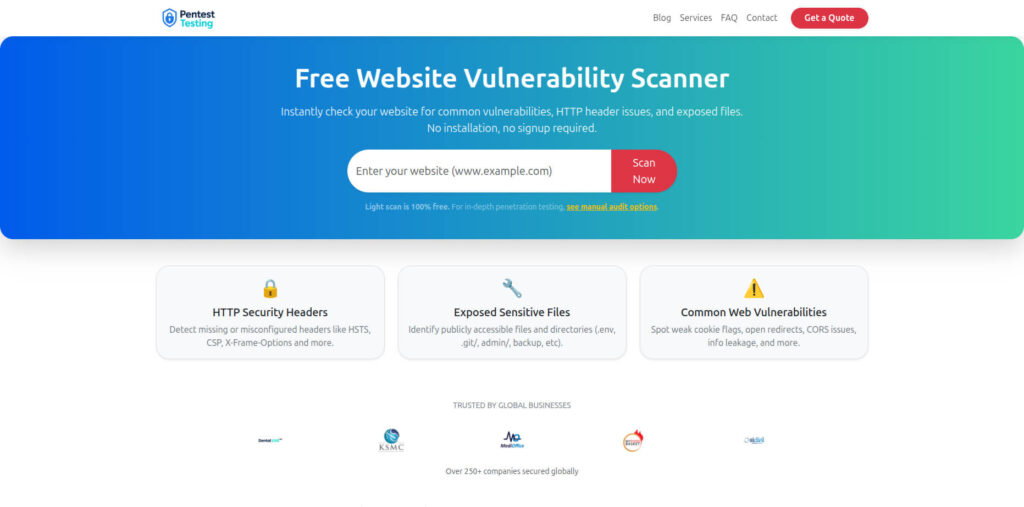
Our Website Vulnerability Scanner at free.pentesttesting.com gives you a fast snapshot of exposed web vulnerabilities—with no signup required—right from the homepage call-to-action.
Sample report screenshot from the tool to check Website Vulnerability:
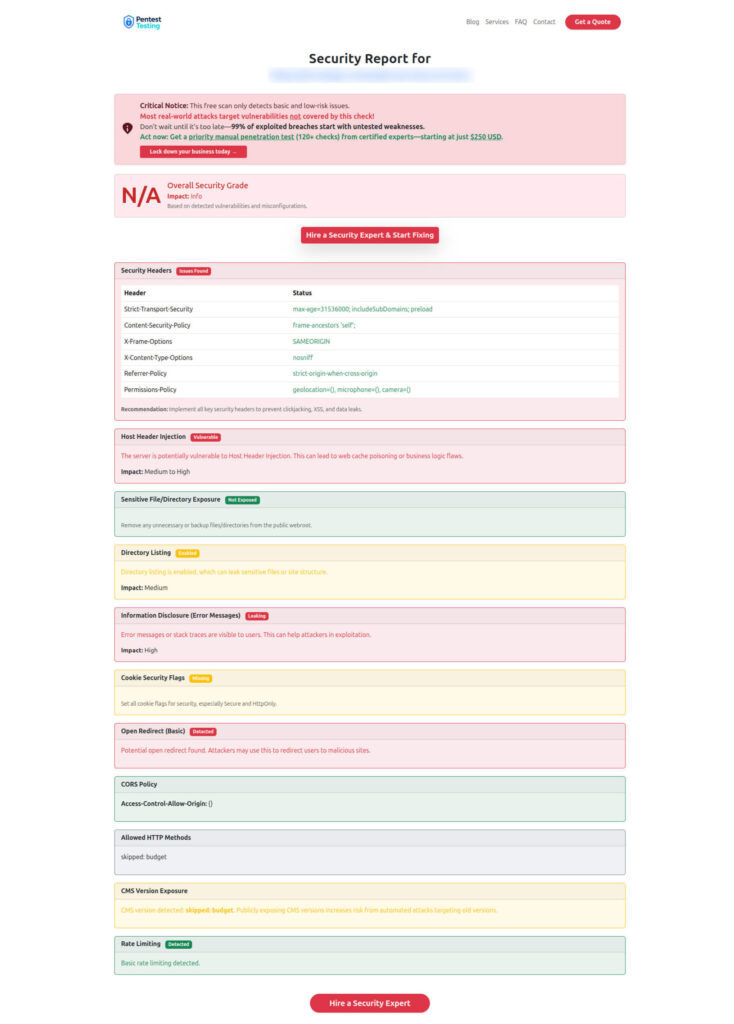
- How findings are grouped by severity (Critical/High/Medium/Low).
- How each issue includes a description, impact, and remediation guidance.
- How the report can be attached directly to your risk register and remediation board.
These visuals reinforce that your multi-tenant SaaS breach containment plan starts with real, testable evidence, not just theory.
5. Where Pentest Testing Corp Fits in Your Tenant Isolation Roadmap
Multi-tenant SaaS breach containment is not a one-off project. It plugs naturally into your existing pentest and compliance cadence:
- Targeted Web & API pentests
Use our Web Application Penetration Testing Services and API Pentest Testing Services to validate real exploitability of tenant isolation and RBAC flaws—not just discover them. - Cloud & infrastructure context
Multi-tenant SaaS often sits on shared cloud primitives. Our Cloud Pentest Testing helps ensure IAM, VPC design, and storage controls don’t quietly undermine tenant isolation at the infrastructure level. - Risk assessment & remediation sprints
Feed all cross-tenant risks into our Risk Assessment Services, then use our Remediation Services to execute a structured, fix-first plan with evidence your auditors will accept. - Ongoing PTaaS cadence
Once your 30-day tenant isolation sprint is complete, roll it into a recurring Pentest Testing as a Service (PTaaS) model so every new feature, migration, and acquisition is tested for tenant breakout risks on a continuous basis.
For additional context around risk-registers, supply-chain attack surface, NIS2 reporting, and AI governance, cross-link to these recent articles:
- EU AI Act SOC 2: 7 Proven Steps to AI Governance
- 5 Proven Steps for a Risk Register Remediation Plan
- 60-Day Sprint to Shrink Your Supply-Chain Attack Surface
- NIS2 Reporting Drill: 24h/72h/1-Month Proven Evidence Kit
They complement this multi-tenant SaaS breach containment blueprint with broader risk, supply-chain, and regulatory strategies.
🔐 Frequently Asked Questions (FAQs)
Find answers to commonly asked questions about Multi-Tenant SaaS Breach Containment & Tenant Isolation.