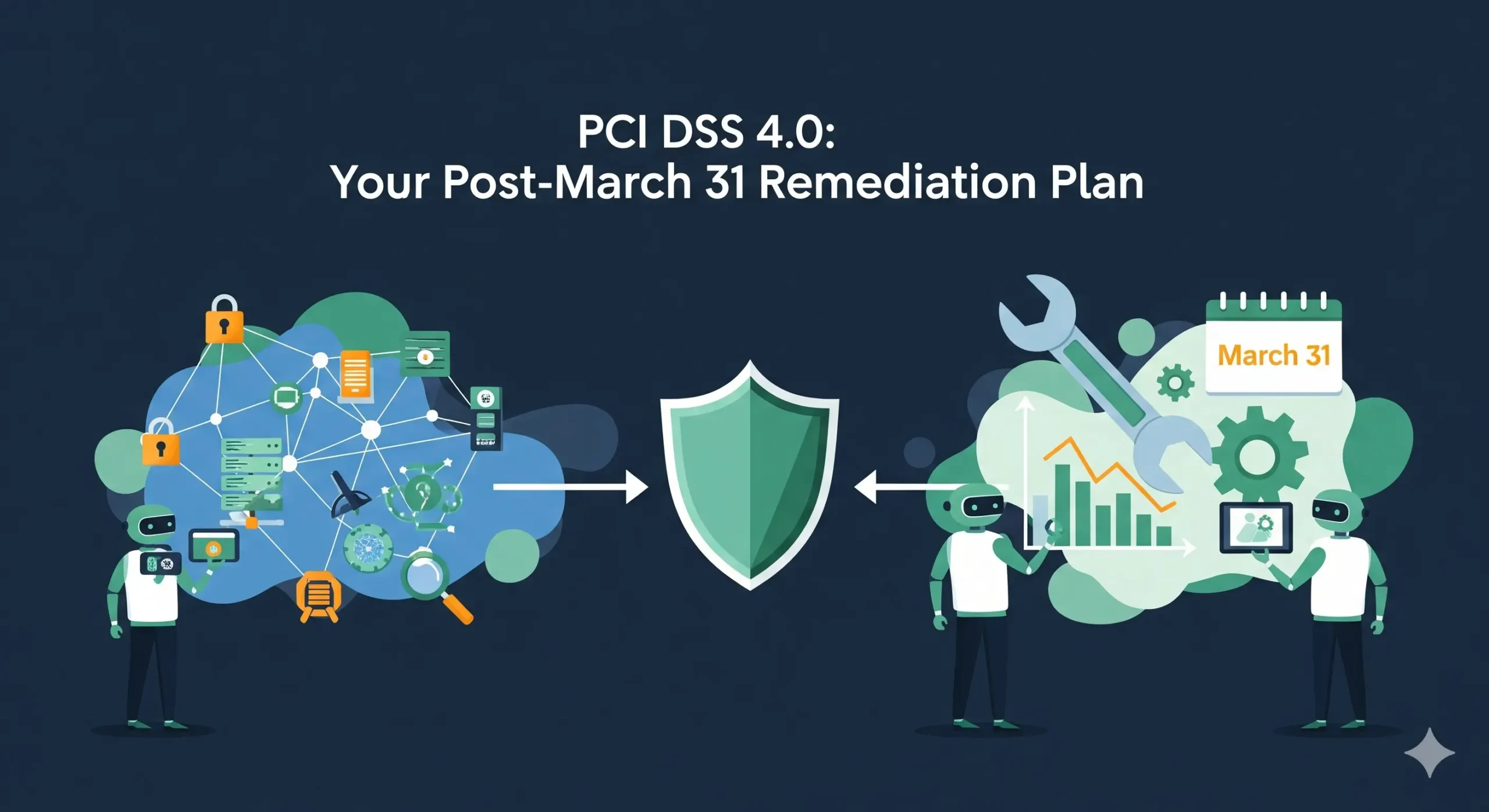
7 Powerful KEV-Driven Vulnerability Management Sprint
Most SMBs don’t fail vulnerability management because they “ignore CVSS.” They fail because everything looks urgent, and teams default to whichever ticket screams the loudest.
KEV-driven vulnerability management fixes that by anchoring your week to a simple rule:
If it’s known exploited, it goes first—then you prove it’s fixed.
This playbook gives you a practical, repeatable 7-day exploit-first fix sprint: ingest KEV → match to your asset inventory → patch/mitigate → validate → produce a proof pack leadership and auditors will actually trust.
If you want help turning this into an operating rhythm (plus evidence that stands up in audits), start here:
- Risk Assessment Services: https://www.pentesttesting.com/risk-assessment-services/
- Remediation Services: https://www.pentesttesting.com/remediation-services/
What KEV is (and what it isn’t)
KEV (Known Exploited Vulnerabilities) is not a “most severe vulnerabilities” list. It’s a “this is being exploited in the real world” signal.
In KEV-driven vulnerability management, you use KEV as your weekly prioritization backbone because it answers the question executives care about:
- “What can attackers actually use right now to get in?”
What KEV isn’t:
- Not a replacement for your broader vuln program (you still need coverage for non-KEV criticals).
- Not a guarantee of impact in your environment (your exposure depends on assets, configuration, and reachability).
- Not a reason to panic—KEV is a reason to operate.
The 7-day cadence: a weekly exploit-first fix sprint
Below is a cadence that works for SMB teams even when you’re wearing multiple hats.
Day 1 — Ingest KEV and normalize it
- Pull the latest KEV feed (JSON) and store it in a dated folder.
- Normalize vendors/products into your internal naming.
- Tag entries into buckets (edge/VPN, identity, internet-facing apps, dev platforms, endpoint software).
Day 2 — Match KEV to your asset inventory
- Compare KEV product identifiers to your asset inventory (CMDB, spreadsheet, EDR export—whatever is real).
- Mark assets as:
- Internet-facing
- Privileged / identity adjacent
- High blast radius (shared services, gateways, CI/CD)
- Produce a “KEV hit list” with owners and deadlines.
Day 3 — Fix the most exposed first
- Patch where possible.
- If patching isn’t immediate: mitigate (disable feature, restrict exposure, WAF rule, segmentation, temporary block/allow lists).
Day 4 — Validate (don’t assume)
- Verify versions/config and exposure are actually changed.
- Run targeted checks and lightweight verification scans.
Day 5 — Close the loop with tickets + evidence
- Update tickets with:
- Before/after proof
- Logs/screenshots
- Validation output
- Capture “what changed” in one place.
Day 6 — Exceptions (only if defensible)
- If you can’t patch, create a time-bound exception:
- Reason, compensating controls, review date
- Ownership + sign-off
Day 7 — Report and reset
- Produce a one-page sprint summary:
- Fixed / mitigated / accepted risk
- Remaining exposure
- Next sprint focus
That’s the operational heart of KEV-driven vulnerability management—short cycles, tight scope, proof by default.
“Exploit-first” SLA table (SMB-friendly)
Use this as your default SLA baseline. Adjust by business reality, but keep the ordering.
| Priority bucket | Typical scope | Fix/mitigate SLA | Validation SLA | Notes |
|---|---|---|---|---|
| P0: Internet-facing | Public apps, gateways, reverse proxies, exposed admin panels | 24–72 hours | 24 hours after change | Treat as “attack now” |
| P1: Identity + Privileged | SSO, federation, MFA flows, admin workstations, jump hosts | 72 hours | 48 hours | Identity failures become org-wide failures |
| P2: VPN/Edge/Internal Gateways | VPNs, firewalls, remote access appliances, internal proxies | 7 days | 72 hours | Often high impact + high reach |
| P3: Dev platforms | Git services, CI/CD, artifact registries, secrets tooling | 7–14 days | 7 days | Compromise turns into supply-chain risk |
| P4: Endpoints / user apps | Browsers, office suites, common agents | 14–30 days | 14 days | Use phased rollout + telemetry |
Want the exact patch order + verification checklist?
Follow our January 2026 Patch Tuesday “patch-first” map built for SMBs (includes PowerShell verification and evidence pack templates):
https://www.pentesttesting.com/january-2026-patch-tuesday-smb-patch-first/
Proof pack: the evidence auditors and leadership expect
Your proof pack should make one claim easy to verify:
“This KEV item applied to these assets, we fixed/mitigated it, and here’s how we know.”
Minimum proof pack items
- Scope: asset list affected (export/screenshot)
- Decision: why prioritized (KEV hit + exposure tag)
- Remediation: patch/mitigation record (ticket + change reference)
- Validation: version/exposure proof (commands + scan output)
- Exceptions: time-bound acceptance + compensating controls
Suggested folder structure
KEV-Sprint-Proof-Pack/
  2026-01-Week-03/
    00_KEV_Intake/
      kev_raw.json
      kev_normalized.json
    01_Asset_Match/
      inventory_snapshot.csv
      kev_hits.csv
    02_Tickets_and_Changes/
      tickets_export.csv
      change_notes.md
    03_Remediation_Proof/
      patch_logs/
      config_changes/
      screenshots/
    04_Validation/
      validation_output/
      verification_scans/
    05_Exceptions/
      exceptions.yaml
      exception_approvals/
    06_Integrity/
      sha256_manifest.txt
Quick win automation: KEV JSON ingest → tickets → exceptions
Below are copy/paste-ready building blocks to automate KEV-driven vulnerability management without buying a full platform on day one.
1) Ingest KEV JSON (store + diff)
Set KEV_FEED_URL to the official KEV JSON feed URL (keep it in a secret store if needed).
# kev_ingest.py
import os, json, hashlib
from datetime import datetime, timezone
import urllib.request

OUTDIR = os.getenv("OUTDIR", "KEV-Sprint-Proof-Pack/2026-01-Week-03/00_KEV_Intake")
FEED_URL = os.environ["KEV_FEED_URL"]  # set in env/CI secret

os.makedirs(OUTDIR, exist_ok=True)

def sha256_bytes(b: bytes) -> str:
    return hashlib.sha256(b).hexdigest()

raw_path = f"{OUTDIR}/kev_raw.json"
norm_path = f"{OUTDIR}/kev_normalized.json"
meta_path = f"{OUTDIR}/kev_meta.json"

raw = urllib.request.urlopen(FEED_URL, timeout=30).read()
raw_hash = sha256_bytes(raw)

with open(raw_path, "wb") as f:
    f.write(raw)

data = json.loads(raw.decode("utf-8", errors="replace"))

# Try common shapes safely (don’t break if schema evolves)
items = data.get("vulnerabilities") or data.get("items") or data.get("cves") or []
normalized = []
for v in items:
    normalized.append({
        "cve": v.get("cveID") or v.get("cve") or "UNKNOWN",
        "vendorProject": v.get("vendorProject") or v.get("vendor") or "",
        "product": v.get("product") or "",
        "shortDescription": v.get("shortDescription") or v.get("description") or "",
        "requiredAction": v.get("requiredAction") or "",
        "dueDate": v.get("dueDate") or "",
        "knownRansomwareCampaignUse": v.get("knownRansomwareCampaignUse") or "",
        "cpe": v.get("cpeName") or v.get("cpe") or "",
    })

with open(norm_path, "w", encoding="utf-8") as f:
    json.dump(normalized, f, indent=2)

meta = {
    "generated_at": datetime.now(timezone.utc).isoformat(),
    "raw_sha256": raw_hash,
    "count": len(normalized),
}
with open(meta_path, "w", encoding="utf-8") as f:
    json.dump(meta, f, indent=2)

print(f"Saved: {raw_path}, {norm_path} ({len(normalized)} items)")
2) Match KEV to your asset inventory (CSV → hit list)
Create inventory_snapshot.csv like:
asset_id,hostname,owner,env,internet_facing,product,version,notes
# kev_match_assets.py
import csv, json, re
from pathlib import Path

SPRINT_DIR = Path("KEV-Sprint-Proof-Pack/2026-01-Week-03")
KEV_NORM = SPRINT_DIR / "00_KEV_Intake/kev_normalized.json"
INV = SPRINT_DIR / "01_Asset_Match/inventory_snapshot.csv"
OUT = SPRINT_DIR / "01_Asset_Match/kev_hits.csv"

SPRINT_DIR.joinpath("01_Asset_Match").mkdir(parents=True, exist_ok=True)

kev = json.loads(KEV_NORM.read_text(encoding="utf-8"))
inventory = list(csv.DictReader(INV.open(newline="", encoding="utf-8")))

def norm(s: str) -> str:
    return re.sub(r"[^a-z0-9]+", " ", (s or "").lower()).strip()

hits = []
for asset in inventory:
    a_prod = norm(asset.get("product", ""))
    for k in kev:
        kp = norm(k.get("product", "")) + " " + norm(k.get("vendorProject", ""))
        # Simple but effective baseline matching; refine with your naming map over time
        if a_prod and (a_prod in kp or kp in a_prod):
            hits.append({
                "asset_id": asset.get("asset_id"),
                "hostname": asset.get("hostname"),
                "owner": asset.get("owner"),
                "env": asset.get("env"),
                "internet_facing": asset.get("internet_facing"),
                "product": asset.get("product"),
                "version": asset.get("version"),
                "cve": k.get("cve"),
                "dueDate": k.get("dueDate"),
                "requiredAction": k.get("requiredAction"),
            })

with OUT.open("w", newline="", encoding="utf-8") as f:
    w = csv.DictWriter(f, fieldnames=list(hits[0].keys()) if hits else [])
    if hits:
        w.writeheader()
        w.writerows(hits)

print(f"KEV hits: {len(hits)} → {OUT}")
Tip: As you mature, replace name-matching with a small mapping file (product_aliases.yaml) so your KEV-to-inventory match rate improves without manual work.
3) Auto-create tickets (generic REST pattern)
This snippet shows the pattern without locking you to one platform. Use it for Jira, ServiceNow, Azure DevOps, etc.
# create_tickets_generic.py
import os, csv, json
import urllib.request

HITS_CSV = "KEV-Sprint-Proof-Pack/2026-01-Week-03/01_Asset_Match/kev_hits.csv"
API_BASE = os.environ["TICKETING_API_BASE"]     # e.g., https://your-ticketing/api
API_TOKEN = os.environ["TICKETING_API_TOKEN"]   # store securely

def post(path: str, payload: dict):
    req = urllib.request.Request(
        API_BASE.rstrip("/") + "/" + path.lstrip("/"),
        data=json.dumps(payload).encode("utf-8"),
        headers={
            "Authorization": f"Bearer {API_TOKEN}",
            "Content-Type": "application/json",
        },
        method="POST",
    )
    with urllib.request.urlopen(req, timeout=30) as r:
        return json.loads(r.read().decode("utf-8", errors="replace"))

with open(HITS_CSV, newline="", encoding="utf-8") as f:
    rows = list(csv.DictReader(f))

for r in rows:
    priority = "P0" if (r.get("internet_facing","").lower() in ("true","yes","1")) else "P1"
    summary = f"[{priority}] KEV fix: {r['product']} on {r['hostname']} ({r['cve']})"
    payload = {
        "summary": summary,
        "description": (
            f"KEV-driven vulnerability management sprint item\n\n"
            f"Asset: {r['hostname']} ({r['asset_id']})\n"
            f"Owner: {r['owner']}\n"
            f"Environment: {r['env']}\n"
            f"Internet-facing: {r['internet_facing']}\n"
            f"CVE: {r['cve']}\n"
            f"Due: {r['dueDate']}\n"
            f"Action: {r['requiredAction']}\n"
        ),
        "labels": ["KEV", "Exploit-First", priority],
    }
    resp = post("/tickets", payload)  # adjust to your system route
    print("Created:", resp.get("id") or resp)
4) Exception workflow (time-bound + enforced)
Create exceptions.yaml (owned and reviewed):
# exceptions.yaml
- asset_id: "srv-0142"
  hostname: "legacy-app01"
  cve: "CVE-XXXX-YYYY"
  reason: "Vendor patch not available for this version"
  compensating_controls:
    - "Restrict to internal VLAN only"
    - "WAF rule enabled for affected endpoint"
    - "Enhanced auth logging + alerting"
  risk_owner: "IT Manager"
  approved_by: "Leadership"
  review_by: "2026-02-15"
Enforce it automatically:
# enforce_exceptions.py
import yaml
from datetime import datetime

EXC = "KEV-Sprint-Proof-Pack/2026-01-Week-03/05_Exceptions/exceptions.yaml"

with open(EXC, "r", encoding="utf-8") as f:
    items = yaml.safe_load(f) or []

today = datetime.utcnow().date()
expired = []
for e in items:
    review_by = datetime.strptime(e["review_by"], "%Y-%m-%d").date()
    if review_by < today:
        expired.append(e)

if expired:
    print("Expired exceptions (must review today):")
    for e in expired:
        print(f"- {e['hostname']} {e['cve']} (review_by {e['review_by']})")
    raise SystemExit(2)

print("OK: no expired exceptions")
5) Schedule it weekly (CI cron job)
Example scheduled job (adjust to your environment):
# .github/workflows/kev_sprint.yml
name: KEV Sprint Weekly
on:
  schedule:
    - cron: "0 3 * * 1"  # Mondays 03:00 UTC
jobs:
  kev:
    runs-on: ubuntu-latest
    steps:
      - uses: actions/checkout@v4
      - name: Run KEV ingest + match
        env:
          KEV_FEED_URL: ${{ secrets.KEV_FEED_URL }}
        run: |
          python3 kev_ingest.py
          python3 kev_match_assets.py
Validation: lightweight checks that prevent “we patched (probably)”
Validation is where KEV-driven vulnerability management becomes credible.
Quick exposure verification (port + service reachability)
# verify_reachability.sh (targeted + low-noise)
nmap -sV -Pn -p 80,443,22,3389,445 --reason --version-light -iL targets.txt -oN verification_nmap.txt
Evidence integrity (tamper-evident proof pack)
# run inside the sprint folder
find . -type f -not -path "./06_Integrity/*" -print0 | sort -z | xargs -0 sha256sum > 06_Integrity/sha256_manifest.txt
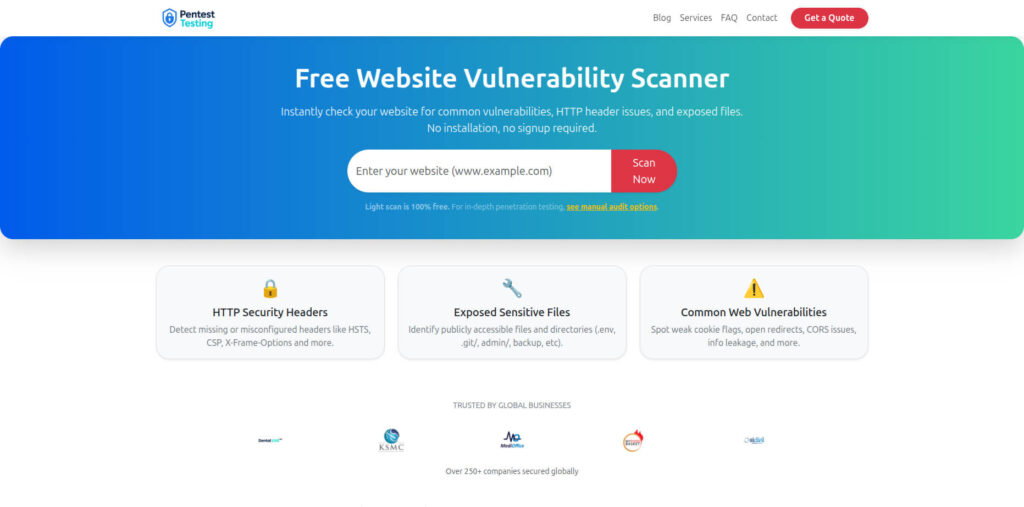
Add proof using our free security scanner
Use our free tool to add web-facing validation evidence to your sprint proof pack:
Free tool page: https://free.pentesttesting.com/
Pentest Testing Corp’s Free Website Vulnerability Scanner
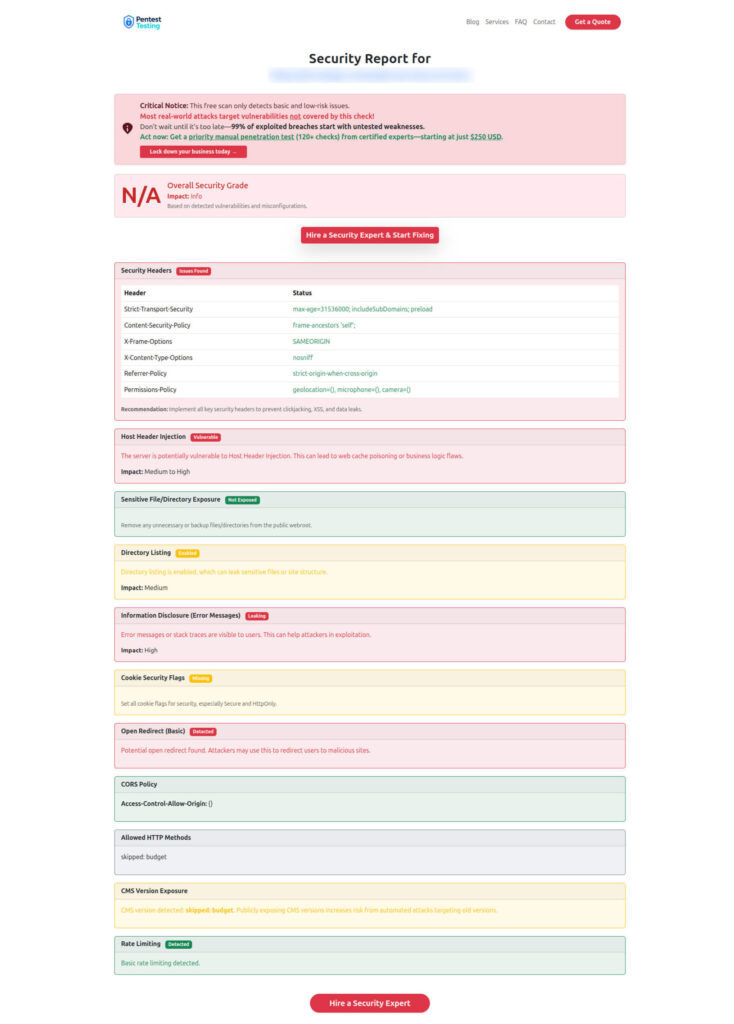
Example scan report output to check Website Vulnerability
Where Pentest Testing Corp helps (fast path to operational maturity)
If you want this workflow implemented end-to-end (inventory alignment, exploit-first SLAs, ticket automation, validation, and audit-ready reporting), these services map directly to the sprint:
- Risk Assessment Services: https://www.pentesttesting.com/risk-assessment-services/
- Remediation Services: https://www.pentesttesting.com/remediation-services/
And for ongoing insights and playbooks: https://www.pentesttesting.com/blog/
Related reading (recent posts from our blog)
Use these to reinforce your internal rollout and evidence practices:
- Patch proof and audit artifacts: https://www.pentesttesting.com/audit-ready-patch-evidence-pack/
- Replacing unpatchable/EOL gear safely: https://www.pentesttesting.com/eol-network-devices-replacement-playbook/
- Why scanning alone isn’t enough: https://www.pentesttesting.com/free-vulnerability-scanner-not-enough/
- Rapid response playbook example: https://www.pentesttesting.com/sonicwall-sma1000-zero-day-48-hour-plan/
- Another 48-hour patch workflow example: https://www.pentesttesting.com/webkit-zero-day-48-hour-patch-playbook/
Final takeaway
A clean weekly rhythm beats heroics. KEV-driven vulnerability management turns “too many vulnerabilities” into a predictable, auditable sprint—focused on what attackers are actually exploiting, and backed by proof.
🔐 Frequently Asked Questions (FAQs)
Find answers to commonly asked questions about the KEV-Driven Vulnerability Management Sprint.