7 Powerful CISA KEV Remediation Sprint in 30 Days
If you’ve ever had an auditor ask, “Show me how you remediate critical vulnerabilities,” you already know the trap: showing a scan report isn’t enough. Auditors want a repeatable vulnerability-to-remediation program—with clear ownership, prioritization logic, approvals, verification, and a trail of evidence that demonstrates controls are operating consistently.
That’s exactly what a CISA KEV remediation sprint gives you: a time-boxed workflow to eliminate actively exploited vulnerabilities first, reduce real-world exposure, and deliver an evidence pack that stands up to SOC 2, ISO 27001, HIPAA, and PCI DSS scrutiny.
This guide is a practical, week-by-week vulnerability remediation sprint you can run in 30 days, then repeat monthly without turning your team into a perpetual fire brigade. And if your stack includes common exposed services (GeoServer is a typical “real-world” example pattern), this cadence is the fastest way to turn “we’re aware” into “we closed it—with proof.”
New playbook: If you’re tracking KEV-listed edge device risks, don’t miss our Sierra Wireless AirLink ALEOS vulnerability response guide. It covers rapid scoping, management-plane isolation, segmentation patterns, patch vs replace decisions, and validation steps to prove closure.
https://www.pentesttesting.com/sierra-wireless-airlink-aleos-vulnerability/
Why “scan-and-forget” fails audits (and incident response)
“Scan-and-forget” isn’t a tooling problem. It’s a process problem.
How it fails audits
Auditors don’t just validate whether vulnerabilities exist—they evaluate whether your organization:
- identifies vulnerabilities consistently,
- prioritizes using a defensible method,
- remediates within defined timelines,
- validates remediation effectiveness,
- documents exceptions and compensating controls,
- and produces evidence reliably.
If findings aren’t tied to asset inventory, owners, approvals, and verification, the program looks ad-hoc—even if engineering does good work.
How it fails incident response
For actively exploited vulnerabilities, the “time between detection and closure” becomes a measurable exposure window. If you can’t show a systematic response tied to CISA KEV, you risk repeating the same pattern: awareness without closure.
A mature vulnerability-to-remediation program answers these questions every time:
- What assets are affected (inventory + exposure)?
- How do we prioritize (exploitability + business impact + compliance impact)?
- What did we change (patch/hardening/comp controls + approvals)?
- How did we validate (targeted retest/pentest verification)?
- What evidence proves the above (ticket trail + before/after proof)?
What makes a CISA KEV remediation sprint “auditor-acceptable”
A CISA KEV remediation sprint is not “patch everything.” It’s a disciplined workflow with:
- Time-boxing (30 days) to enforce urgency and closure.
- KEV-driven prioritization to focus on actively exploited vulnerabilities.
- Change control baked in (CAB/PR approvals and scheduled windows).
- Validation (targeted retest/pentest confirmation).
- Evidence packaging aligned to common audit narratives.
Think of it as a governance wrapper around technical remediation.
Sprint operating model (roles, RACI, and guardrails)
Before Week 1 starts, define these sprint roles (small teams can combine roles; just keep accountability clear):
- Sprint Captain (Security/Platform): runs the process, tracks blockers, owns evidence structure.
- System Owners: approve changes and downtime, accept residual risk.
- Engineering Assignees: implement patching/hardening/comp controls.
- Compliance Owner (SOC 2/ISO/HIPAA/PCI): ensures evidence maps to control expectations.
- QA/Release Manager (optional): ensures safe deployments and rollback plans.
Sprint guardrails (non-negotiable)
- “Closed” means validated, not “we think it’s patched.”
- Every high-priority item has a ticket, an owner, and a due date.
- Every change has approval (PR or CAB).
- Every closure has proof (before/after + retest output).
- Exceptions are documented with compensating controls and an expiration date.
These guardrails make your vulnerability remediation sprint repeatable and defensible.
For the organizational ownership model behind a full pentest report rather than a single KEV alert, see who owns the fix after a pentest, which maps these roles to a broader 30-day closure plan across product, engineering, cloud, and compliance.
Week 1 (Days 1–7): Scope + inventory (external attack surface + crown jewels)
Goal: build an inventory you can defend in an audit and use operationally in the sprint.
Week 1 outputs (deliverables)
- External attack surface inventory (domains, apps, APIs, exposed services)
- Crown jewels list (auth, billing, admin consoles, PHI/PII/PCI zones)
- Ownership mapping (system owner + engineering assignee)
- “In-scope” statement for the sprint (so you can show control boundaries)
Code example: inventory builder (CSV → JSON you can track)
# inventory_build.py
import csv, json
from datetime import datetime

REQUIRED = {"asset_id","hostname","owner","env","criticality","exposure"}  # exposure: internet/internal

def load_assets(path="assets.csv"):
    with open(path, newline="", encoding="utf-8") as f:
        rows = list(csv.DictReader(f))
    if not rows:
        raise ValueError("assets.csv has no rows")
    missing = REQUIRED - set(rows[0].keys())
    if missing:
        raise ValueError(f"Missing columns: {sorted(missing)}")
    return rows

assets = load_assets()
payload = {"generated_at": datetime.utcnow().isoformat() + "Z", "assets": assets}
with open("inventory.json","w",encoding="utf-8") as f:
    json.dump(payload,f,indent=2)
print(f"OK: inventory.json ({len(assets)} assets)")
Code example: crown-jewel tagging (keeps triage consistent)
# crown_jewels.py
import json

CROWN_HINTS = ["admin","auth","login","oauth","sso","billing","checkout","payment","patient","phi","pci","vault","secrets"]

inv = json.load(open("inventory.json","r",encoding="utf-8"))
for a in inv["assets"]:
    text = (a.get("hostname","") + " " + a.get("notes","")).lower()
    crit = a.get("criticality","").lower()
    a["is_crown_jewel"] = (crit in {"critical","high"}) or any(h in text for h in CROWN_HINTS)

json.dump(inv, open("inventory_tagged.json","w",encoding="utf-8"), indent=2)
print("OK: inventory_tagged.json")
Practical tip: scope by “exposure + impact”
A CISA KEV remediation sprint gets traction when you scope to:
- internet-exposed assets first,
- then crown jewels,
- then “everything else.”
That ordering is easier to justify to auditors and leadership because it’s risk-based.
Week 2 (Days 8–14): Triage by exploitability + business impact + compliance impact
Goal: transform raw scan output into an actionable, defensible backlog using CISA KEV as a primary driver for actively exploited vulnerabilities.
Triage logic that holds up under audit
Prioritize by:
- CISA KEV match (highest urgency)
- Exposure (internet > internal)
- Crown-jewel criticality
- Data/process impact (PHI/PCI/PII, revenue, authentication, admin)
This ensures your vulnerability remediation sprint focuses on “what can be exploited now” rather than “what looks scary on paper.”
Code example: KEV correlation + scoring
# kev_triage.py
import json, csv

def load_json(p): return json.load(open(p,"r",encoding="utf-8"))

def kev_index(kev):
    items = kev.get("vulnerabilities") or kev.get("catalog") or []
    out = {}
    for v in items:
        cve = (v.get("cveID") or v.get("cve") or "").strip().upper()
        if cve:
            out[cve] = v
    return out

inv = load_json("inventory_tagged.json")
assets = {a["asset_id"]: a for a in inv["assets"]}

kev = load_json("kev.json")  # keep internally mirrored in your environment
kidx = kev_index(kev)

rows = list(csv.DictReader(open("vulns.csv", newline="", encoding="utf-8")))  # asset_id,cve,severity,product

def score(r):
    a = assets.get(r["asset_id"], {})
    cve = r["cve"].strip().upper()

    kev_hit = 50 if cve in kidx else 0
    internet = 25 if a.get("exposure","").lower() == "internet" else 0
    crown = 15 if str(a.get("is_crown_jewel","")).lower() in {"true","1","yes"} else 0

    # keep the model explainable
    return min(100, kev_hit + internet + crown + 10)

for r in rows:
    r["is_cisa_kev"] = str(r["cve"].strip().upper() in kidx).lower()
    r["risk_score"] = score(r)

rows.sort(key=lambda x: int(x["risk_score"]), reverse=True)

with open("triage_backlog.csv","w",newline="",encoding="utf-8") as f:
    w = csv.DictWriter(f, fieldnames=rows[0].keys())
    w.writeheader(); w.writerows(rows)

print("OK: triage_backlog.csv")
Add compliance impact without “keyword stuffing”
Instead of trying to label every issue “SOC 2/ISO/HIPAA/PCI,” tag only when it’s relevant:
- touches regulated data,
- affects authentication/authorization,
- affects logging/integrity,
- affects perimeter boundaries.
This is how your vulnerability-to-remediation program becomes clear and credible.
Optional: backlog limit to avoid burnout
Set a sprint limit such as:
- Top 20 KEV items, plus
- Top 10 internet-exposed non-KEV criticals, plus
- “One strategic” item (e.g., eliminate an exposed legacy service).
That keeps the CISA KEV remediation sprint sustainable.
Week 3 (Days 15–21): Remediation plan (patch/hardening/comp controls) + change windows
Goal: implement remediation with safety and documentation, so the sprint produces a clean audit trail.
Week 3 outputs
- Remediation plan per prioritized item (patch path, fallback, owner, deadline)
- Change approvals (PR/CAB)
- Maintenance window schedule
- Compensating control decisions for anything that can’t be patched quickly
Code example: ticket exporter (triage backlog → importable CSV)
# ticket_export.py
import csv
from datetime import date, timedelta

IN = "triage_backlog.csv"
OUT = "tickets_import.csv"

with open(IN, newline="", encoding="utf-8") as f:
    rows = list(csv.DictReader(f))

fields = ["Summary","Description","Priority","Due date","Labels"]
out = []

due_kev = date.today() + timedelta(days=7)
due_non = date.today() + timedelta(days=14)

for r in rows[:50]:  # cap sprint load
    kev_flag = r.get("is_cisa_kev","false") == "true"
    summary = f"[KEV] {r['cve']} on {r['asset_id']}" if kev_flag else f"{r['cve']} on {r['asset_id']}"

    desc = (
        f"CVE: {r['cve']}\n"
        f"Asset: {r['asset_id']}\n"
        f"Product: {r.get('product','')}\n"
        f"Risk score: {r.get('risk_score','')}\n"
        f"CISA KEV: {kev_flag}\n\n"
        "Acceptance criteria (definition of done):\n"
        "- Fix applied (patch/hardening/compensating control)\n"
        "- Approval recorded (PR/CAB)\n"
        "- Targeted retest passed\n"
        "- Evidence attached (before/after + retest output)\n"
    )

    out.append({
        "Summary": summary,
        "Description": desc,
        "Priority": "Highest" if kev_flag else "High",
        "Due date": str(due_kev if kev_flag else due_non),
        "Labels": "cisa-kev,remediation-sprint" if kev_flag else "remediation-sprint"
    })

with open(OUT,"w",newline="",encoding="utf-8") as f:
    w = csv.DictWriter(f, fieldnames=fields)
    w.writeheader(); w.writerows(out)

print("OK:", OUT)
Code example: Ansible patch + evidence capture (before/after)
# ansible/patch.yml
- name: Patch + capture evidence (audit-friendly)
  hosts: targets
  become: true
  serial: 10
  tasks:
    - name: Before snapshot
      shell: "date -Is && uname -a && (dpkg -l || rpm -qa) | sha256sum"
      register: before_state
      changed_when: false

    - name: Apply updates (Debian)
      apt: { update_cache: yes, upgrade: dist }
      when: ansible_os_family == "Debian"

    - name: Apply updates (RedHat)
      yum: { name: "*", state: latest }
      when: ansible_os_family == "RedHat"

    - name: After snapshot
      shell: "date -Is && uname -a && (dpkg -l || rpm -qa) | sha256sum"
      register: after_state
      changed_when: false

    - name: Write evidence log
      copy:
        dest: "/var/log/kev-sprint-evidence.txt"
        content: |
          BEFORE:
          {{ before_state.stdout }}
          AFTER:
          {{ after_state.stdout }}
Hardening examples (compensating controls while patching)
Hardening is often the fastest risk reducer in a vulnerability remediation sprint, especially for exposed services.
Nginx baseline hardening (headers + TLS + rate limiting)
# nginx/security.conf
server_tokens off;

add_header X-Content-Type-Options nosniff always;
add_header X-Frame-Options DENY always;
add_header Referrer-Policy no-referrer always;

ssl_protocols TLSv1.2 TLSv1.3;
ssl_prefer_server_ciphers off;

limit_req_zone $binary_remote_addr zone=rl:10m rate=10r/s;

location / {
  limit_req zone=rl burst=20 nodelay;
}
Network ACL approach (example: only allow admin paths from VPN CIDR)
# Example (conceptual): restrict admin interface access
# Use your cloud firewall / security group / ingress controller equivalents
ALLOW_ADMIN_FROM="10.0.0.0/8"
DENY_ALL="0.0.0.0/0"

echo "Allow admin only from: $ALLOW_ADMIN_FROM"
echo "Deny admin from: $DENY_ALL"
These compensating controls help reduce exposure to actively exploited vulnerabilities while the full patch window is scheduled and approved—exactly the kind of decision auditors expect to see documented in a vulnerability-to-remediation program.
Week 4 (Days 22–30): Validation (targeted retest/pentest) + closure criteria + evidence pack
Goal: prove remediation effectiveness and package evidence consistently.
Closure criteria you should standardize
A KEV item is “Closed” only when:
- fix is deployed to all in-scope assets,
- targeted retest confirms the vulnerable condition is gone,
- ticket includes approvals and before/after proof,
- exception path is documented (if applicable),
- evidence is archived.
This makes your CISA KEV remediation sprint defensible and repeatable.
Code example: CI retest workflow (staging)
# .github/workflows/kev-retest.yml
name: KEV Targeted Retest

on:
  workflow_dispatch:
  schedule:
    - cron: "0 2 * * 1"  # weekly cadence

jobs:
  retest:
    runs-on: ubuntu-latest
    steps:
      - uses: actions/checkout@v4

      - name: Run targeted retest checks
        env:
          TARGET_BASE_URL: ${{ secrets.TARGET_BASE_URL }}
        run: |
          echo "Targeted retest against $TARGET_BASE_URL"
          ./scripts/targeted-retest.sh > retest-output.txt

      - name: Upload evidence artifact
        uses: actions/upload-artifact@v4
        with:
          name: kev-retest-evidence
          path: retest-output.txt
Code example: evidence pack builder (manifest + hashes)
# evidence_pack.py
import hashlib, json, os, zipfile
from datetime import datetime

EVIDENCE_DIR = "evidence"
OUT_ZIP = "KEV-Evidence-Pack.zip"

def sha256(path):
    h = hashlib.sha256()
    with open(path, "rb") as f:
        for chunk in iter(lambda: f.read(1024*1024), b""):
            h.update(chunk)
    return h.hexdigest()

files = []
for root, _, names in os.walk(EVIDENCE_DIR):
    for n in names:
        files.append(os.path.join(root, n))

manifest = {
    "generated_at": datetime.utcnow().isoformat() + "Z",
    "files": [{"path": f, "sha256": sha256(f)} for f in sorted(files)]
}

os.makedirs(EVIDENCE_DIR, exist_ok=True)
with open(os.path.join(EVIDENCE_DIR, "manifest.json"), "w", encoding="utf-8") as f:
    json.dump(manifest, f, indent=2)

with zipfile.ZipFile(OUT_ZIP, "w", compression=zipfile.ZIP_DEFLATED) as z:
    for f in sorted(files):
        z.write(f)
    z.write(os.path.join(EVIDENCE_DIR, "manifest.json"))

print(f"OK: {OUT_ZIP} ({len(files)} files + manifest)")
For internet-facing findings, a targeted external penetration retest is the independent validation auditors expect at closure.
Evidence pack structure auditors accept (copy/paste)
Use a consistent folder structure every month. That consistency is the hidden superpower of a vulnerability-to-remediation program.
/01-scope/inventory, crown jewels, in-scope statement/02-triage/KEV match list, scoring logic, prioritized backlog/03-tickets/ticket exports + owners + due dates/04-approvals/PR approvals, CAB approvals, maintenance windows/05-fix-proof/patch logs, config diffs, before/after scans/06-retest/targeted retest output, pentest verification summary/07-control-mapping/short mapping notes (SOC 2 / ISO / HIPAA / PCI)/08-exec-summary/leadership summary: risk reduced, residual risk, next sprint date
Code example: lightweight control-mapping file (keeps compliance sane)
# control-mapping.yml
items:
  - cve: CVE-XXXX-YYYY
    system: "customer-api"
    sprint: "2025-12"
    is_cisa_kev: true
    notes: "KEV prioritized; internet-exposed; crown jewel"
    evidence:
      - "03-tickets/JIRA-1234.pdf"
      - "04-approvals/PR-8891-approval.png"
      - "05-fix-proof/before-after-scan.png"
      - "06-retest/retest-output.txt"
How to operationalize monthly (without burnout)
A monthly CISA KEV remediation sprint works when you make it predictable:
Suggested monthly cadence
- Week 1: refresh inventory + update scope changes
- Week 2: KEV triage + backlog grooming
- Week 3: remediation + change windows
- Week 4: validation + evidence pack + exec summary
Keep metrics boring, visible, and consistent
Track:
- KEV items opened vs closed
- median time-to-triage (days)
- median time-to-fix (days)
- median time-to-validate (days)
Build a small “compensating controls library”
Examples you can reuse:
- admin interface restrictions (VPN-only)
- WAF/rate limits on high-risk endpoints
- temporary feature toggles to disable vulnerable modules
- improved logging and alerting around exploitation indicators
This keeps your vulnerability remediation sprint practical even when patch windows slip—without losing audit defensibility.
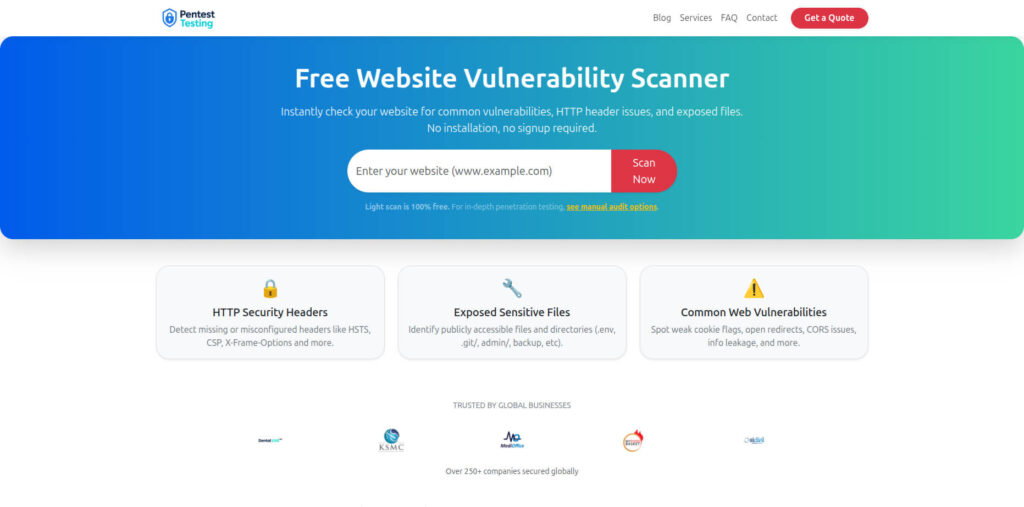
Quick win: use our free scanner for clean before/after evidence
Use our free tool to capture consistent baseline and post-fix evidence for your vulnerability remediation sprint, especially when you’re closing actively exploited vulnerabilities tied to CISA KEV.
Free Website Vulnerability Scanner page by Pentest Testing Corp
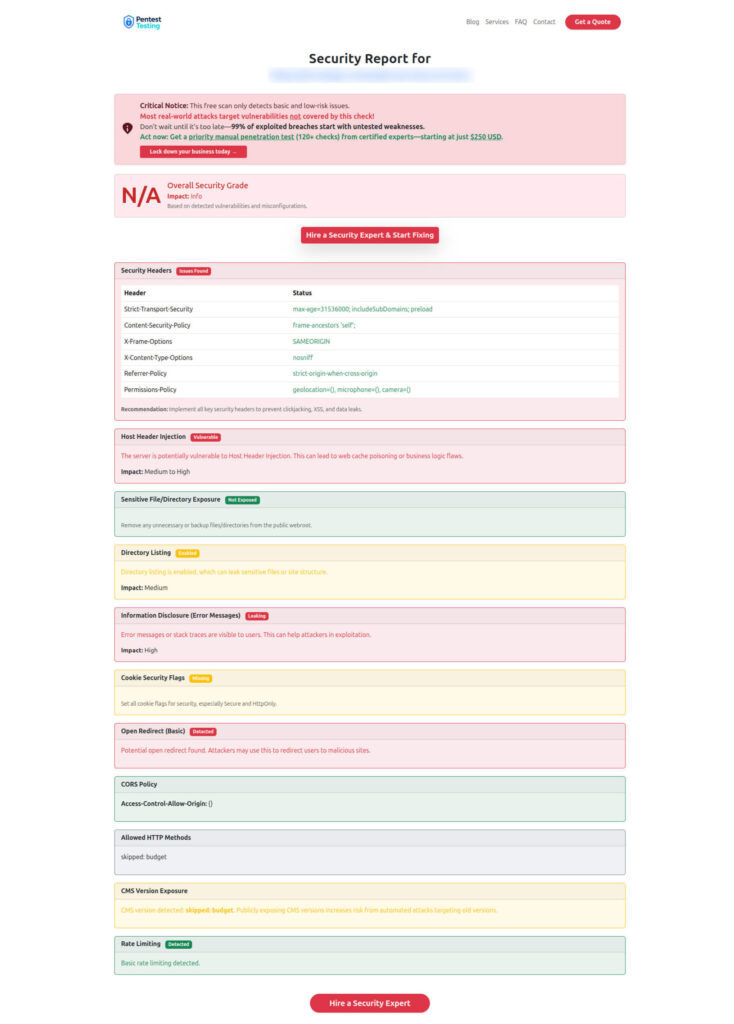
Sample report from our tool to check Website Vulnerability
Where Pentest Testing Corp helps (roadmap → fixes → proof)
If you want this sprint to be audit-ready from day one:
- Build your roadmap with Risk Assessment Services: https://www.pentesttesting.com/risk-assessment-services/
- Execute fixes with an accountable plan via Remediation Services: https://www.pentesttesting.com/remediation-services/
Related reading from our Playbook
- https://www.pentesttesting.com/compliance-risk-assessment-remediation/
- https://www.pentesttesting.com/risk-register-remediation-plan/
- https://www.pentesttesting.com/shrink-your-supply-chain-attack-surface/
- https://www.pentesttesting.com/ai-red-teaming-steps/
- https://www.pentesttesting.com/multi-tenant-saas-breach-containment/
🔐 Frequently Asked Questions (FAQs)
Find answers to commonly asked questions about the CISA KEV remediation sprint.