7 Powerful Fixes for Misconfigured Edge Devices
Attackers don’t need brand-new zero-days if your misconfigured edge devices already give them reachability, weak auth paths, and persistence at the perimeter. In incident reviews, the pattern is familiar: exposed management planes, legacy protocols left enabled, permissive ACLs/VPN policies, and missing logging—followed by weeks of undetected access.
This post turns that reality into a practical pentest + hardening sprint you can run in days: build an edge inventory, validate abuse paths, lock down configuration, and produce an audit-ready evidence pack.

Scope note: Everything below assumes authorized testing on assets you own/manage.
Apple WebKit Zero-Day in the Wild: 48-Hour Patch Plan (iOS/iPadOS/macOS/Safari)
A practical enterprise response guide for WebKit zero-day patching—prioritization, phased deployment, proof-of-patch verification, and audit-ready artifacts.
https://www.pentesttesting.com/webkit-zero-day-48-hour-patch-playbook/
Why misconfiguration beats zero-days for attackers
Zero-days are expensive and noisy. Misconfigured edge devices are cheap, repeatable, and often “sticky” (persistence via config changes, VPN users, route rules, or admin tokens). When the edge is weak, attackers can:
- land on exposed admin UIs or SSH,
- abuse default/legacy auth,
- pivot through VPN concentrators,
- blend in because edge telemetry is sparse or absent.
If you fix edge configuration hygiene, you reduce breach probability and improve your audit posture.
The sprint model (what you’ll deliver)
By the end, you should have:
- Edge inventory (routers, VPN gateways, remote admin planes, management appliances, cloud-hosted edge)
- Exposure + auth review results (what’s reachable, how it authenticates, what’s risky)
- Config pentest checklist results (hardening gaps + proof)
- Detection coverage for credential theft/replay indicators
- Secure baselines + change control artifacts
- Evidence pack (before/after configs, approvals, validation tests, monitoring screenshots)
Step 1: Build an “edge inventory” you can defend
Start with a single source of truth (CSV/YAML/CMDB export). Keep it simple but complete.
Inventory CSV template
asset_id,hostname,public_ip,mgmt_url,vendor_model,firmware,owner,env,criticality,exposure,notes
edge-001,gw-vpn-1,203.0.113.10,https://gw-vpn-1.example.com,F5,15.1,netops,prod,critical,internet,"VPN concentrator"
edge-002,fw-admin-1,198.51.100.20,https://fw-admin-1.example.com,FortiGate,7.2,secops,prod,high,internet,"Mgmt UI behind allowlist"
Convert CSV → JSON (for tracking + evidence)
# inventory_build.py
import csv, json
from datetime import datetime

REQUIRED = {"asset_id","hostname","owner","env","criticality","exposure"}

with open("edge_assets.csv", newline="", encoding="utf-8") as f:
    rows = list(csv.DictReader(f))

missing = REQUIRED - set(rows[0].keys())
if missing:
    raise SystemExit(f"Missing columns: {sorted(missing)}")

payload = {
    "generated_at": datetime.utcnow().isoformat() + "Z",
    "assets": rows
}
with open("edge_inventory.json", "w", encoding="utf-8") as f:
    json.dump(payload, f, indent=2)

print(f"OK: edge_inventory.json ({len(rows)} assets)")
Cloud-hosted edge discovery (AWS example)
# Internet-facing load balancers
aws elbv2 describe-load-balancers \
  --query 'LoadBalancers[?Scheme==`internet-facing`].[LoadBalancerName,DNSName,VpcId]' \
  --output table

# Public IPv4 instances (quick view)
aws ec2 describe-instances \
  --query 'Reservations[].Instances[?PublicIpAddress!=null].[InstanceId,PublicIpAddress,Tags[?Key==`Name`].Value|[0],VpcId]' \
  --output table

# Security groups exposing management ports (adjust ports to your policy)
aws ec2 describe-security-groups \
  --query "SecurityGroups[?IpPermissions[?FromPort==\`22\` || FromPort==\`443\` || FromPort==\`8443\`]].[GroupId,GroupName,VpcId]" \
  --output table
Step 2: External exposure + authentication review
Your goal: prove what’s reachable from the internet and how it authenticates.
Fast reachability scan (targeted ports)
# Replace TARGETS.txt with your public IPs / hostnames (one per line)
nmap -iL TARGETS.txt -sS -sV -Pn --open \
  -p 22,23,80,443,445,3389,5900,8000,8080,8443,9443,10443 \
  -oA edge-external-scan
Flag “management plane exposure” automatically
# flag_mgmt_exposure.py
import xml.etree.ElementTree as ET

MGMT_PORTS = {22,23,80,443,8080,8443,9443,10443,3389}

tree = ET.parse("edge-external-scan.xml")
root = tree.getroot()

for host in root.findall("host"):
    addr = host.find("address").attrib.get("addr")
    ports = host.find("ports")
    if ports is None:
        continue
    open_mgmt = []
    for p in ports.findall("port"):
        state = p.find("state").attrib.get("state")
        if state != "open":
            continue
        portid = int(p.attrib.get("portid"))
        if portid in MGMT_PORTS:
            svc = (p.find("service").attrib.get("name") if p.find("service") is not None else "unknown")
            open_mgmt.append((portid, svc))
    if open_mgmt:
        print(f"[MGMT EXPOSED] {addr}: {open_mgmt}")
Auth review checklist (quick hits)
- Is MFA enforced for all admin access paths (UI/SSH/VPN admin/API)?
- Are local accounts minimized, rotated, and monitored?
- Any legacy auth (basic auth, LDAP binds without TLS, weak RADIUS policy)?
- Is admin access device-bound (jump host/VPN) and IP-allowlisted?
- Are default services disabled (Telnet, SNMPv2c, HTTP)?
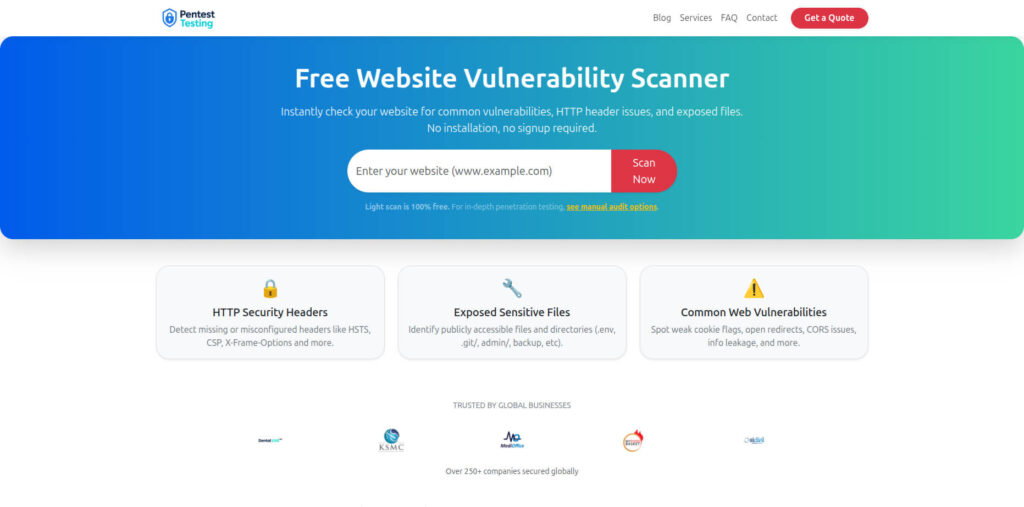
Free Website Vulnerability Scanner tool page from our free Security tool page
Step 3: Configuration pentest checklist (routers, VPN gateways, admin planes)
This is where misconfigured edge devices turn into incidents. Validate each control with evidence.
3.1 Management plane isolation (non-negotiable)
Target state: management is reachable only from a dedicated admin network (VPN/jump host), never “anywhere.”
Example: reverse-proxy allowlist for a management UI
# /etc/nginx/conf.d/mgmt-allowlist.conf
server {
  listen 443 ssl;
  server_name fw-admin.example.com;

  # Only allow from VPN / admin jump ranges
  allow 10.10.0.0/16;
  allow 192.168.50.0/24;
  deny all;

  location / {
    proxy_pass https://EDGE_MGMT_UPSTREAM;
    proxy_set_header Host $host;
    proxy_set_header X-Forwarded-For $remote_addr;
  }
}
3.2 “No legacy” services baseline (example policy)
- Disable Telnet, FTP, HTTP
- Enforce SSH v2 only
- Prefer SNMPv3; disable community strings
- Block admin ports at perimeter unless explicitly required
3.3 VPN policy hardening (stop lateral movement)
- Restrict VPN users/groups to least privilege routes
- Disable split-tunnel where it increases risk (or control tightly)
- Enforce device posture checks where supported
- Short session lifetimes + re-auth for admin functions
3.4 Automated config backup (proof + drift detection)
# backup_edge_configs.py (Netmiko)
from netmiko import ConnectHandler
from datetime import datetime
import pathlib, json

DEVICES = json.load(open("devices.json", "r", encoding="utf-8"))
outdir = pathlib.Path("backups") / datetime.utcnow().strftime("%Y%m%d")
outdir.mkdir(parents=True, exist_ok=True)

for d in DEVICES:
    conn = ConnectHandler(**d)
    hostname = conn.find_prompt().strip("#>")
    cfg = conn.send_command("show running-config")
    (outdir / f"{hostname}.cfg").write_text(cfg, encoding="utf-8")
    conn.disconnect()
    print(f"Saved {hostname}")
devices.json example (store secrets securely in practice):
[
  {"device_type":"cisco_ios","host":"10.10.10.5","username":"netops","password":"REDACTED"},
  {"device_type":"cisco_ios","host":"10.10.10.6","username":"netops","password":"REDACTED"}
]
Config drift with Git
git init
git add backups/
git commit -m "Baseline edge configs"
# Later:
git diff HEAD -- backups/
Step 4: Credential theft & replay detection (what to alert on)
For misconfigured edge devices, attackers often use valid creds/tokens. Detection must focus on behavior, not signatures.
Alert ideas that work in real environments
- New admin session from unseen ASN / country
- Successful login after multiple failures
- Config export/backup download attempts
- New VPN user/group assignment
- New route/ACL/NAT rule added outside change window
- Management UI accessed without jump host headers or VPN source ranges
Example: Splunk SPL (generic)
index=edge_logs action=login result=success
| stats earliest(_time) as first_seen latest(_time) as last_seen by user src_ip
| where first_seen > relative_time(now(), "-7d")
Example: Microsoft Sentinel KQL (generic)
EdgeLogs
| where EventType == "AdminLogin" and Result == "Success"
| summarize count(), dcount(SourceIP) by User, bin(TimeGenerated, 1h)
| where dcount_SourceIP > 3
Step 5: Secure baseline + change control (so fixes stick)
Hardening that isn’t governed becomes “temporary.” Make baselines enforceable:
Golden config approach (simple + effective)
- Store templates per device class (router/VPN/WAF)
- Require PR/CAB approval for any change
- Document break-glass access and rotate credentials after use
- Schedule monthly validation scans against management plane exposure
Evidence-friendly change record (YAML)
change_id: CHG-2025-EDGE-0142
assets:
  - edge-001
controls:
  - mgmt_plane_isolation
  - disable_legacy_protocols
  - vpn_policy_least_privilege
approvals:
  - name: System Owner
    date: 2025-12-28
validation:
  - nmap_external_scan: edge-external-scan.xml
  - config_backup: backups/20251228/gw-vpn-1.cfg
  - monitoring_screenshot: evidence/siem-alerts.png
Step 6: Evidence pack for audits (inventory → before/after → validation)
Auditors and leadership want proof that controls operate consistently. Package it once; reuse forever.
Evidence pack structure (copy/paste)
evidence-pack/
  01-inventory/
    edge_inventory.json
    ownership-map.csv
  02-exposure/
    edge-external-scan.xml
    edge-external-scan.nmap
  03-configs/
    before/
    after/
    diffs/
  04-change-control/
    CHG-*.yaml
    approvals/
  05-validation/
    retest-notes.md
    screenshots/
  06-monitoring/
    siem-queries.txt
    alert-screenshots/
  manifest.txt
  manifest.sha256
Generate a hash manifest (tamper-evident)
cd evidence-pack
find . -type f -not -name "manifest.*" -print0 | sort -z | xargs -0 sha256sum > manifest.sha256
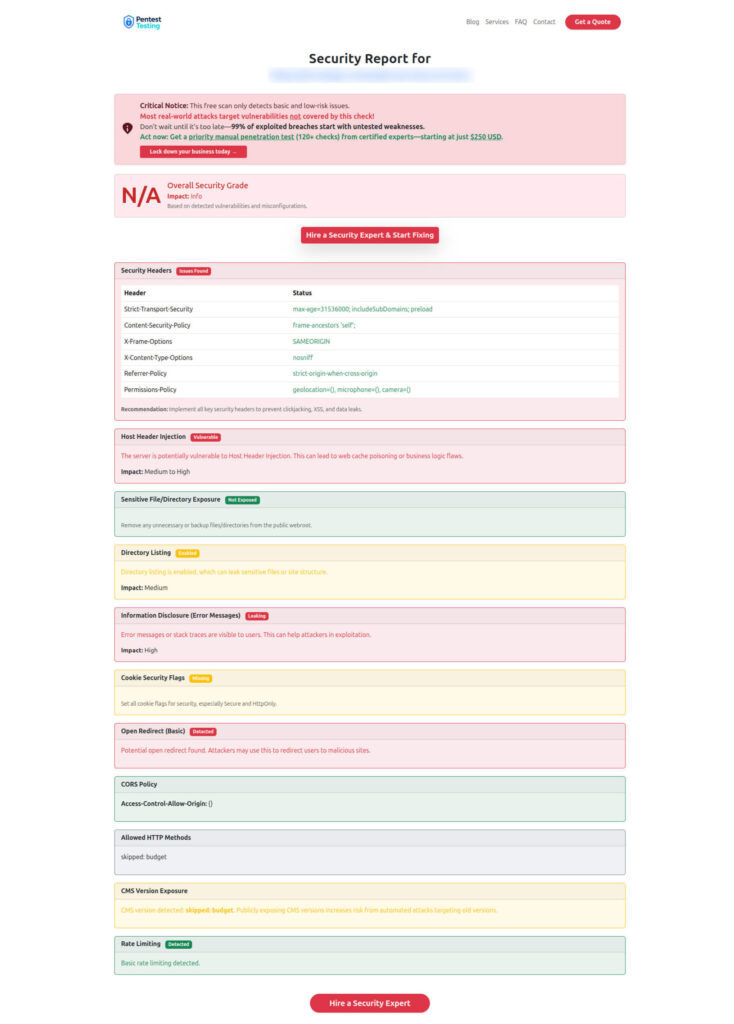
Sample report screenshot from our free tool to check Website Vulnerability
Where Pentest Testing Corp helps (pentest → hardening → proof)
If you want this sprint executed as a structured engagement (with screenshots, reproducible validation, and executive-ready reporting), these pages are the best next steps:
- Risk Assessment Services: https://www.pentesttesting.com/risk-assessment-services/
- Remediation Services: https://www.pentesttesting.com/remediation-services/
Related reading from our blog
If you’re building a repeatable “find → fix → prove” program, these are strong complements:
- https://www.pentesttesting.com/cisa-kev-remediation-sprint-in-30-days/
- https://www.pentesttesting.com/sierra-wireless-airlink-aleos-vulnerability/
- https://www.pentesttesting.com/react2shell-cve-2025-55182-fix-steps/
- https://www.pentesttesting.com/sec-cyber-disclosure-8k-playbook/
🔐 Frequently Asked Questions (FAQs)
Find answers to commonly asked questions about Misconfigured Edge Devices Hardening Sprint.