9 Proven API Abuse Detection Plays WAFs Miss
Traditional WAFs and flat rate limits are great at blocking known bad patterns. But API abuse detection is a different game: attackers can look “normal” per request while quietly draining value through API logic abuse, sequence manipulation, and downstream resource exhaustion.
This guide shows practical, production-ready detection signals and response tactics you can implement today—without turning your API into a CAPTCHA maze.
Want an expert, end-to-end validation of your API controls (authz, abuse, logic, data exposure)? Start here:
API Penetration Testing: https://www.pentesttesting.com/risk-assessment-services/
(Or go direct to API testing services: https://www.pentesttesting.com/api-pentest-testing-services/)

1) Modern API abuse patterns that evade WAFs
Business logic abuse (high impact, low volume)
This is the “the request is valid, but the intent is hostile” category:
- promo/coupon enumeration
- inventory/cart hoarding
- OTP/email/SMS spam through legitimate flows
- scraping proprietary data via allowed endpoints
- “low-and-slow” account takeover patterns (many accounts, low frequency each)
Chained endpoints + sequence manipulation
WAFs usually inspect a request in isolation. Abuse often lives in the sequence:
- login → token refresh → export loops
- password reset endpoints used as an oracle (existence checks)
- browse/search patterns that mimic users but at machine precision
Indirect amplification (resource exhaustion without “high traffic”)
One request can fan out into many expensive operations:
- heavy search endpoints (DB + cache misses)
- report generation
- export endpoints
- image/PDF rendering
- webhook retries that multiply
Parameter ambiguity and pollution
Attackers exploit parser differences:
- duplicate keys (
id=1&id=2) - mixed content-type parsing edge cases
- nested parameters that hit different code paths
The defensive lesson: API abuse detection must be stateful and cost-aware.
2) Why traditional WAF signatures and thresholds fall short
Stateless rules vs. stateful abuse:
WAFs are strongest when a single request is obviously malicious. API abuse is frequently “clean requests” arranged into harmful behavior.
Per-IP rate limits are easy to route around:
- NAT pools, mobile networks, rotating proxies, distributed fleets
- abuse spread across accounts/tokens (not IPs)
Thresholds ignore business cost:
“100 requests/min” means nothing if 5 requests trigger 10,000 DB reads.
WAFs don’t see downstream signals:
- DB timeouts, queue depth, cache miss storms
- application error codes that indicate enumeration or automation
3) The detection signals that actually matter
Below are high-signal indicators for API abuse detection that won’t feel like keyword stuffing in alerts.
Signal A — Entropy shifts (mutation, guessing, automation)
Humans are patterned. Bots are “systematic” or “random” in a different way.
Practical approach: measure entropy of:
- parameter values (IDs, coupons, emails) per principal
- endpoint selection over a time window
- error code distribution (e.g., lots of 404/422/401 bursts)
Python: entropy helper
import math
from collections import Counter

def shannon_entropy(values):
    if not values:
        return 0.0
    c = Counter(values)
    total = len(values)
    return -sum((n/total) * math.log2(n/total) for n in c.values())

# Example usage:
# entropy = shannon_entropy(["A12", "A13", "A14", "A15", "A16"])  # typically lower, sequential
# entropy = shannon_entropy(["X9Q", "P1Z", "0AA", "K7M", "Z2Z"])  # typically higher, random
Signal B — Unusual endpoint sequences (stateful patterns)
Sequence matters more than volume.
Quick win: track the last N endpoint classes per session/user and alert on improbable chains:
login → export → export → exportpassword_reset → password_reset → password_resetsearch → search → searchat machine-like intervals
Simple n-gram scoring (starter pattern)
from collections import defaultdict, Counter

# Train on “normal” sequences: store n-gram counts per endpoint class
ngram_counts = Counter()
prefix_counts = Counter()

def update_model(seq, n=3):
    for i in range(len(seq)-n+1):
        ngram = tuple(seq[i:i+n])
        prefix = ngram[:-1]
        ngram_counts[ngram] += 1
        prefix_counts[prefix] += 1

def score_next(prefix, nxt):
    # Lower probability => more suspicious
    prefix = tuple(prefix)
    ngram = prefix + (nxt,)
    if prefix_counts[prefix] == 0:
        return 0.0
    return ngram_counts[ngram] / prefix_counts[prefix]

# If score is near 0 for an observed prefix->next transition, flag for review/throttle
Signal C — Downstream errors and latency “echo”
Abuse often causes:
- DB timeouts
- queue backlog
- cache churn
- 429 spikes (your own controls firing)
This is where WAF-only programs miss the story.
Rule of thumb: alert on “behavior + downstream stress” correlation, not either alone.
Signal D — Principal-based concurrency
Bots parallelize. Humans don’t.
Track concurrent in-flight requests per:
- API key
- user ID
- session ID
- device fingerprint (even a lightweight one)
4) Real-time tooling patterns (stateful + adaptive)
A practical architecture for modern API security monitoring:
Edge (WAF) → API gateway → App middleware → Stateful store (Redis) → Logs/SIEM
4.1 Structured logging (non-negotiable for detection + DFIR)
Emit one JSON record per request with stable identifiers.
Example JSON log schema
{
  "ts": "2026-02-22T10:15:12.012Z",
  "request_id": "req_2f3c9f4a",
  "trace_id": "4b3b0c1c2f2b1a9e",
  "client_ip": "203.0.113.10",
  "principal": {"type":"api_key","id":"key_8d2"},
  "session_id": "sess_b91",
  "method": "GET",
  "path": "/v1/export",
  "endpoint_class": "export",
  "status": 200,
  "latency_ms": 842,
  "bytes_in": 412,
  "bytes_out": 98123,
  "auth": {"result":"ok"},
  "risk_score": 62,
  "action": "throttle",
  "reason_codes": ["seq_anomaly","high_concurrency"]
}
4.2 Express/Node middleware: risk score + adaptive throttling
This is a real-world pattern you can ship quickly.
import crypto from "crypto";
import Redis from "ioredis";

const redis = new Redis(process.env.REDIS_URL);

function requestId(req) {
  return req.headers["x-request-id"] || "req_" + crypto.randomBytes(8).toString("hex");
}

function endpointClass(path) {
  if (path.startsWith("/v1/login")) return "login";
  if (path.startsWith("/v1/otp")) return "otp";
  if (path.startsWith("/v1/export")) return "export";
  if (path.startsWith("/v1/search")) return "search";
  return "public_read";
}

function computeRisk(ctx) {
  let s = 0;
  if (!ctx.authenticated) s += 15;
  if (ctx.authFailRatio > 0.4) s += 25;
  if (ctx.sessionAgeSec < 30) s += 10;
  s += ctx.endpointRisk;
  if (ctx.concurrent > 8) s += 20;
  return Math.min(s, 100);
}

function decision(score) {
  if (score < 25) return "allow";
  if (score < 55) return "throttle";
  if (score < 80) return "challenge";
  return "block";
}

function retryAfterSeconds(score) {
  const s = Math.max(0, Math.min(score, 100));
  return Math.ceil(1 + (s / 100) * 59); // 1..60
}

export async function abuseGuard(req, res, next) {
  const rid = requestId(req);
  res.setHeader("X-Request-Id", rid);

  const principal = req.headers["x-api-key"] ? `key:${req.headers["x-api-key"].slice(0, 12)}` : `ip:${req.ip}`;
  const cls = endpointClass(req.path);

  // Minimal state keys
  const concKey = `conc:${principal}`;
  const failKey = `fails:${principal}`;
  const sessKey = `sess:${principal}`;

  // Track concurrency (incr before, decr after)
  const concurrent = await redis.incr(concKey);
  await redis.expire(concKey, 60);

  const start = Date.now();
  res.on("finish", async () => {
    await redis.decr(concKey);
    // Track auth failures (example)
    if (res.statusCode === 401) {
      await redis.incr(failKey);
      await redis.expire(failKey, 300);
    }
    // Store last seen timestamp (session age approximation)
    await redis.set(sessKey, String(Date.now()), "EX", 3600);

    const latency = Date.now() - start;
    console.log(JSON.stringify({
      ts: new Date().toISOString(),
      request_id: rid,
      principal,
      path: req.path,
      endpoint_class: cls,
      status: res.statusCode,
      latency_ms: latency
    }));
  });

  // Read state for scoring
  const fails = parseInt((await redis.get(failKey)) || "0", 10);
  const lastSeen = parseInt((await redis.get(sessKey)) || "0", 10);
  const sessionAgeSec = lastSeen ? (Date.now() - lastSeen) / 1000 : 999999;

  const endpointRisk = ({ login:25, otp:30, export:20, search:10, public_read:0 }[cls] ?? 5);
  const authFailRatio = fails / Math.max(1, fails + 10); // starter heuristic

  const score = computeRisk({
    authenticated: Boolean(req.user),
    authFailRatio,
    sessionAgeSec,
    endpointRisk,
    concurrent
  });

  const act = decision(score);

  if (act === "allow") return next();

  if (act === "throttle") {
    const ra = retryAfterSeconds(score);
    res.setHeader("Retry-After", String(ra));
    return res.status(429).json({ error: "Too Many Requests", request_id: rid });
  }

  if (act === "challenge") {
    // Keep it simple: step-up to re-auth / stronger token / mTLS for B2B
    return res.status(401).json({ error: "Step-up required", request_id: rid });
  }

  return res.status(403).json({ error: "Blocked", request_id: rid });
}
4.3 Atomic token bucket (Redis Lua) for cost-based enforcement
Cost-based throttling stops expensive endpoints from being abused “within limits”.
-- token_bucket.lua
-- KEYS[1] = bucket key
-- ARGV[1] = now_ms
-- ARGV[2] = refill_rate_per_ms
-- ARGV[3] = capacity
-- ARGV[4] = cost

local key = KEYS[1]
local now = tonumber(ARGV[1])
local rate = tonumber(ARGV[2])
local cap = tonumber(ARGV[3])
local cost = tonumber(ARGV[4])

local data = redis.call("HMGET", key, "tokens", "ts")
local tokens = tonumber(data[1]) or cap
local ts = tonumber(data[2]) or now

-- refill
local delta = math.max(0, now - ts)
tokens = math.min(cap, tokens + delta * rate)

local allowed = 0
if tokens >= cost then
  tokens = tokens - cost
  allowed = 1
end

redis.call("HMSET", key, "tokens", tokens, "ts", now)
redis.call("PEXPIRE", key, 60000)

return allowed
Caller-side idea: compute cost per request using endpoint class + risk score:
function requestCost(endpointClass, score) {
  const base = { public_read:1, search:2, login:5, otp:6, export:8, payment:10 }[endpointClass] ?? 2;
  const extra = Math.floor(score / 20); // 0..5
  return base + extra;
}
4.4 FastAPI (Python) middleware variant
from fastapi import FastAPI, Request
from fastapi.responses import JSONResponse
import time, secrets
import redis

r = redis.Redis.from_url("redis://localhost:6379/0")
app = FastAPI()

def endpoint_class(path: str) -> str:
    if path.startswith("/v1/login"): return "login"
    if path.startswith("/v1/otp"): return "otp"
    if path.startswith("/v1/export"): return "export"
    if path.startswith("/v1/search"): return "search"
    return "public_read"

@app.middleware("http")
async def abuse_guard(request: Request, call_next):
    rid = request.headers.get("x-request-id") or f"req_{secrets.token_hex(8)}"
    cls = endpoint_class(request.url.path)
    principal = request.headers.get("x-api-key", request.client.host)[:16]

    conc_key = f"conc:{principal}"
    concurrent = r.incr(conc_key)
    r.expire(conc_key, 60)

    start = time.time()
    try:
        # Simple starter rule: block abnormal concurrency on expensive endpoints
        if cls in {"export","otp","login"} and concurrent > 12:
            return JSONResponse({"error":"Too Many Requests","request_id":rid}, status_code=429, headers={"X-Request-Id": rid})

        response = await call_next(request)
        return response
    finally:
        r.decr(conc_key)
        latency_ms = int((time.time() - start) * 1000)
        # log JSON to stdout / collector
        print({
            "ts": time.strftime("%Y-%m-%dT%H:%M:%SZ", time.gmtime()),
            "request_id": rid,
            "principal": principal,
            "path": request.url.path,
            "endpoint_class": cls,
            "latency_ms": latency_ms
        })
5) Response playbook: throttle → challenge → contain
For API abuse response playbooks, aim for progressive friction:
Step 1 — Dynamic throttling (fastest, least disruptive)
- return 429 with
Retry-After - ramp backoff based on risk score and endpoint cost
- prefer principal-based throttles (API key/user/session), not IP-only
Step 2 — Challenge escalation (only on risk)
Use step-up controls selectively:
- re-authentication for sensitive flows
- short-lived tokens
- mTLS for B2B API clients (where feasible)
- “proof token” bound to session (avoid permanent friction)
Step 3 — Containment and “downstream protection”
When you detect high-confidence abuse:
- freeze/rotate the abused API key
- temporarily disable high-cost endpoints for that principal
- route suspicious traffic to a minimal handler that returns safe errors quickly
- protect dependencies (DB, queues) with circuit breakers
Node: cheap-fail for abusive principals
const deny = new Set(); // load from Redis in real life

export function denylistGuard(req, res, next) {
  const principal = req.headers["x-api-key"] ? `key:${req.headers["x-api-key"].slice(0, 12)}` : `ip:${req.ip}`;
  if (deny.has(principal)) {
    // Cheap response, preserve request_id for DFIR correlation
    const rid = req.headers["x-request-id"] || "req_" + crypto.randomBytes(8).toString("hex");
    res.set("X-Request-Id", rid);
    return res.status(403).json({ error: "Blocked", request_id: rid });
  }
  return next();
}
6) Logging for incident readiness (DFIR-friendly)
If you want API abuse detection to hold up during real incidents, log for reconstruction:
Minimum fields to capture:
request_id,trace_id, timestamp (UTC), service name- principal identifiers:
user_id,api_key_id,session_id - endpoint + method + status
- latency, bytes in/out, downstream timing (DB/queue)
- decision + reason codes (why throttled/blocked)
- auth outcomes (success/fail type), token refresh events
When an incident hits, your DFIR team should be able to answer:
- What happened first?
- Which principal did what?
- What changed after we deployed controls?
Need DFIR support or logging readiness validation?
DFIR services: https://www.pentesttesting.com/digital-forensic-analysis-services/
Remediation + hardening: https://www.pentesttesting.com/remediation-services/
SQL: timeline reconstruction (example)
SELECT
  ts, request_id, principal_id, path, status, latency_ms, action, reason_codes
FROM api_gateway_logs
WHERE principal_id = 'key_8d2'
  AND ts BETWEEN '2026-02-22 00:00:00' AND '2026-02-22 23:59:59'
ORDER BY ts ASC;
7) Case example: fix pattern + measurable outcome
Problem: An API saw recurring spikes in DB CPU and “random” timeouts. WAF alerts looked normal, and IP-based rate limits weren’t triggering.
Findings (behavioral):
- high concurrency per API key on
/exportand/search - endpoint chain anomalies (
search → export) repeating at machine intervals - entropy shifts in search filters (systematic mutation)
Controls deployed:
- cost-based token bucket per principal for expensive endpoints
- sequence anomaly scoring in middleware → throttle/challenge
- cheaper failure mode for high-confidence abuse
Measured outcome (within 72 hours):
- large drop in downstream timeouts (5xx)
- DB CPU stabilized during peak
- abuse traffic contained without impacting normal users (minimal false positives)
Traffic graph suggestion (before/after):
- Graph 1:
requests/minvs429/min - Graph 2:
db_time_ms p95before/after - Graph 3:
export endpoint latency p95before/after
(If you want, your engineering team can generate these from gateway logs and APM metrics.)
8) Free tool + Sample report)
Free Website Vulnerability Scanner tool Dashboard
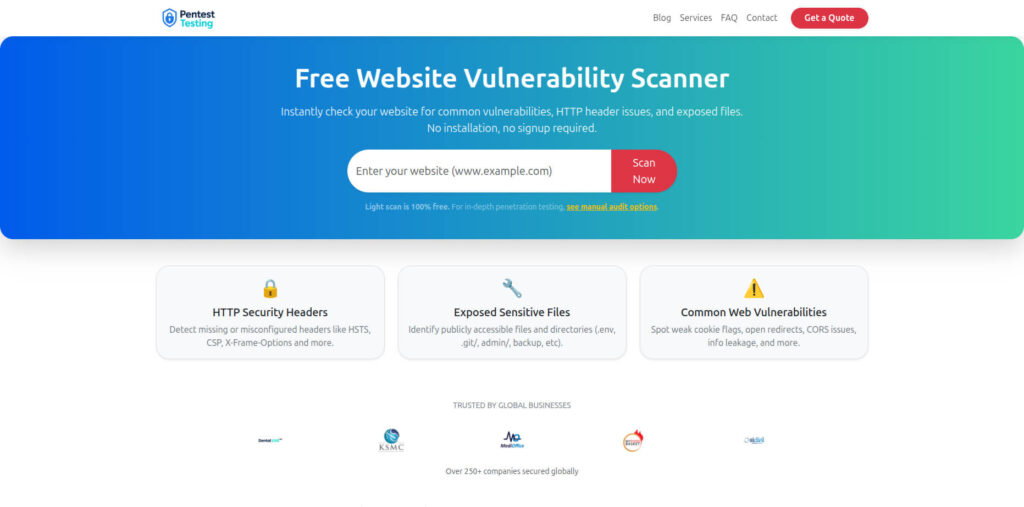
Link (Free Tool): https://free.pentesttesting.com/
Sample report to check Website Vulnerability
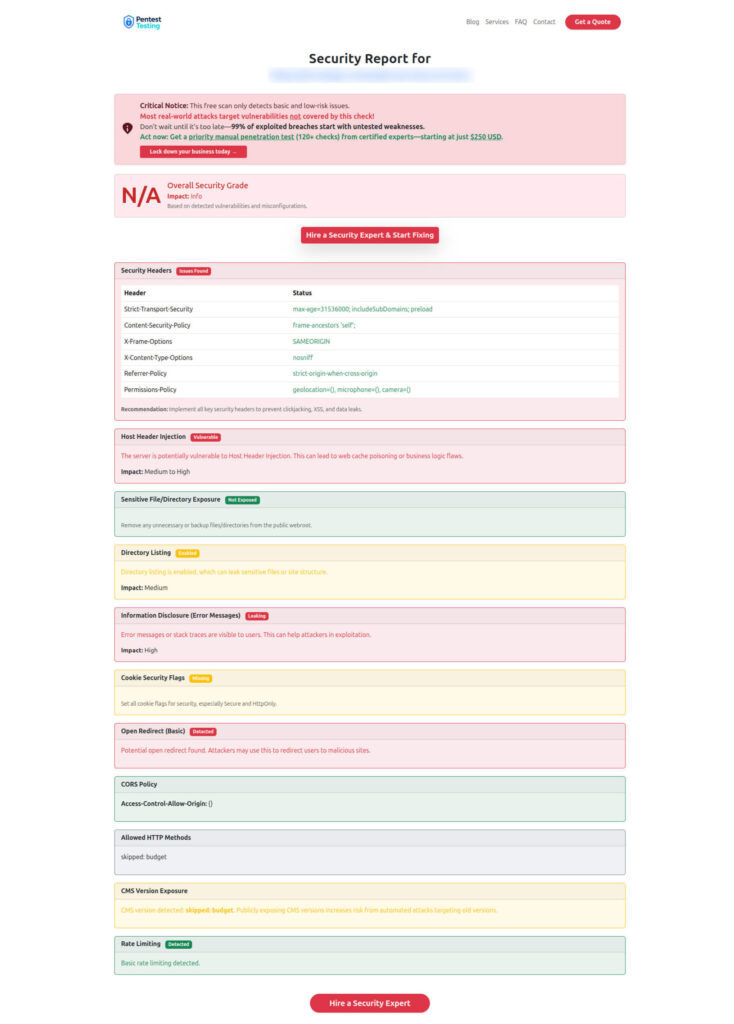
Practical next steps
If you want a professional assessment and an implementation roadmap:
- API penetration testing / risk assessment: https://www.pentesttesting.com/risk-assessment-services/
- API testing services: https://www.pentesttesting.com/api-pentest-testing-services/
- Remediation services: https://www.pentesttesting.com/remediation-services/
- DFIR + logging readiness: https://www.pentesttesting.com/digital-forensic-analysis-services/
Related recent reads from our blog
- 7 Powerful Risk-Driven API Throttling Tactics
- 9 Powerful Webhook Security Patterns That Stop Breaches
- 7 Powerful Forensic Readiness Steps for SMBs
- 7 Powerful Endpoint Deception Strategies to Contain Breaches
🔐 Frequently Asked Questions (FAQs)
Find answers to commonly asked questions about API Abuse Detection Plays.