7 Powerful Risk-Driven API Throttling Tactics
Traditional rate limiting answers one question: “How many requests per minute?”
Attackers are asking a different question: “How do I look normal while I drain value?”
That’s why risk-driven API throttling matters. Instead of punishing every client equally, you adapt control strength to risk—based on identity confidence, behavior, endpoint sensitivity, and real-time signals. The goal is simple:
- Protect production APIs from abuse
- Avoid breaking legitimate customers
- Generate usable evidence for detection and forensics
If you want an expert review of your current controls, start with a structured gap assessment:
https://www.pentesttesting.com/risk-assessment-services/
Or validate your API security end-to-end with:
https://www.pentesttesting.com/api-pentest-testing-services/
Latest Post: API Abuse Detection That Evades Traditional WAFs
Learn the 7 signals WAF rules miss—sequence anomalies, entropy shifts, cost-based throttling—and how to respond with adaptive controls and incident-ready logging.
Read more: https://www.pentesttesting.com/api-abuse-detection-waf-evasion/
Why traditional rate limiting isn’t enough
A flat “100 req/min per IP” policy fails in production because:
- Bots rotate IPs (residential proxies, cloud fleets, NAT pools)
- Credential stuffing is “low and slow” (many accounts, low volume per IP)
- Scraper fleets distribute load (thousands of identities, each “within limits”)
- Logic abuse isn’t volumetric (e.g., cart manipulation, promo validation, OTP spam)
Risk-driven API throttling fixes this by throttling based on risk, not just volume.
Abuse taxonomy: what you’re actually defending
Think in two categories:
1) Volumetric abuse
- brute traffic floods at the API edge
- endpoint hammering (search, export, list APIs)
- queue exhaustion
2) Logic abuse (often more damaging)
- credential reuse + session cycling
- automated mutation attacks (parameter variations to bypass caching or detection)
- enumeration (usernames, IDs, invoices, promo codes, OTPs)
- scrapers copying priced content, inventory, listings, or proprietary data
Your throttling strategy should treat login, OTP, password reset, search, export, and payments as high-risk surfaces even at low request rates.
Designing risk-driven throttling: signals that actually work
A good risk model doesn’t need “perfect device fingerprinting.” It needs stable, explainable signals you can log and tune.
Practical signals (mix-and-match)
Identity confidence
- authenticated user ID vs anonymous
- API key reputation / age
- session age and continuity (new session every request is suspicious)
Behavior
- auth failure ratios (failed logins / total)
- endpoint sequence anomalies (login → export → export → export)
- high-entropy parameter mutation (IDs incrementing, coupon guessing)
- concurrency spikes per user/token
Network + client
- ASN / geo anomalies relative to account history
- user-agent churn patterns
- “headless-ish” header patterns (missing Accept-Language, odd TLS/HTTP2 fingerprints if available)
Endpoint sensitivity
- cost to serve (DB-heavy search vs cached GET)
- business risk (OTP, checkout, account recovery)
Key idea: Risk-driven API throttling is strongest when you can compute risk per (principal, session, endpoint class).
Core pattern: translate risk → decision
Most teams need four outcomes, not one:
- Allow (normal)
- Throttle (soft control: 429 + Retry-After)
- Challenge (step-up: CAPTCHA/OTP/mTLS/proof token)
- Block (hard deny, temporary or permanent)
Risk scoring (simple, explainable)
Here’s a minimal risk scoring approach you can implement today:
# risk_score.py (reference logic)
def risk_score(ctx: dict) -> int:
    score = 0

    # Identity confidence
    if not ctx.get("authenticated"):
        score += 15
    if ctx.get("api_key_age_days", 999) < 3:
        score += 10

    # Auth behavior
    if ctx.get("auth_fail_ratio", 0.0) > 0.4:
        score += 25

    # Session continuity
    if ctx.get("session_age_seconds", 999999) < 30:
        score += 10

    # Endpoint sensitivity
    score += ctx.get("endpoint_risk", 0)  # e.g. login=25, otp=30, export=20, search=10

    # Concurrency / burstiness
    if ctx.get("concurrent_requests", 0) > 8:
        score += 20

    return min(score, 100)
Decision thresholds
def decision(score: int) -> str:
    if score < 25:
        return "allow"
    if score < 55:
        return "throttle"
    if score < 80:
        return "challenge"
    return "block"
This is the foundation of risk-driven API throttling: risk determines friction.
Abuse mitigations you can deploy without breaking services
1) Dynamic backoff (adaptive throttling)
Instead of a fixed “429,” increase backoff as risk increases:
// dynamic-backoff.js (Express-style)
function retryAfterSeconds(score) {
  // 0..100 -> 1..60 seconds
  const s = Math.max(0, Math.min(score, 100));
  return Math.ceil(1 + (s / 100) * 59);
}

function throttleResponse(res, score, reason = "throttled") {
  const retryAfter = retryAfterSeconds(score);
  res.set("Retry-After", String(retryAfter));
  return res.status(429).json({
    error: "Too Many Requests",
    reason,
    retry_after_seconds: retryAfter,
  });
}
Why it works: Legit users naturally slow down; bots often don’t.
2) “Cost-based” throttling (charge more for risky requests)
Instead of counting every request as 1, assign a token cost:
// cost-based-tokens.js
function requestCost({ endpointClass, score }) {
  const base = {
    public_read: 1,
    search: 2,
    login: 5,
    otp: 6,
    export: 8,
    payment: 10,
  }[endpointClass] ?? 2;

  // score adds 0..5 extra cost
  const extra = Math.floor(score / 20);
  return base + extra;
}
This makes abuse expensive while keeping normal usage smooth.
3) CAPTCHA / step-up at risk thresholds (and the “challenge farm” reality)
CAPTCHAs are useful only when:
- you gate them behind risk thresholds (don’t CAPTCHA everyone)
- you accept that challenge farms exist (humans can solve challenges)
So: treat CAPTCHA as a delay + signal, not your only defense. Pair it with:
- session continuity requirements
- proof tokens bound to session/device
- stricter throttles after challenge success if behavior stays abnormal
A simple “proof token” pattern:
// challenge-token.js (concept)
import crypto from "crypto";

const SECRET = process.env.CHALLENGE_SIGNING_SECRET;

export function mintProofToken({ sub, ttlSeconds = 600 }) {
  const exp = Math.floor(Date.now() / 1000) + ttlSeconds;
  const payload = JSON.stringify({ sub, exp });
  const sig = crypto.createHmac("sha256", SECRET).update(payload).digest("hex");
  return Buffer.from(`${payload}.${sig}`).toString("base64url");
}

export function verifyProofToken(token) {
  const raw = Buffer.from(token, "base64url").toString("utf8");
  const [payload, sig] = raw.split(".");
  const expected = crypto.createHmac("sha256", SECRET).update(payload).digest("hex");
  if (expected !== sig) return null;
  const obj = JSON.parse(payload);
  if (obj.exp < Math.floor(Date.now() / 1000)) return null;
  return obj;
}
Integrating with API gateways + WAF for layered protection
Risk-driven API throttling works best as layers:
- Edge/Gateway: coarse traffic shaping + burst control
- App: identity-aware throttling + logic abuse controls
- WAF: known-bad patterns, reputation controls, and cheap blocking
NGINX: baseline per-IP throttling + sensitive route zones
# nginx.conf (reference)
limit_req_zone $binary_remote_addr zone=ip_global:10m rate=30r/s;
limit_req_zone $binary_remote_addr zone=ip_login:10m   rate=5r/s;
limit_req_zone $binary_remote_addr zone=ip_search:10m  rate=10r/s;

server {
  location /api/ {
    limit_req zone=ip_global burst=60 nodelay;
  }

  location = /api/login {
    limit_req zone=ip_login burst=10 nodelay;
  }

  location /api/search {
    limit_req zone=ip_search burst=20 nodelay;
  }
}
App layer: identity-aware throttling with Redis token bucket (atomic)
For real production reliability, avoid in-memory counters. Use Redis + Lua for atomic token bucket updates:
-- redis_token_bucket.lua
-- KEYS[1] = bucket key
-- ARGV[1] = capacity
-- ARGV[2] = refill_per_sec
-- ARGV[3] = now_ms
-- ARGV[4] = cost

local key = KEYS[1]
local capacity = tonumber(ARGV[1])
local refill = tonumber(ARGV[2])
local now = tonumber(ARGV[3])
local cost = tonumber(ARGV[4])

local data = redis.call("HMGET", key, "tokens", "ts")
local tokens = tonumber(data[1])
local ts = tonumber(data[2])

if tokens == nil then tokens = capacity end
if ts == nil then ts = now end

local elapsed = math.max(0, now - ts) / 1000.0
local new_tokens = math.min(capacity, tokens + elapsed * refill)

if new_tokens < cost then
  redis.call("HMSET", key, "tokens", new_tokens, "ts", now)
  redis.call("EXPIRE", key, 3600)
  return {0, new_tokens}
end

new_tokens = new_tokens - cost
redis.call("HMSET", key, "tokens", new_tokens, "ts", now)
redis.call("EXPIRE", key, 3600)
return {1, new_tokens}
Node.js wrapper (Express middleware style):
// risk_throttle_mw.js
import { createClient } from "redis";
import fs from "fs";

const redis = createClient({ url: process.env.REDIS_URL });
await redis.connect();

const LUA = fs.readFileSync("./redis_token_bucket.lua", "utf8");
const sha = await redis.scriptLoad(LUA);

function identityKey(req) {
  // Prefer stable principal: api key -> user id -> session id -> IP fallback
  const apiKey = req.headers["x-api-key"];
  const userId = req.user?.id;
  const sessionId = req.headers["x-session-id"];
  return apiKey ? `k:${apiKey}` : userId ? `u:${userId}` : sessionId ? `s:${sessionId}` : `ip:${req.ip}`;
}

export async function riskDrivenThrottle(req, res, next) {
  const endpointClass = req.endpointClass || "public_read";

  const ctx = {
    authenticated: Boolean(req.user),
    api_key_age_days: req.apiKeyAgeDays ?? 999,
    auth_fail_ratio: req.authFailRatio ?? 0,
    session_age_seconds: req.sessionAgeSeconds ?? 999999,
    endpoint_risk: req.endpointRisk ?? 0,
    concurrent_requests: req.concurrentRequests ?? 0,
  };

  const score = req.riskScore(ctx);               // plug in your risk scorer
  const dec = req.riskDecision(score);            // allow/throttle/challenge/block
  const cost = req.requestCost({ endpointClass, score });

  if (dec === "block") return res.status(403).json({ error: "Forbidden" });
  if (dec === "challenge") return res.status(401).json({ error: "Challenge required" });

  // Token bucket parameters per endpoint class
  const capacity = endpointClass === "login" ? 20 : 60;
  const refillPerSec = endpointClass === "login" ? 0.5 : 2.0;

  const key = `rt:${endpointClass}:${identityKey(req)}`;
  const nowMs = Date.now();

  const result = await redis.evalSha(sha, {
    keys: [key],
    arguments: [String(capacity), String(refillPerSec), String(nowMs), String(cost)],
  });

  const allowed = Number(result[0]) === 1;
  if (!allowed) {
    res.set("X-Risk-Score", String(score));
    res.set("Retry-After", "5");
    return res.status(429).json({ error: "Too Many Requests" });
  }

  res.set("X-Risk-Score", String(score));
  return next();
}
This gives you real-time, identity-aware throttling that scales beyond IP-based controls.
Logging for detection and forensic context (don’t skip this)
Without forensics-ready logging, throttling becomes guesswork.
At minimum, log:
- request_id / trace_id
- principal (user/api key), session id
- endpoint class, risk score, decision
- auth success/fail (where relevant)
- response code + latency
- key headers (user-agent, accept-language), without storing secrets
Example structured JSON log record
{
  "ts": "2026-02-19T12:34:56.789Z",
  "request_id": "8f3c2a...",
  "principal": "u:12345",
  "session_id": "s:ab12...",
  "ip": "203.0.113.10",
  "method": "POST",
  "path": "/api/login",
  "endpoint_class": "login",
  "risk_score": 72,
  "decision": "throttle",
  "status": 429,
  "latency_ms": 34,
  "ua": "Mozilla/5.0 ..."
}
If you’re building an evidence-first posture (recommended), align your logging to DFIR needs:
- https://www.pentesttesting.com/forensic-analysis-services/
- https://www.pentesttesting.com/digital-forensic-analysis-services/
And if you need help fixing the gaps found during assessment/testing:
https://www.pentesttesting.com/remediation-services/
Validation + rollback playbook (safe deployments)
Roll out risk-driven API throttling like a production feature—because it is one.
1) Deploy in “observe” mode first
- compute risk score
- log decision
- don’t enforce yet
2) Add enforcement by endpoint class
Start with:
login,otp,password-reset,export,search
3) Protect with feature flags
- global kill switch
- per-route enforcement toggle
- per-tenant override
4) Monitor the right metrics
- 2xx/4xx/5xx rates per endpoint
- 429 rates split by (tenant, endpoint, auth status)
- login success rate & conversion
- latency (p50/p95/p99)
- support tickets / customer complaints
5) Rollback rules
Rollback immediately if:
- 429s spike for authenticated users
- error budgets burn due to throttling logic
- revenue-critical flows degrade
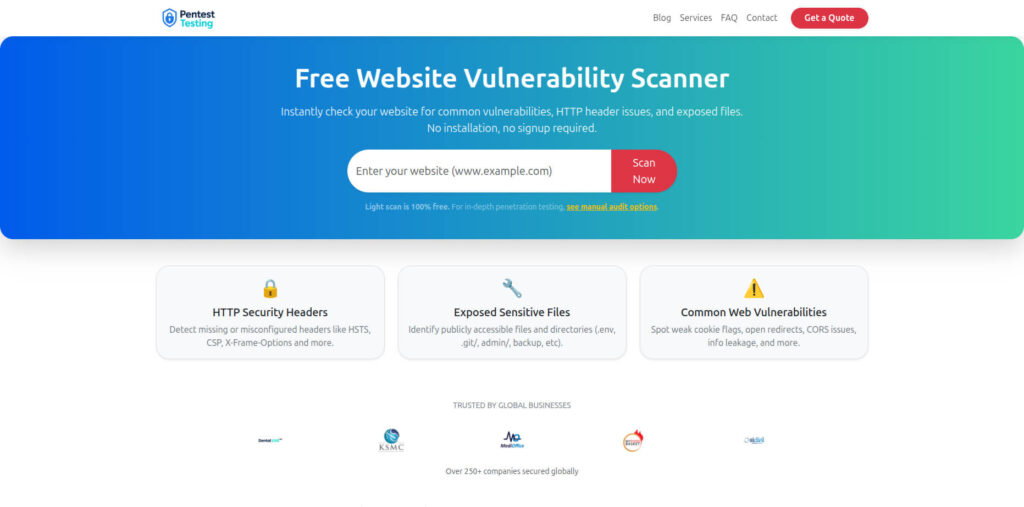
Free Website Vulnerability Scanner tool Dashboard
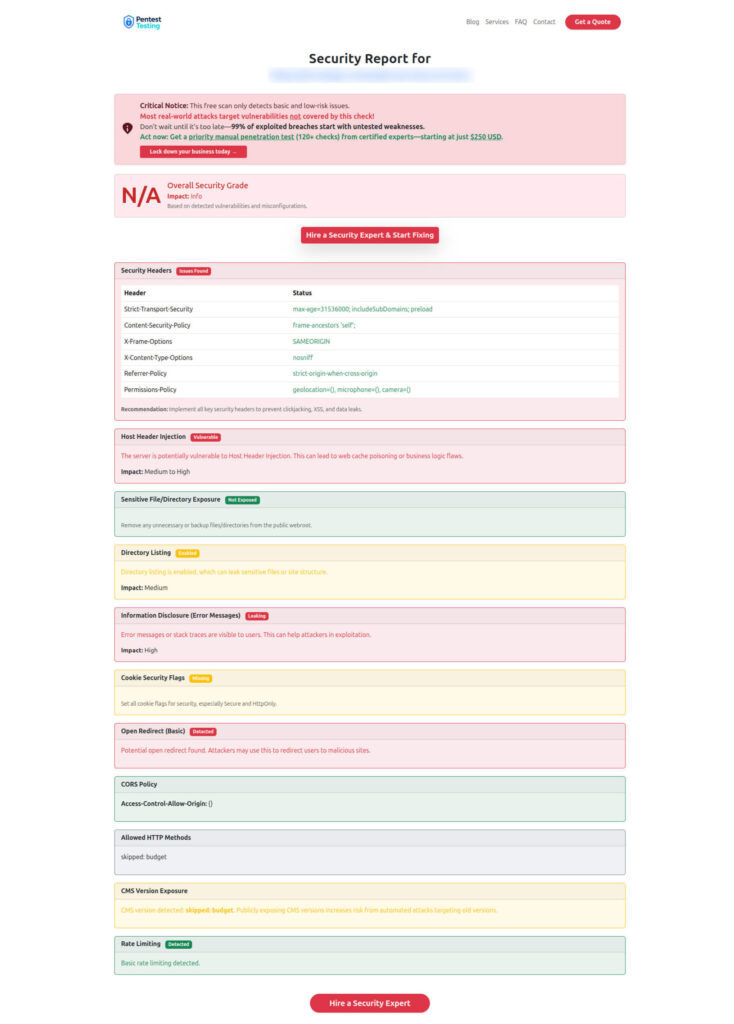
Sample report from the tool to check Website Vulnerability
Related recent reads from our blog
- Webhook hardening patterns (highly relevant to API abuse): https://www.pentesttesting.com/webhook-security-best-practices/
- Forensics-first logging and retention: https://www.pentesttesting.com/forensic-readiness-smb-log-retention/
- Rapid DFIR checklist for high-tempo incidents: https://www.pentesttesting.com/rapid-dfir-checklist-patch-to-proof/
- Post-patch “prove you’re clean” playbook: https://www.pentesttesting.com/post-patch-forensics-playbook-2026/
- Deception strategies that create high-signal alerts: https://www.pentesttesting.com/endpoint-deception-strategies/
Practical next steps
If you want to implement risk-driven API throttling without breaking production, do this in order:
- Classify endpoints by sensitivity (login/otp/export/search/payment).
- Add observe-mode risk scoring + structured logs.
- Enforce token bucket throttling per identity (Redis-based).
- Add step-up challenges for mid-risk.
- Review outcomes weekly and tune thresholds based on evidence.
For a professional review/testing of your current API controls:
https://www.pentesttesting.com/api-pentest-testing-services/
For prioritized fixes and hardening support:
https://www.pentesttesting.com/remediation-services/
For a program-level gap roadmap:
https://www.pentesttesting.com/risk-assessment-services/
🔐 Frequently Asked Questions (FAQs)
Find answers to commonly asked questions about Risk-Driven API Throttling Tactics.