9-Step Post-Patch Forensics Playbook: Bulletproof Clean
Patching fast is good. Proving you’re clean after patching is what prevents repeat incidents, customer escalations, and audit pain.
This post-patch forensics playbook gives you a practical, evidence-first method to verify integrity across Windows, Android, and iOS/iPadOS after high-impact 2026 security bulletins—and to produce documentation your SOC, leadership, and customers can trust.
If you want the “done-with-you” version (policy + automation + reporting), start here:
- Risk Assessment Services: https://www.pentesttesting.com/risk-assessment-services/
- Remediation Services: https://www.pentesttesting.com/remediation-services/
- Digital Forensic Analysis Services (DFIR): https://www.pentesttesting.com/digital-forensic-analysis-services/
Why this matters (and why “patched” ≠ “clean”)
Teams often treat patching as the finish line. Attackers treat patching as:
- a distraction window (change noise hides persistence), and
- an opportunity to exploit unpatched outliers (the “last 5%” of endpoints).
So your objective is simple:
Turn patching into proof: baseline → verify patch level → validate integrity → collect artifacts → produce a tamper-evident evidence pack.
That is what a post-patch forensics playbook is designed to do.
Recap: 2026 bulletin context you must validate against
You don’t need to panic-read every advisory to do this well. You need a repeatable verification standard:
Windows: Patch Tuesday + actively exploited CVEs
Windows cycles regularly include “in-the-wild” exploitation flags. Your minimum standard is:
- verify OS build/KB deployment across all in-scope endpoints,
- validate update success (not “pending reboot” limbo),
- hunt for suspicious persistence that predates patching.
Android: January 2026 patch level validation
Android’s ecosystem reality: a bulletin exists doesn’t mean your fleet is patched. You must verify the security patch string (e.g., 2026-01-05 or later) at scale.
Apple iOS/iPadOS 26.2: WebKit fixes
WebKit risk is not “Safari only.” iOS web rendering paths show up in embedded browsers and app link handlers—meaning your validation must focus on:
- OS version baseline,
- unusual browser/app behavior signals,
- realistic evidence collection boundaries (privacy + platform constraints).
New: Stop “patch and forget.” Learn forensic-driven security hardening to validate post-patch resilience with real evidence (Windows/Linux/Android/iOS playbooks + automation).
https://www.pentesttesting.com/forensic-driven-security-hardening/
The 9-step post-patch forensics playbook
1) Define a machine-checkable “clean baseline”
Write down what “patched and clean” means so it can be validated automatically.
Baseline policy (YAML)
# post_patch_baseline.yaml
baseline_name: "2026 Hot Bulletins Baseline"
targets:
  windows:
    required_within_hours: 72
    checks:
      - os_build_verified
      - kb_installed_verified
      - reboot_state_verified
      - defender_healthy
      - integrity_checks_passed
  android:
    min_security_patch_level: "2026-01-05"
    required_within_hours: 72
  ios_ipados:
    min_os_version: "26.2"
    required_within_hours: 72

evidence_pack:
  must_include:
    - inventory_export
    - compliance_report
    - exceptions_register
    - log_exports
    - hash_manifest_sha256
Why it matters: this reduces “opinion-based security” and enables patch compliance reporting that holds up under scrutiny.
2) Lock scope: inventory first, exceptions second
No scope = no proof.
Create an asset_scope.csv (CMDB/MDM/Intune export) with at least:
- asset ID, hostname/device ID, owner, department
- OS/platform + version
- last check-in
- criticality + exposure (internet-facing? privileged?)
- patch group/ring
Quick scope snapshot (Python)
# scope_snapshot.py
import csv, json
from datetime import datetime, timezone

INFILE = "asset_scope.csv"
OUTFILE = "asset_scope_snapshot.json"

with open(INFILE, newline="", encoding="utf-8") as f:
    rows = list(csv.DictReader(f))

payload = {
    "generated_at": datetime.now(timezone.utc).isoformat(),
    "asset_count": len(rows),
    "assets": rows,
}

with open(OUTFILE, "w", encoding="utf-8") as f:
    json.dump(payload, f, indent=2)

print(f"OK: wrote {OUTFILE} with {len(rows)} assets")
3) Verify patch deployment (Windows) with evidence exports
Windows patch proof (PowerShell)
This produces auditor-friendly “what was installed” evidence.
# windows_patch_proof.ps1
$OutDir = "Evidence\Windows\$env:COMPUTERNAME"
New-Item -ItemType Directory -Force -Path $OutDir | Out-Null

# OS / build
Get-ComputerInfo | Select-Object WindowsProductName, WindowsVersion, OsBuildNumber |
  ConvertTo-Json | Out-File "$OutDir\os_build.json" -Encoding utf8

# Installed updates (KBs)
Get-HotFix | Sort-Object InstalledOn -Descending |
  Export-Csv "$OutDir\installed_kbs.csv" -NoTypeInformation

# Windows Update event summary (last 14 days)
$Start = (Get-Date).AddDays(-14)
Get-WinEvent -FilterHashtable @{LogName='System'; StartTime=$Start} |
  Where-Object { $_.ProviderName -match 'Microsoft-Windows-WindowsUpdateClient' } |
  Select-Object TimeCreated, Id, LevelDisplayName, Message |
  Export-Csv "$OutDir\windowsupdate_events.csv" -NoTypeInformation

# Pending reboot signal (common “patched but not applied” pitfall)
$RebootPending = Test-Path "HKLM:\SOFTWARE\Microsoft\Windows\CurrentVersion\WindowsUpdate\Auto Update\RebootRequired"
@{ reboot_pending = $RebootPending } | ConvertTo-Json | Out-File "$OutDir\reboot_state.json" -Encoding utf8
Write-Host "Saved Windows patch proof to $OutDir"
4) Validate endpoint integrity (Windows) beyond “KB installed”
After patching, confirm integrity controls did not silently fail.
Integrity checks (PowerShell wrapper)
# windows_integrity_checks.ps1
$OutDir = "Evidence\Windows\$env:COMPUTERNAME"
New-Item -ItemType Directory -Force -Path $OutDir | Out-Null

# Defender health snapshot
Try {
  Get-MpComputerStatus | ConvertTo-Json | Out-File "$OutDir\defender_status.json" -Encoding utf8
} Catch {}

# System file checks (record commands + outputs)
cmd /c "sfc /scannow" | Out-File "$OutDir\sfc_output.txt" -Encoding utf8
cmd /c "DISM /Online /Cleanup-Image /ScanHealth" | Out-File "$OutDir\dism_scanhealth.txt" -Encoding utf8
Post-patch hunting signals (safe, fast checks)
# windows_suspicious_changes.ps1
$OutDir = "Evidence\Windows\$env:COMPUTERNAME"
New-Item -ItemType Directory -Force -Path $OutDir | Out-Null

# New local admins (review changes)
Get-LocalGroupMember -Group "Administrators" |
  Select-Object Name, ObjectClass, PrincipalSource |
  Export-Csv "$OutDir\local_admins.csv" -NoTypeInformation

# Scheduled tasks inventory (persistence review)
Get-ScheduledTask |
  Select-Object TaskName, TaskPath, State |
  Export-Csv "$OutDir\scheduled_tasks.csv" -NoTypeInformation

# Services set to auto start (persistence review)
Get-Service | Where-Object {$_.StartType -eq 'Automatic'} |
  Select-Object Name, Status, DisplayName |
  Export-Csv "$OutDir\auto_services.csv" -NoTypeInformation
If any of these look suspicious, consider a DFIR escalation:
https://www.pentesttesting.com/digital-forensic-analysis-services/
5) Verify Android patch level + collect controlled artifacts
Your “must-have” is the security patch level string and a minimal, privacy-aware evidence set.
Android validation + evidence collection (ADB)
#!/usr/bin/env bash
# android_post_patch_evidence.sh
set -euo pipefail

DEVICE_ID="${1:-}"
OUTDIR="Evidence/Android/${DEVICE_ID:-device}"
mkdir -p "$OUTDIR"

adb ${DEVICE_ID:+-s "$DEVICE_ID"} wait-for-device

# Patch level + build fingerprint
adb ${DEVICE_ID:+-s "$DEVICE_ID"} shell getprop ro.build.version.security_patch > "$OUTDIR/security_patch_level.txt"
adb ${DEVICE_ID:+-s "$DEVICE_ID"} shell getprop ro.build.fingerprint > "$OUTDIR/build_fingerprint.txt"

# Installed packages (review unexpected apps)
adb ${DEVICE_ID:+-s "$DEVICE_ID"} shell pm list packages -f > "$OUTDIR/packages_fullpaths.txt"

# Device admin apps (review enterprise/admin abuse)
adb ${DEVICE_ID:+-s "$DEVICE_ID"} shell dumpsys device_policy > "$OUTDIR/device_policy.txt"

# Log snapshot (bounded)
adb ${DEVICE_ID:+-s "$DEVICE_ID"} logcat -d -t 2000 > "$OUTDIR/logcat_tail.txt"

echo "OK: Saved Android evidence to $OUTDIR"
Android compliance check (minimal)
- If
security_patch_level.txtis <2026-01-05, treat as non-compliant and either:- force update via MDM policy, or
- isolate and add to exceptions register with compensating controls.
6) Validate iOS/iPadOS version + collect realistic evidence
iOS evidence collection is constrained by design. Your goal is still achievable:
- validate OS baseline,
- collect diagnostics in a defensible way,
- escalate only when indicators justify it.
iOS device version proof (libimobiledevice)
#!/usr/bin/env bash
# ios_post_patch_proof.sh
set -euo pipefail

OUTDIR="Evidence/iOS/$(date +%F_%H%M%S)"
mkdir -p "$OUTDIR"

# Requires paired device
ideviceinfo -k ProductVersion > "$OUTDIR/os_version.txt"
ideviceinfo -k ProductType > "$OUTDIR/device_model.txt"
ideviceinfo -k UniqueDeviceID > "$OUTDIR/udid.txt"

echo "OK: Saved iOS version proof to $OUTDIR"
Operational note
- If users reported “weird Safari tabs,” pop-ups, or unexpected profile prompts before patching, treat that as a DFIR trigger, not a “close ticket” moment.
7) Build an Evidence Pack that’s tamper-evident
This is where your post-patch forensics playbook becomes “board-proof.”
Recommended folder structure
Patch-Proof-Pack/
  00_Scope/
  01_Baseline/
  02_Deployment_Proof/
  03_Integrity_Checks/
  04_Log_Exports/
  05_Compliance_Report/
  06_Exceptions/
  07_Screenshots/
  08_Hash_Manifest/
Hash manifest (PowerShell)
# make_hash_manifest.ps1
$Root = "Patch-Proof-Pack"
$Manifest = Join-Path $Root "08_Hash_Manifest\sha256_manifest.txt"
New-Item -ItemType Directory -Force -Path (Split-Path $Manifest) | Out-Null

Get-ChildItem -Path $Root -File -Recurse |
  Where-Object { $_.FullName -notmatch '\\08_Hash_Manifest\\' } |
  ForEach-Object {
    $h = Get-FileHash -Algorithm SHA256 -Path $_.FullName
    "{0}  {1}" -f $h.Hash, ($h.Path.Replace($Root + "\", ""))
  } | Out-File $Manifest -Encoding ascii

Write-Host "OK: wrote $Manifest"
8) Automate compliance scoring + SOC-ready summaries
This is how you stop doing spreadsheet heroics every month.
Compliance scorer (Python)
# compliance_score.py
import csv
from datetime import datetime

BASELINE_ANDROID_SPL = "2026-01-05"
BASELINE_IOS = (26, 2)

def parse_ios(ver: str):
    parts = (ver or "").split(".")
    nums = []
    for p in parts:
        try:
            nums.append(int(p))
        except:
            nums.append(0)
    while len(nums) < 2:
        nums.append(0)
    return tuple(nums[:2])

def ios_ok(ver: str) -> bool:
    return parse_ios(ver) >= BASELINE_IOS

def android_ok(spl: str) -> bool:
    return (spl or "") >= BASELINE_ANDROID_SPL

rows_out = []
checked_at = datetime.utcnow().isoformat() + "Z"

with open("mobile_inventory.csv", newline="", encoding="utf-8") as f:
    r = csv.DictReader(f)
    for row in r:
        platform = (row.get("platform") or "").lower()
        compliant = False
        baseline = ""
        if platform in ("android",):
            compliant = android_ok(row.get("security_patch_level", ""))
            baseline = f"Android SPL >= {BASELINE_ANDROID_SPL}"
        elif platform in ("ios", "ipados"):
            compliant = ios_ok(row.get("os_version", ""))
            baseline = "iOS/iPadOS >= 26.2"

        row["baseline"] = baseline
        row["post_patch_compliant"] = "YES" if compliant else "NO"
        row["checked_at"] = checked_at
        rows_out.append(row)

out_fields = list(rows_out[0].keys()) if rows_out else ["platform","os_version","security_patch_level","post_patch_compliant","checked_at"]
with open("Patch-Proof-Pack/05_Compliance_Report/mobile_compliance.csv", "w", newline="", encoding="utf-8") as o:
    w = csv.DictWriter(o, fieldnames=out_fields)
    w.writeheader()
    w.writerows(rows_out)

print("OK: wrote Patch-Proof-Pack/05_Compliance_Report/mobile_compliance.csv")
9) SIEM/SOAR integration patterns that scale
Your SOAR goal: auto-open tasks for non-compliance + suspicious signals.
Microsoft Sentinel (KQL) ideas
Devices missing required patch baseline (conceptual)
DeviceInfo
| where OSPlatform in ("Windows10", "Windows11")
| project DeviceName, OSPlatform, OSBuild, Timestamp
| order by Timestamp desc
Post-patch anomaly watchlist (conceptual)
DeviceProcessEvents
| where Timestamp > ago(7d)
| where InitiatingProcessAccountName in ("SYSTEM", "LOCAL SERVICE")
| summarize count() by DeviceName, FileName
Splunk ideas (conceptual)
Windows Update events
index=wineventlog sourcetype=WinEventLog:System
Provider_Name="Microsoft-Windows-WindowsUpdateClient"
| stats count by host, EventCode
SOAR playbook skeleton (YAML)
name: post_patch_forensics_playbook
triggers:
  - non_compliant_endpoint_detected
  - high_risk_pre_patch_indicator_detected

actions:
  - create_ticket:
      fields:
        title: "Post-patch validation failed: {{asset}}"
        severity: "high"
        attach: ["compliance_report", "evidence_manifest"]
  - if: suspicious_indicators_present
    then:
      - isolate_endpoint
      - notify_soc
      - start_dfir_intake
  - else:
      - request_remediation_window
      - recheck_in: "24h"
Free tool Dashboard (Free Website Vulnerability Scanner)
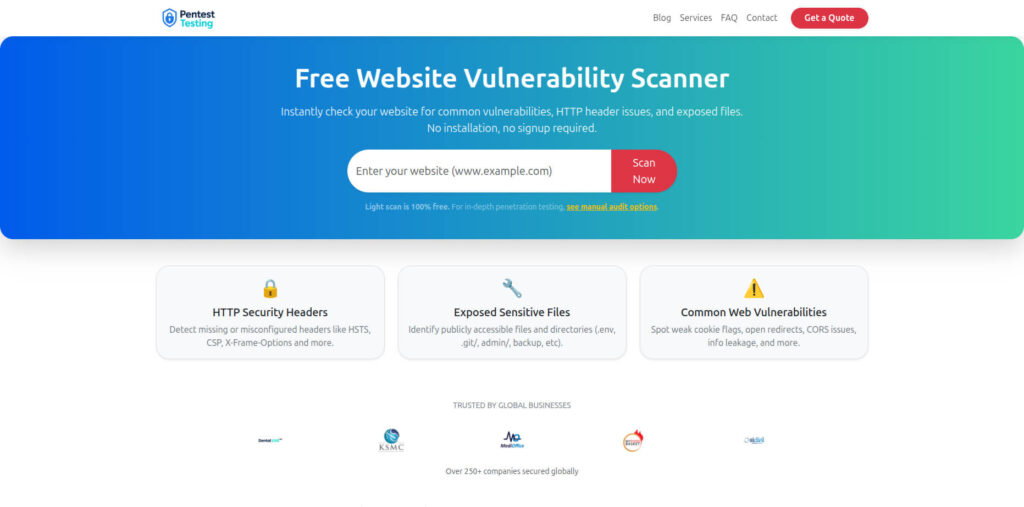
Tool page: https://free.pentesttesting.com/
Sample report to check Website Vulnerability (from the tool)
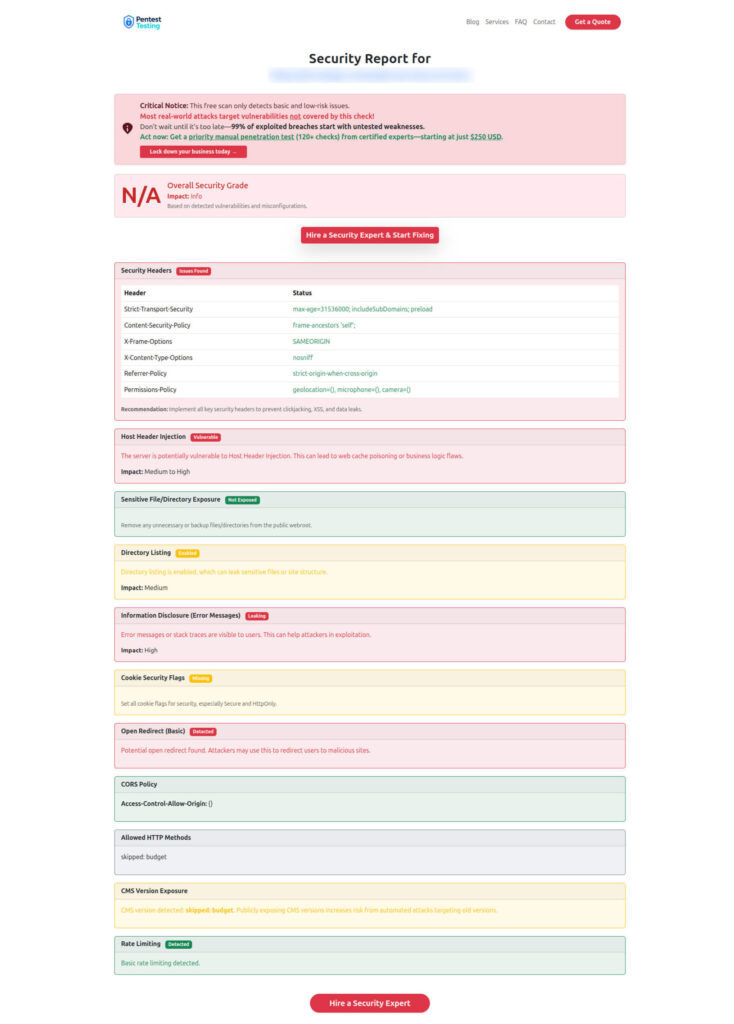
Where Pentest Testing Corp fits (fast path to “proof, not promises”)
If you want this playbook implemented end-to-end (policy + automation + reporting + evidence packs):
- Start with a risk baseline: https://www.pentesttesting.com/risk-assessment-services/
- Close gaps with structured remediation: https://www.pentesttesting.com/remediation-services/
- Escalate suspicious activity to DFIR: https://www.pentesttesting.com/digital-forensic-analysis-services/
Related reading (recent posts from our blog)
Continue from here (same theme, deeper dives):
- Mobile post-patch validation: https://www.pentesttesting.com/mobile-post-patch-validation-playbook/
- Rapid DFIR checklist (patch → proof): https://www.pentesttesting.com/rapid-dfir-checklist-patch-to-proof/
- iPhone suspicious activity DFIR checklist: https://www.pentesttesting.com/iphone-suspicious-activity-dfir-checklist/
- Windows malware forensics (Memory + KAPE): https://www.pentesttesting.com/windows-malware-forensics-memory-kape/
- January 2026 Patch Tuesday for SMBs: https://www.pentesttesting.com/january-2026-patch-tuesday-smb-patch-first/
- Audit-ready patch evidence pack: https://www.pentesttesting.com/audit-ready-patch-evidence-pack/
- Why scanners alone aren’t enough: https://www.pentesttesting.com/free-vulnerability-scanner-not-enough/
🔐 Frequently Asked Questions (FAQs)
Find answers to commonly asked questions about the Post-Patch Forensics Playbook.